THERE’S SOMETHING ABOUT SURFERS PARADISE

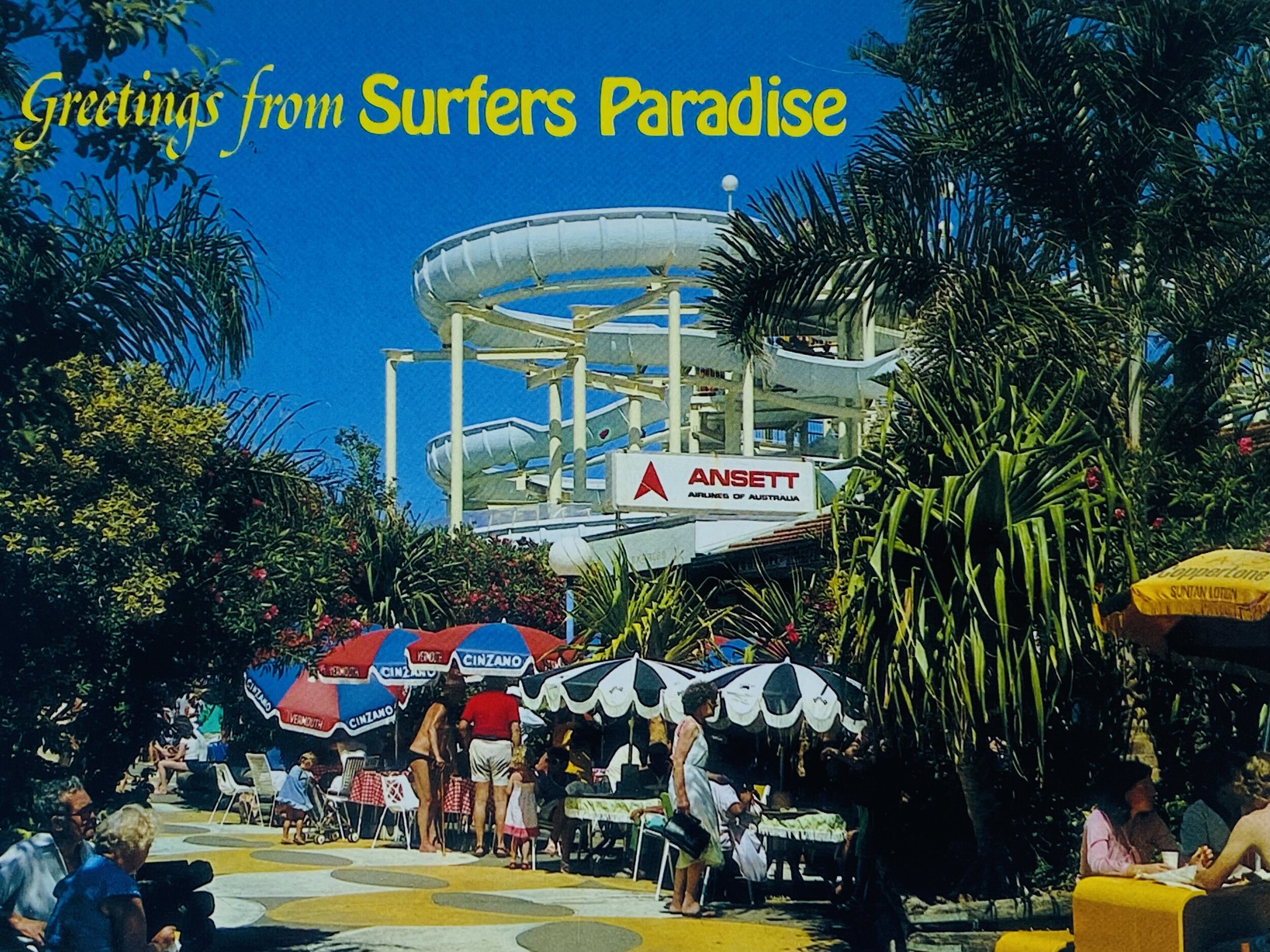
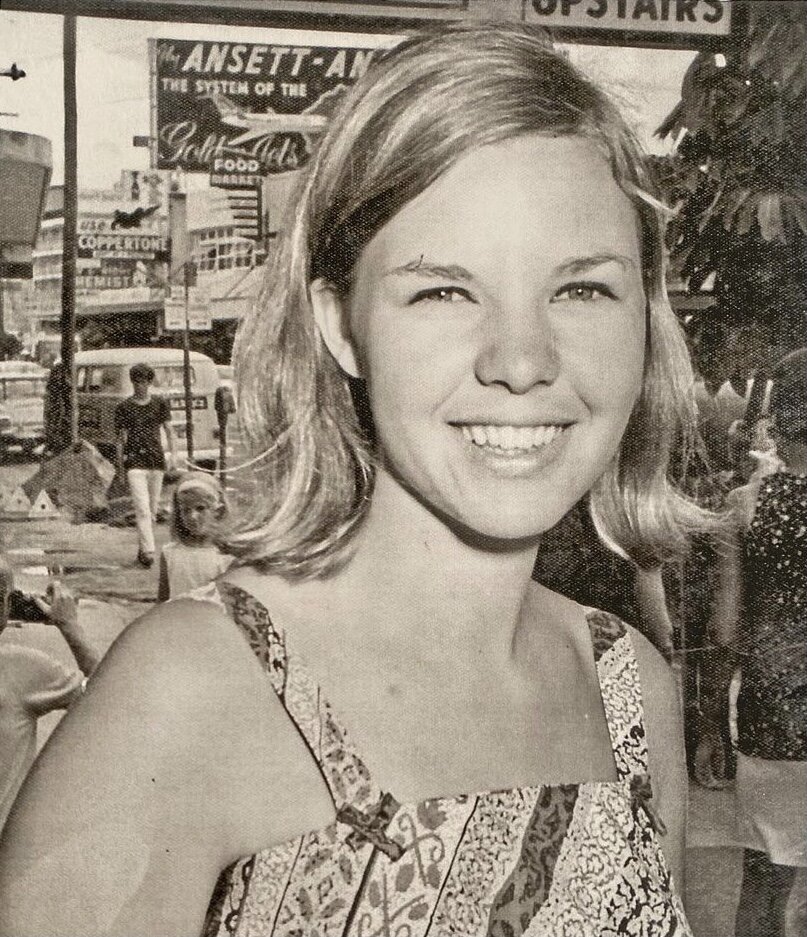
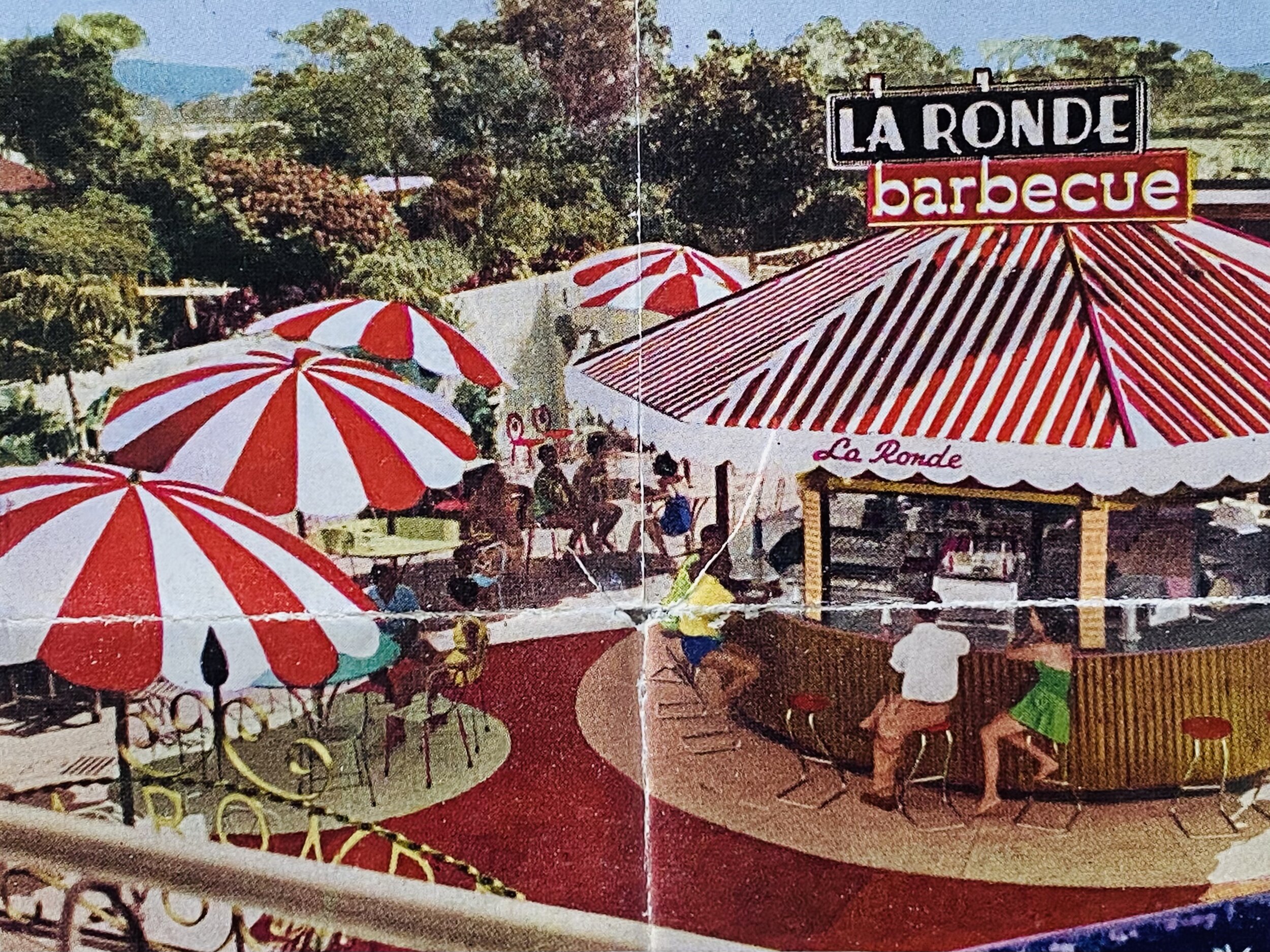
Repost @bmaryd #fridayflashback to the 1960s - my teens - in Surfers Paradise when it was a great place. There was always a roving photographer! I’m wearing my homemade (by me) brown batik shift dress. Note the Ansett ANA sign in the background. Oh, and the Coppertone one! Apart from the fact that I have no wrinkles I love this memory of a simple time. I feel we were the lucky generation. The second photo is of my brother and me at the BBQ in Cavill Avenue where our parents would take us for dinner in January. They would always have one special dinner at Margot Kelly’s as well.

Repost @bmaryd #fridayflashback to the 1960s - my teens - in Surfers Paradise when it was a great place. There was always a roving photographer! I’m wearing my homemade (by me) brown batik shift dress. Note the Ansett ANA sign in the background. Oh, and the Coppertone one! Apart from the fact that I have no wrinkles I love this memory of a simple time. I feel we were the lucky generation. The second photo is of my brother and me at the BBQ in Cavill Avenue where our parents would take us for dinner in January. They would always have one special dinner at Margot Kelly’s as well.

My reaction to this Instagram post of Mary in 1960s Surfers Paradise surprised me. It wasn’t her pretty smile, or the background images of the umbrella tree or vintage cars and signs. It was the unmistakeable tone of lament in Mary’s comment about Surfers Paradise: ‘when it was a great place.

When it was a great place. When it was a great place. When it was a great place. I have listened to this narrative since I moved to the Gold Coast in 1994 when I bought a unit in Surfers Paradise and started work with the council’s town planning department. As a new arrival, it was apparent to me that Surfers was in decline. Its popularity was waning and the surrounding built environment was deteriorating, but I recognised the intrinsic attributes and development potential of the place. I was confident with my investment, and I held out a lot of hope in the future of Surfers Paradise.

Those of us too young to have experienced Surfers Paradise in the 1960s can only imagine what the place was like as it was fast becoming Australia’s premiere holiday destination. Historical photographs, postcards and film footage help us to visualise streetscapes back then, but unsolicited comments, like Mary’s, from the people with lived experience of the place are like gold. Because they can take you straight to the moment and supplement the historical record with sentiment, giving you a sense of what it was actually like to be there. For me, with a keen interest in cultural landscapes and urban design, these comments prompt further thought and inquiry.

My first thought was to imagine sixty years prior, to the turn of the 20th century when Meyer’s Ferry provided the only crossing across the Nerang River from Southport to the nascent settlement of Elston at the river end of what is now Cavill Avenue. How did the Aboriginal Traditional Custodians feel about changes to the natural landscape through farming and timber milling, then later, the construction of roads and accommodation for holidaymakers? All these developments destroyed their middens, cleared vegetation and flattened the dunes. Did they think about the overstory and long for times past, stretching back millennia, when this was a great meeting place of river, land and sea, unrecognisable from 1960s Surfers Paradise? And how about looking forward sixty years from now? Can we even approximate what future Surfers Paradise will look like? Thanks to Mary’s inadvertent comment, I have felt compelled to write and share some thoughts about Surfers Paradise.

SWINGING SIXTIES

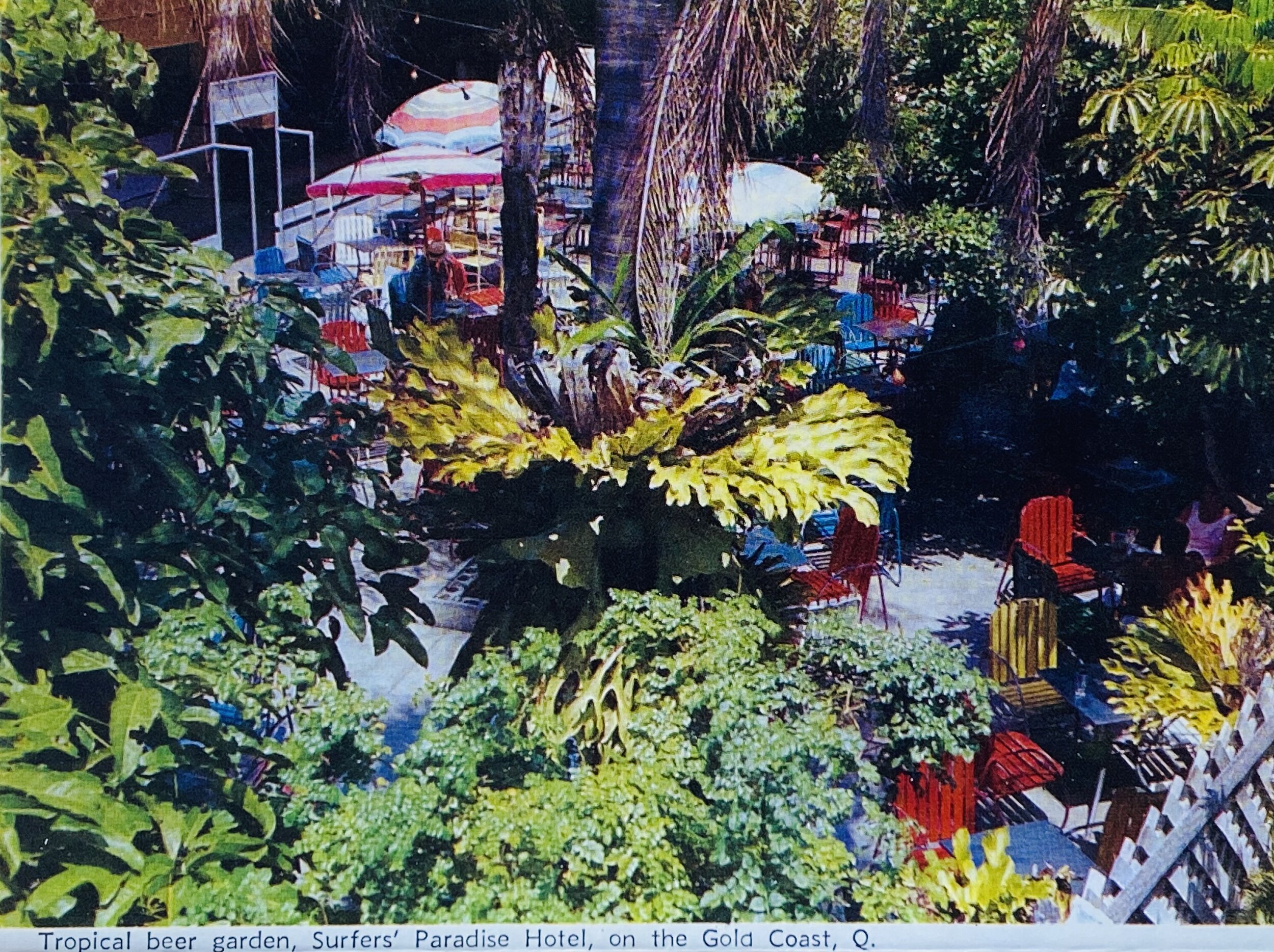
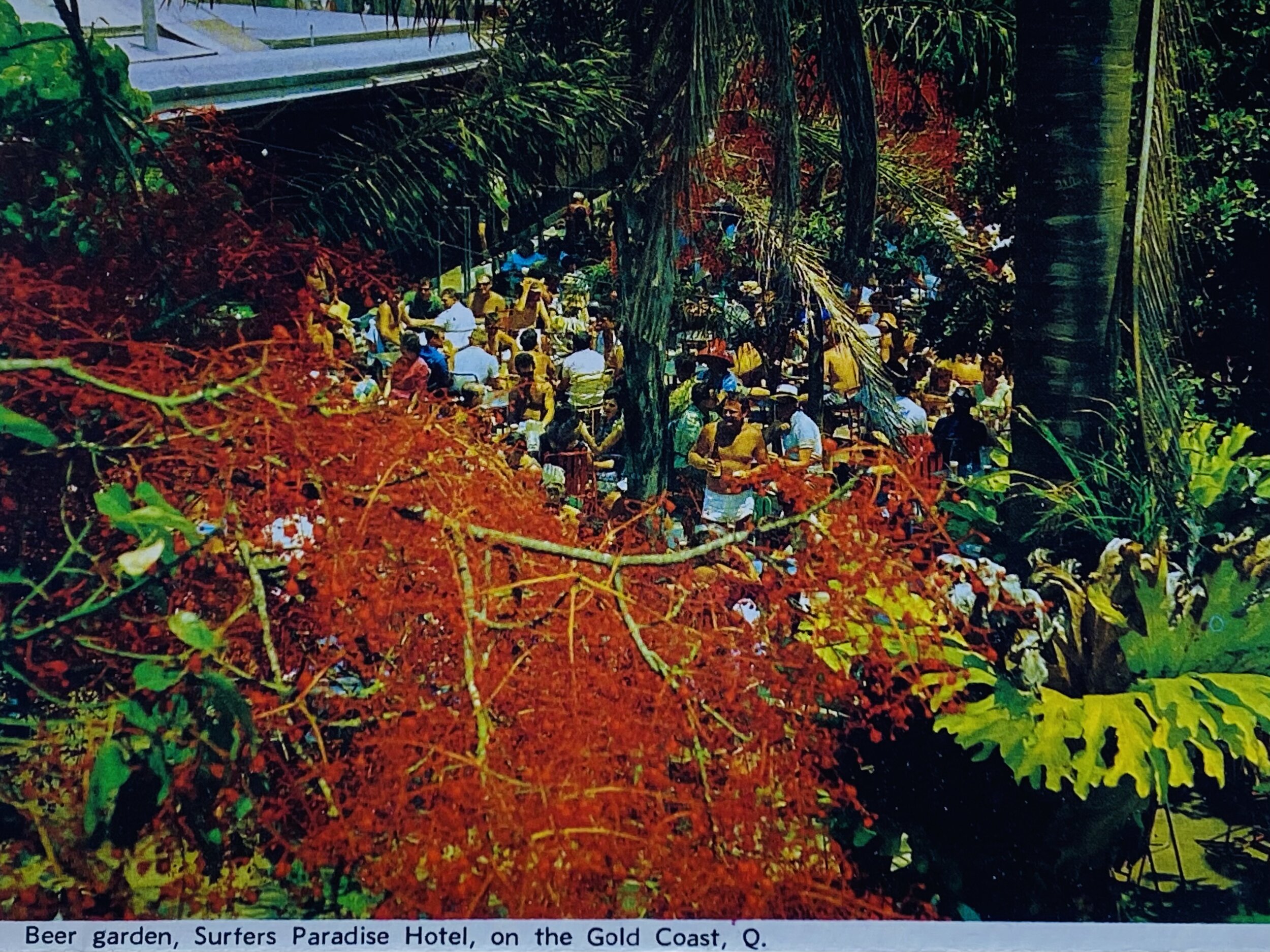
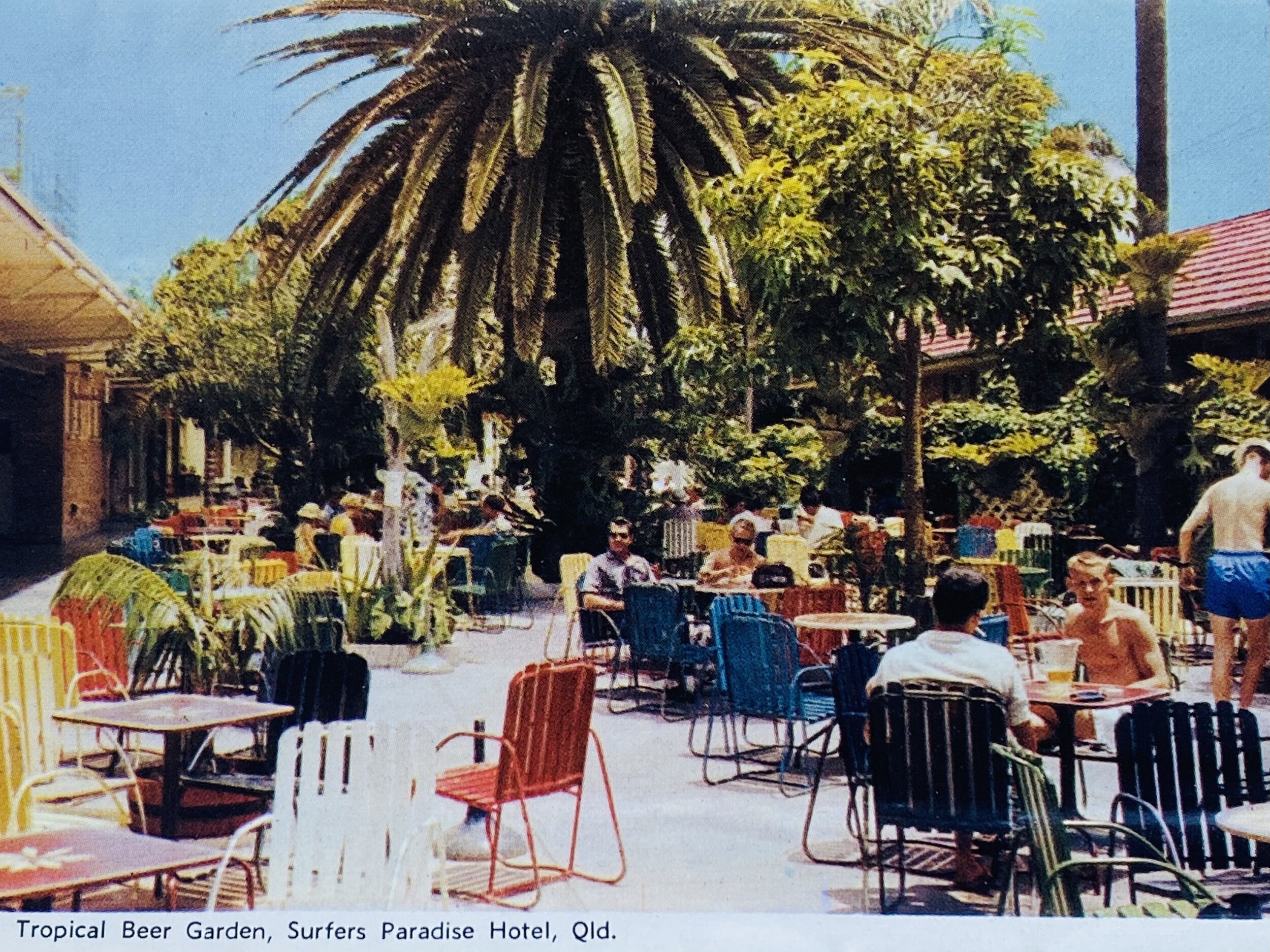
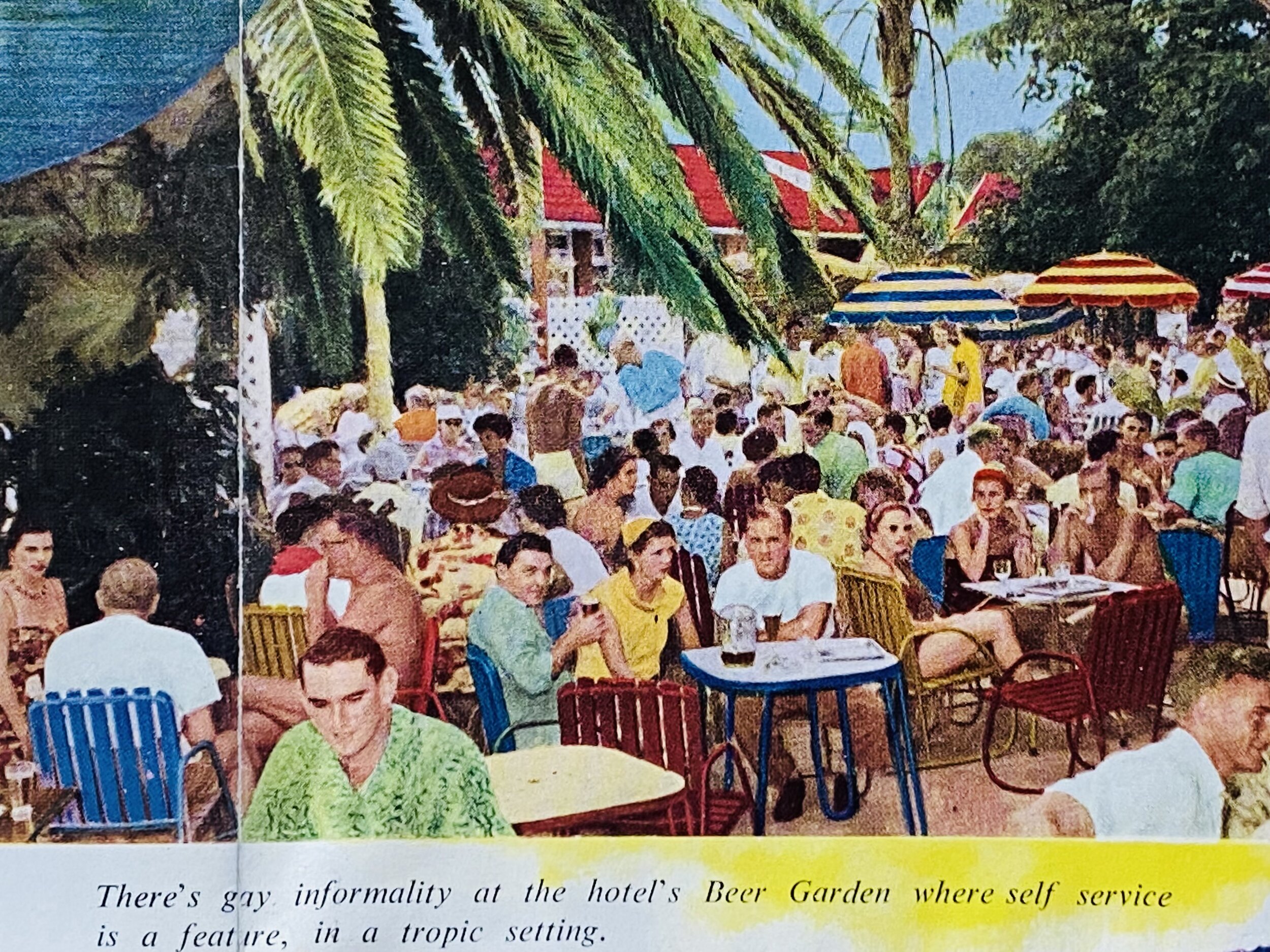
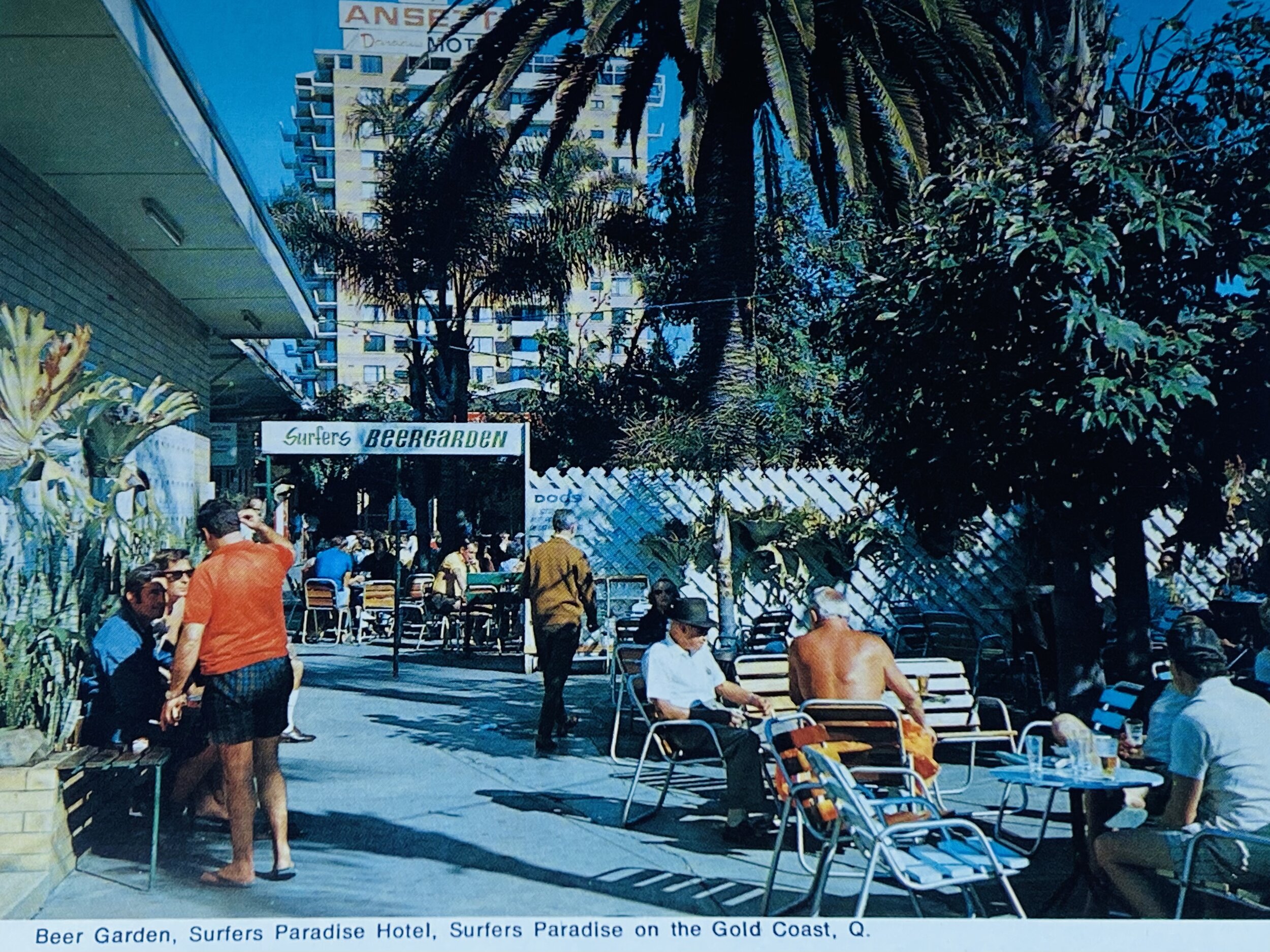
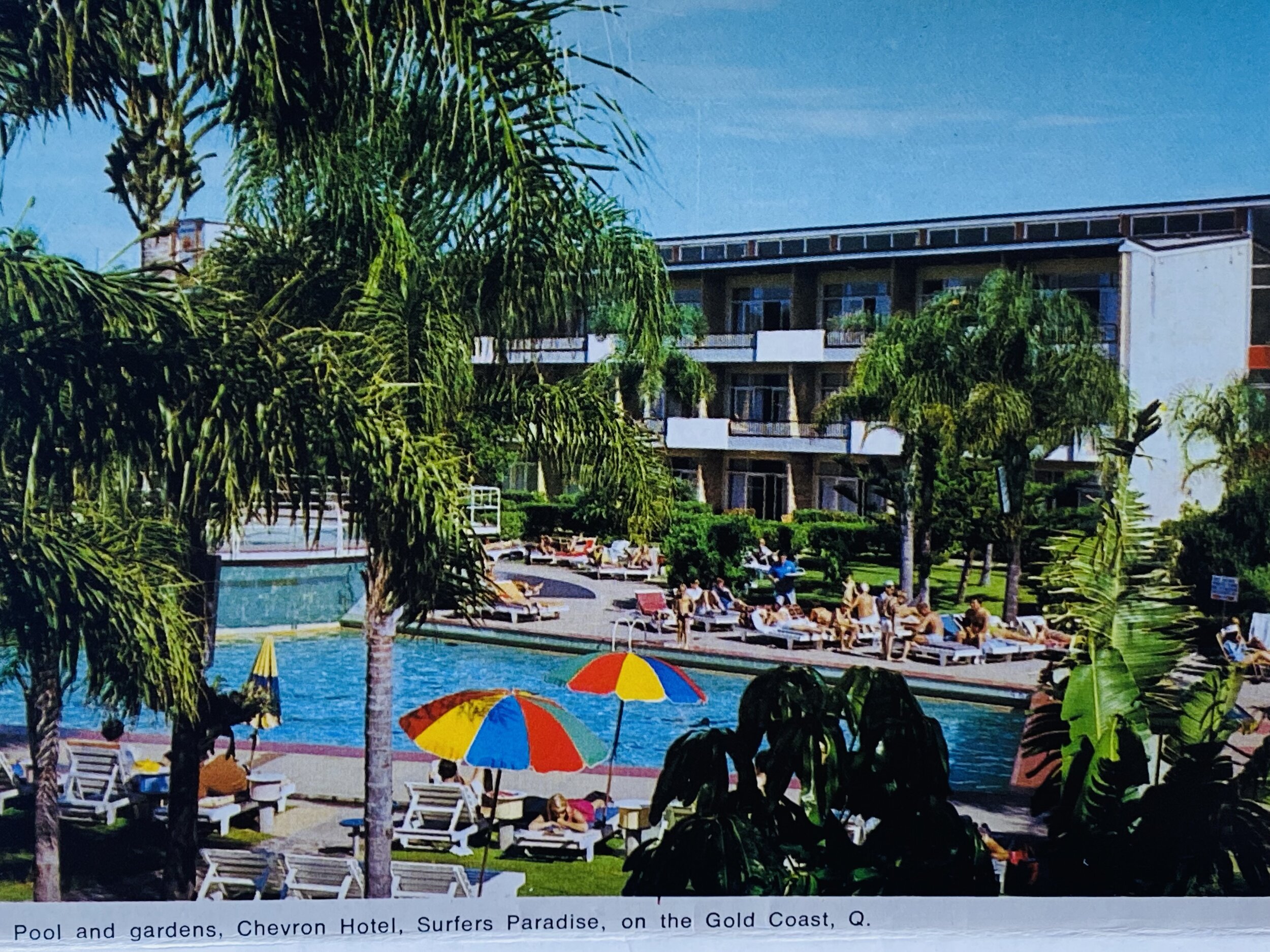
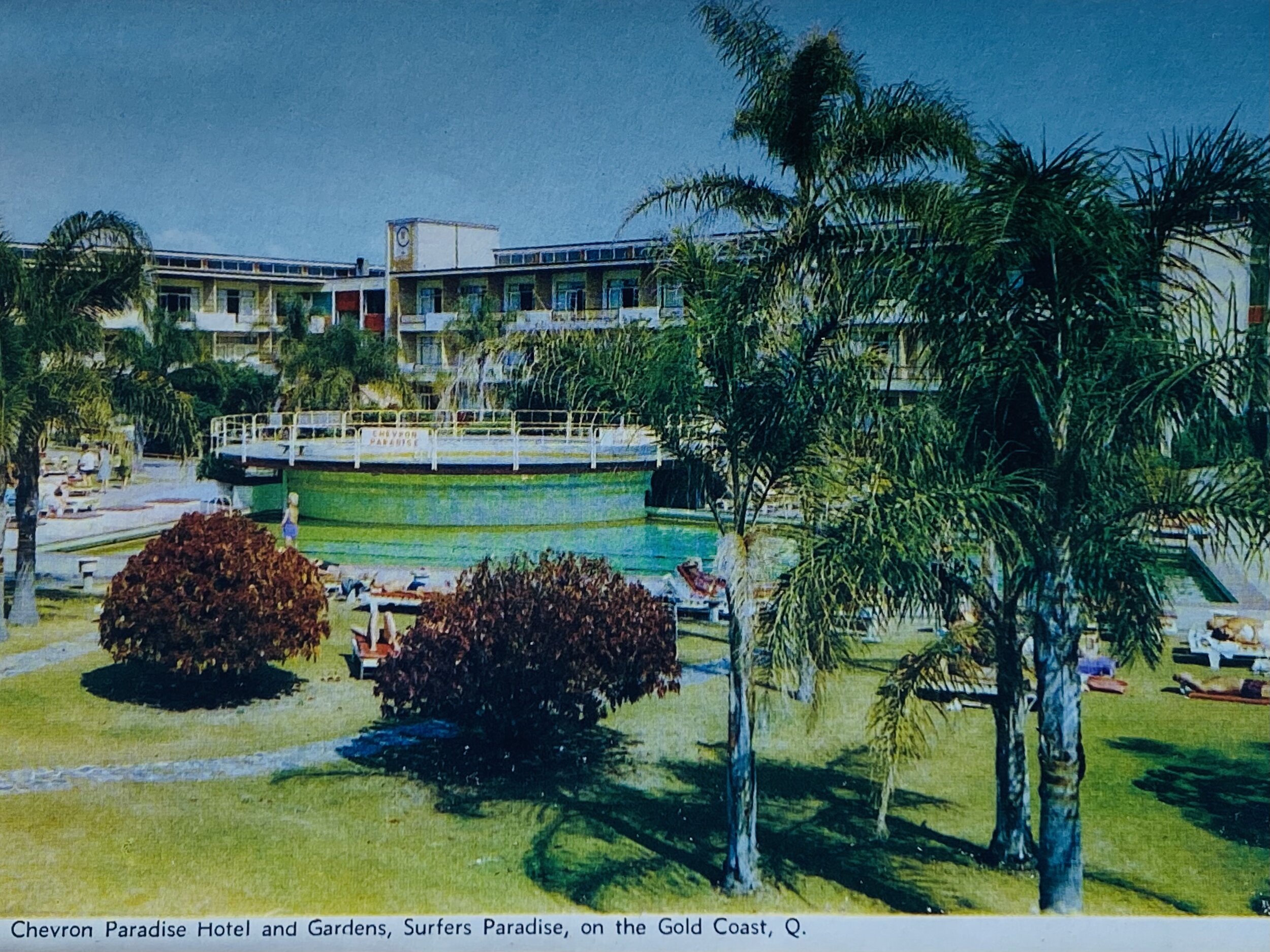
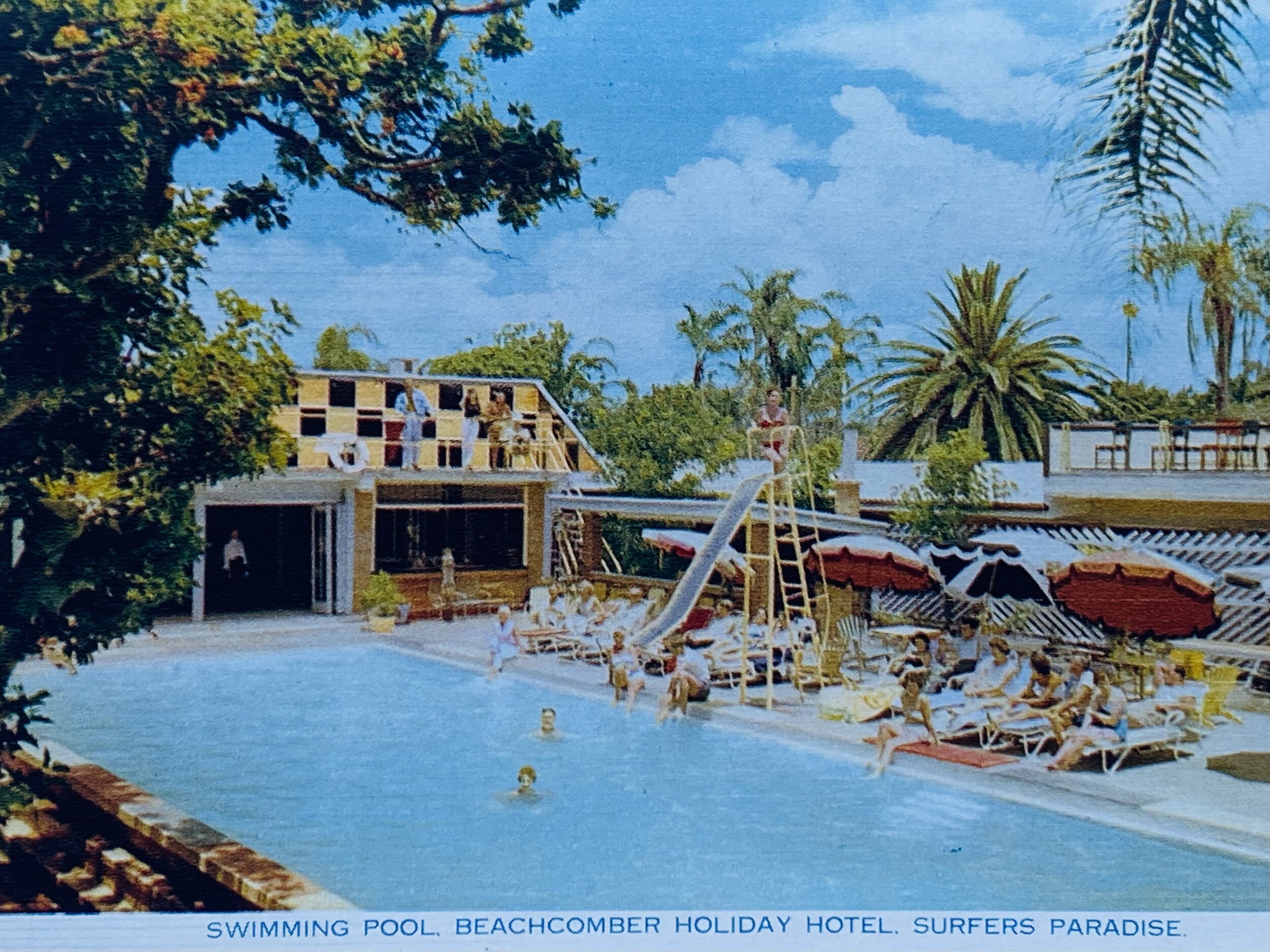
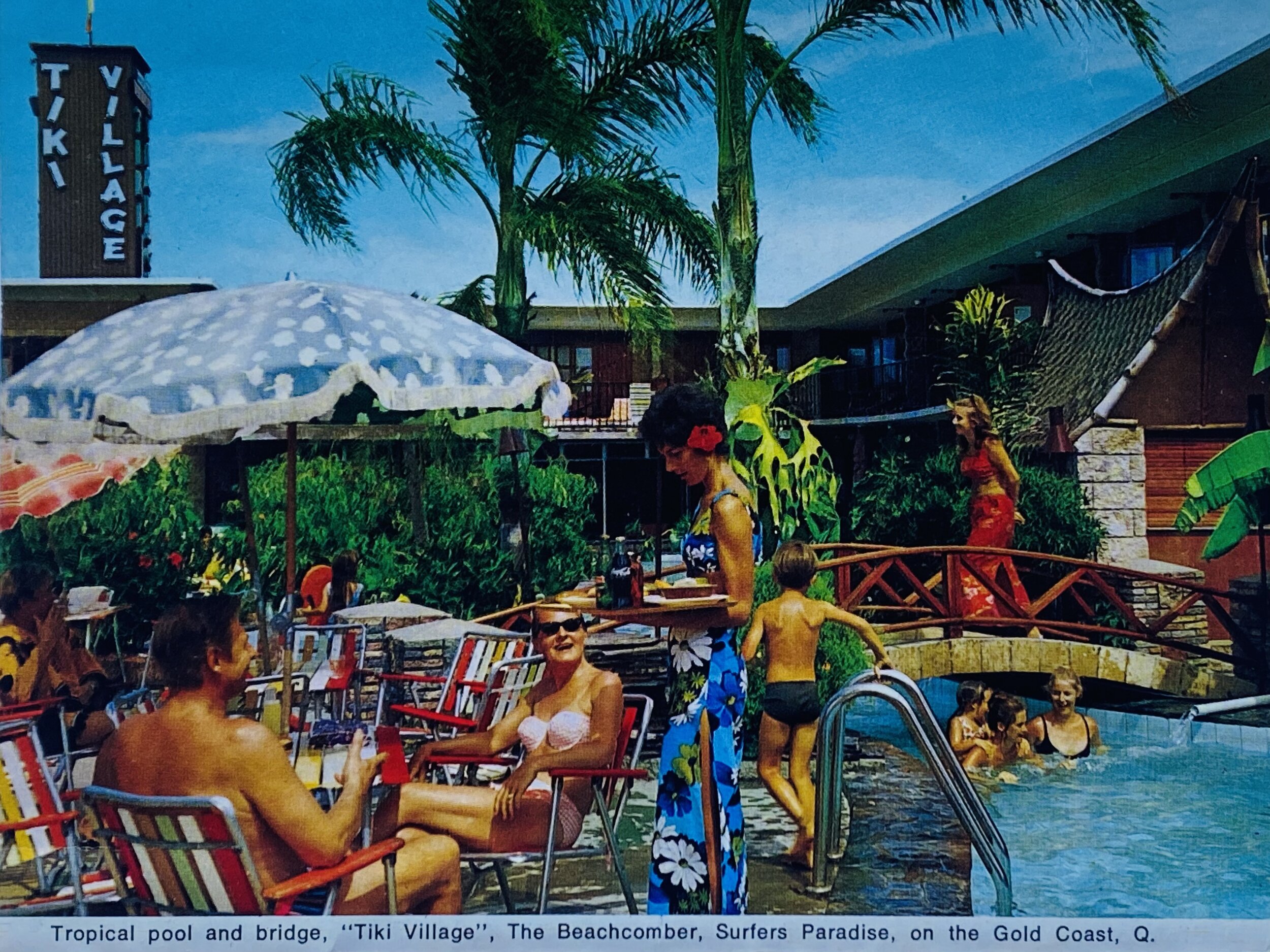
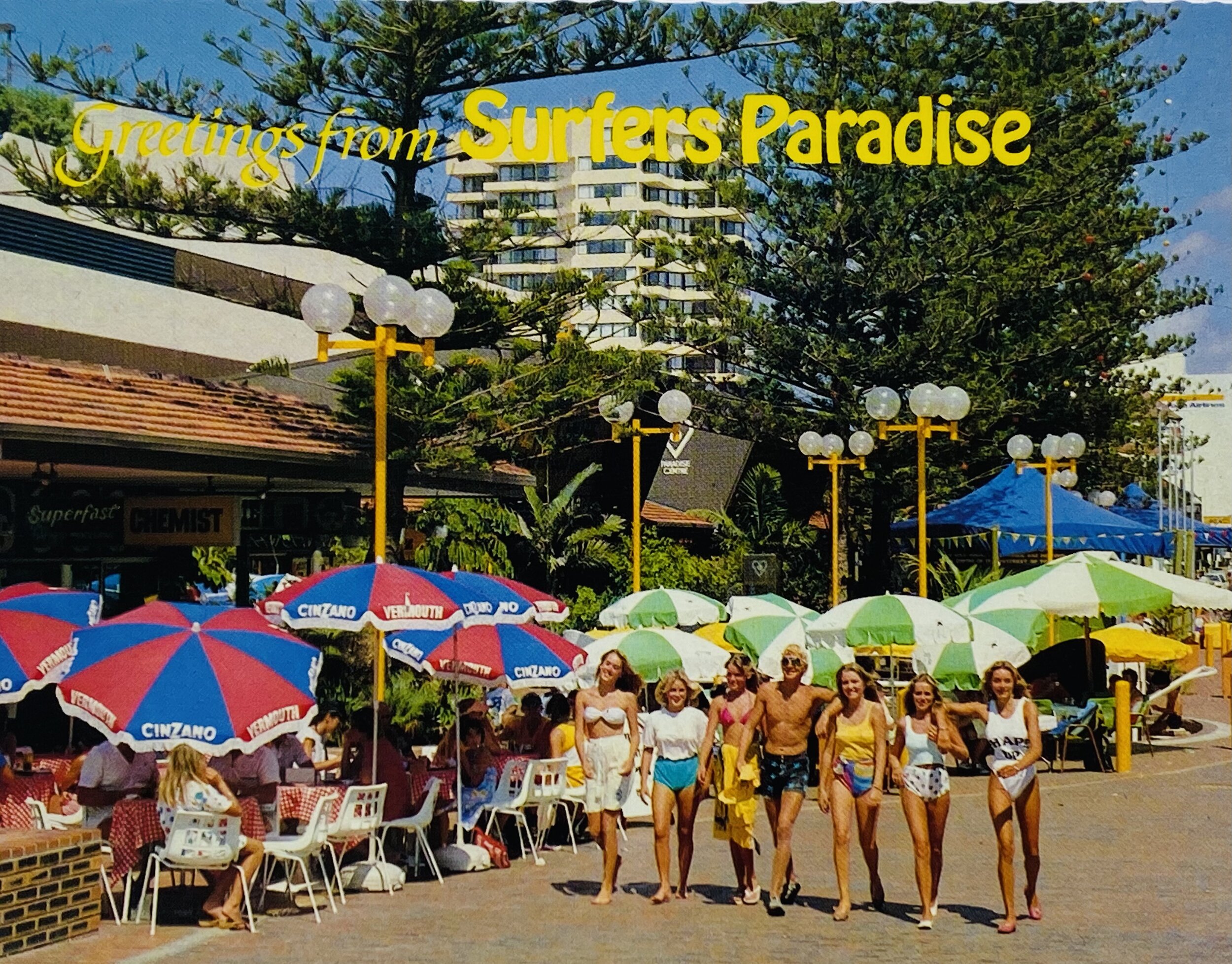
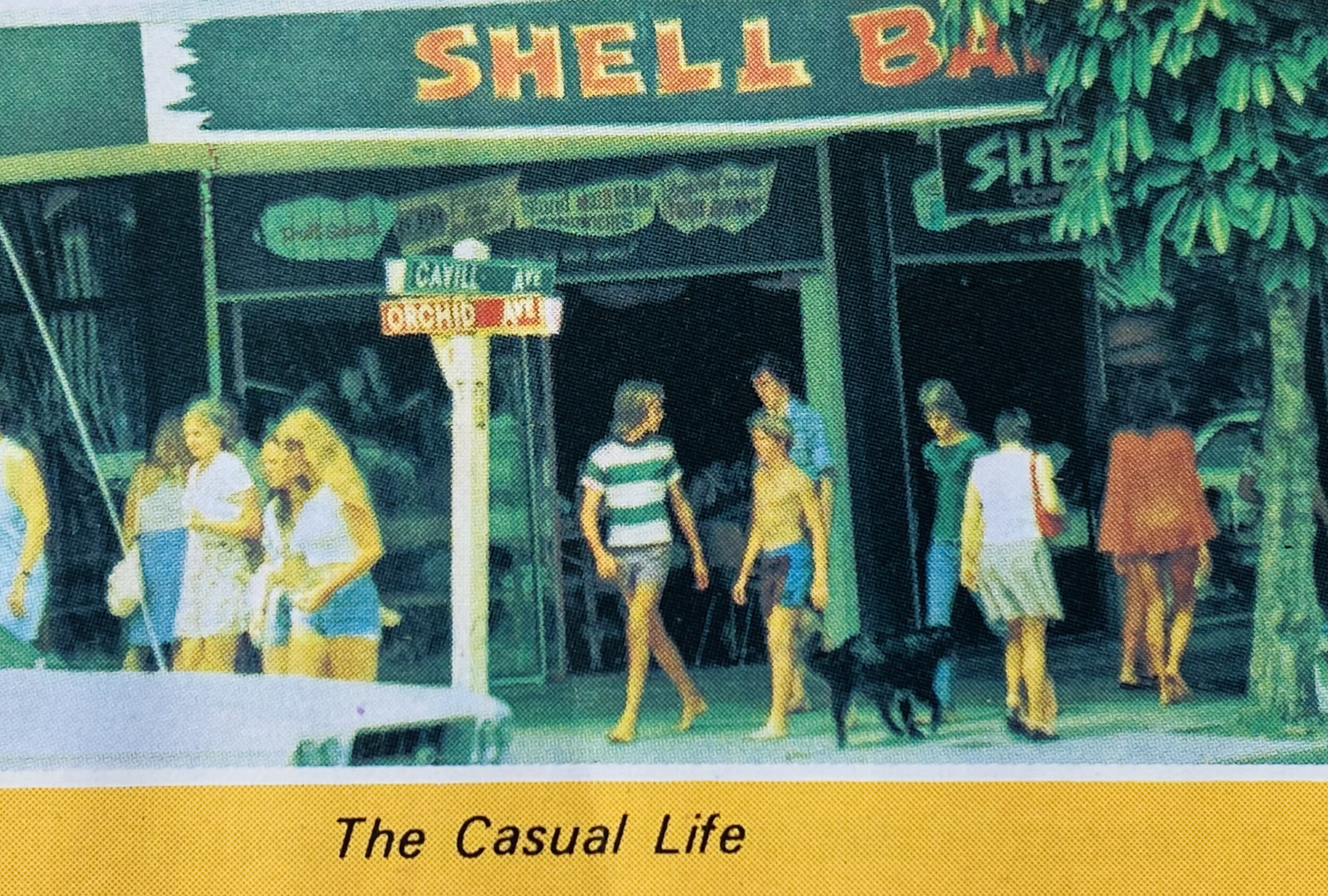
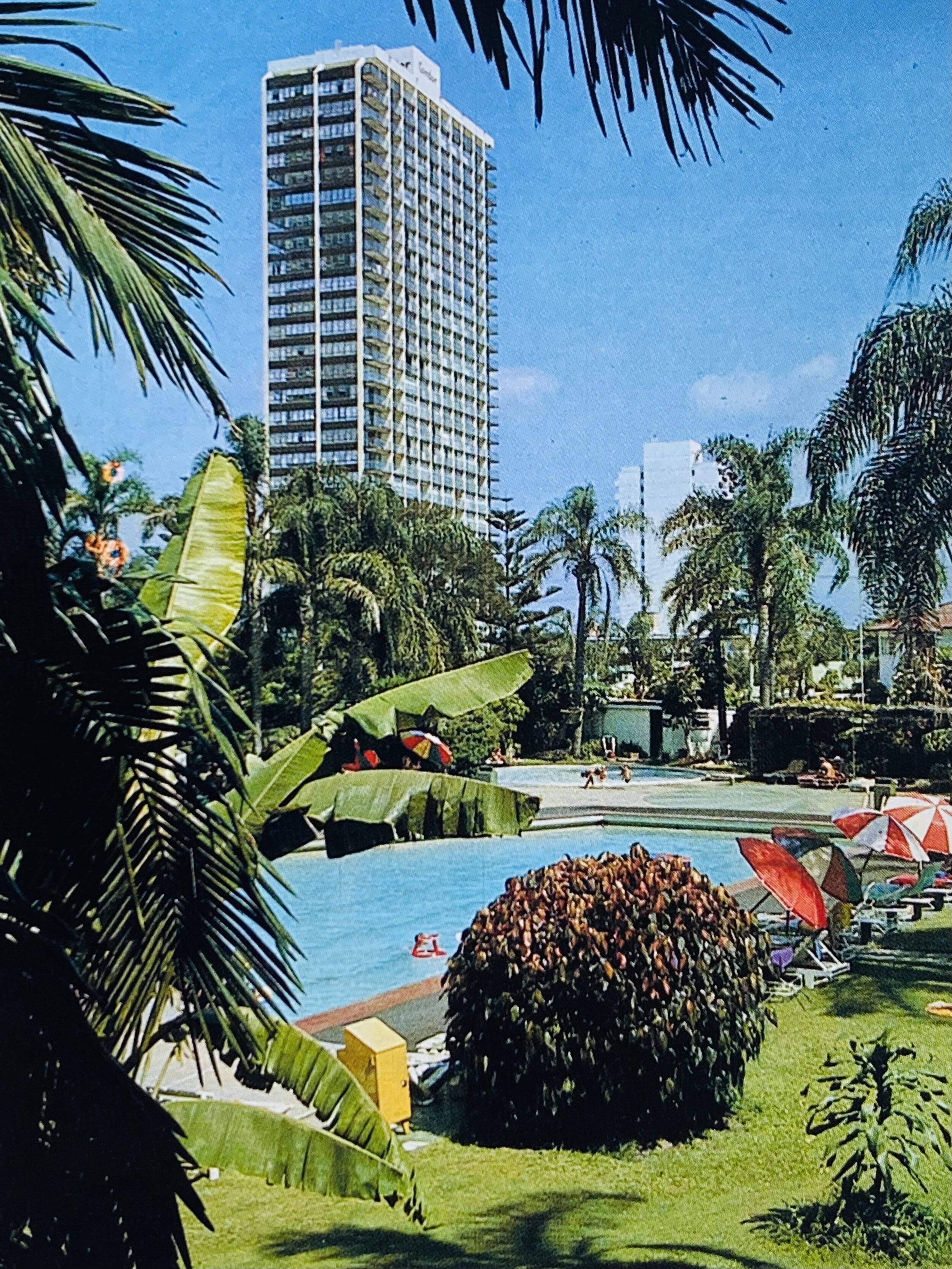
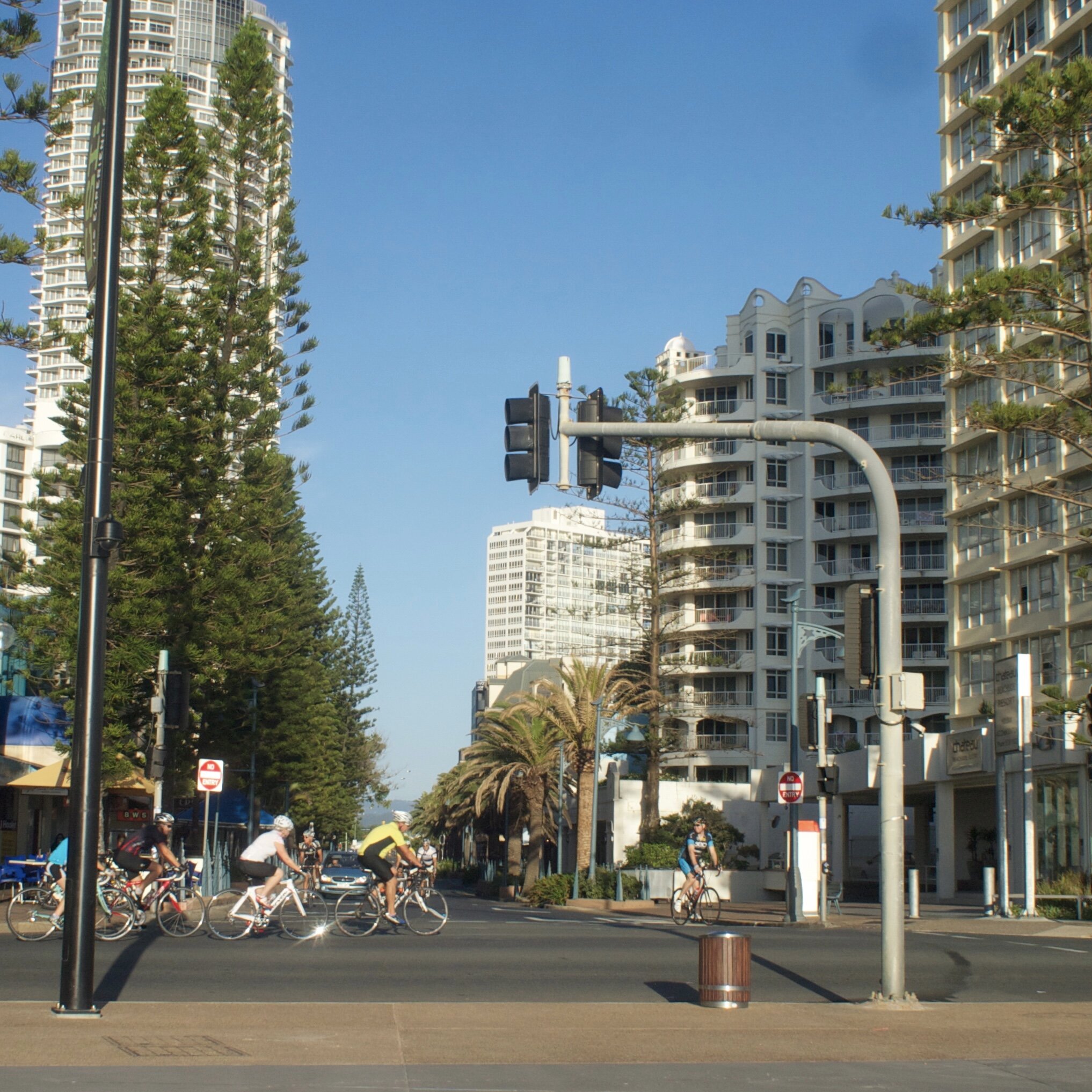
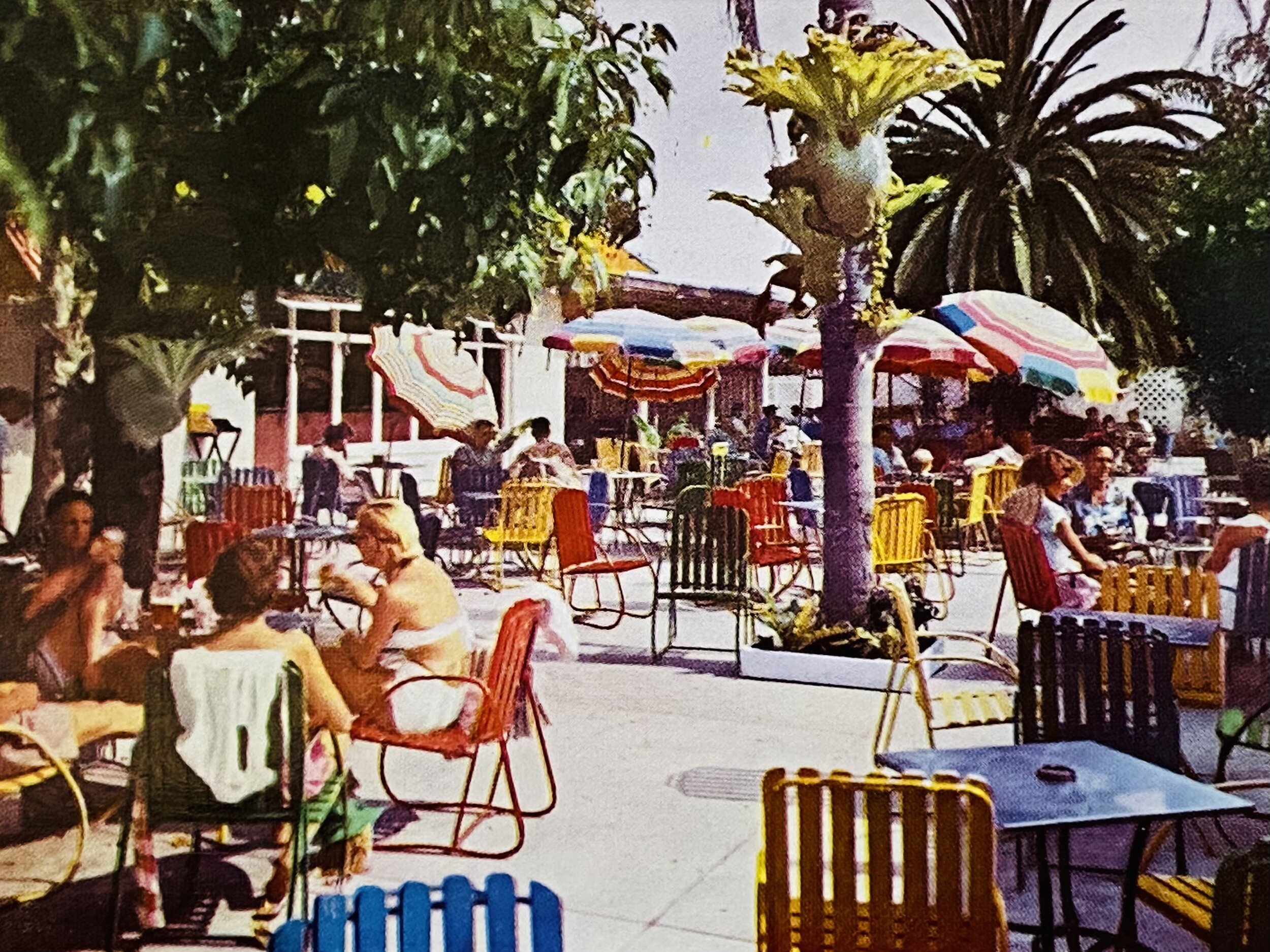
From what I have gathered, the beach at Surfers was always the main attraction. But Surfers in the 1960s was also unique for its al fresco cafes, invigorating the streets with their casual furniture, bright umbrellas and of course people on holiday. In the central area, narrow arcades cut through the streets, providing safe, easy, sheltered access to a variety of restaurants, fashion shops and entertainment businesses. Planted Norfolk pines gave structure and shade to most east-west streets, and there were entertainment venues set in tropical gardens, like the Surfers Paradise Hotel Beer Garden and the Chevron Hotel. Motels like Tiki Village, Beachcomber and El Dorado featured fabulous gardens with pools that could be seen from the streets. Even holiday flats and guesthouses, most notably Uncle Tom’s Cabins, presented their gardens as a drawcard. The whole precinct was walkable and lively and inviting. You could step off the beach and into a shaded garden. It felt like an integrated resort, a paradise, albeit with a growing problem of car parking.
BOOMING SEVENTIES AND EIGHTIES

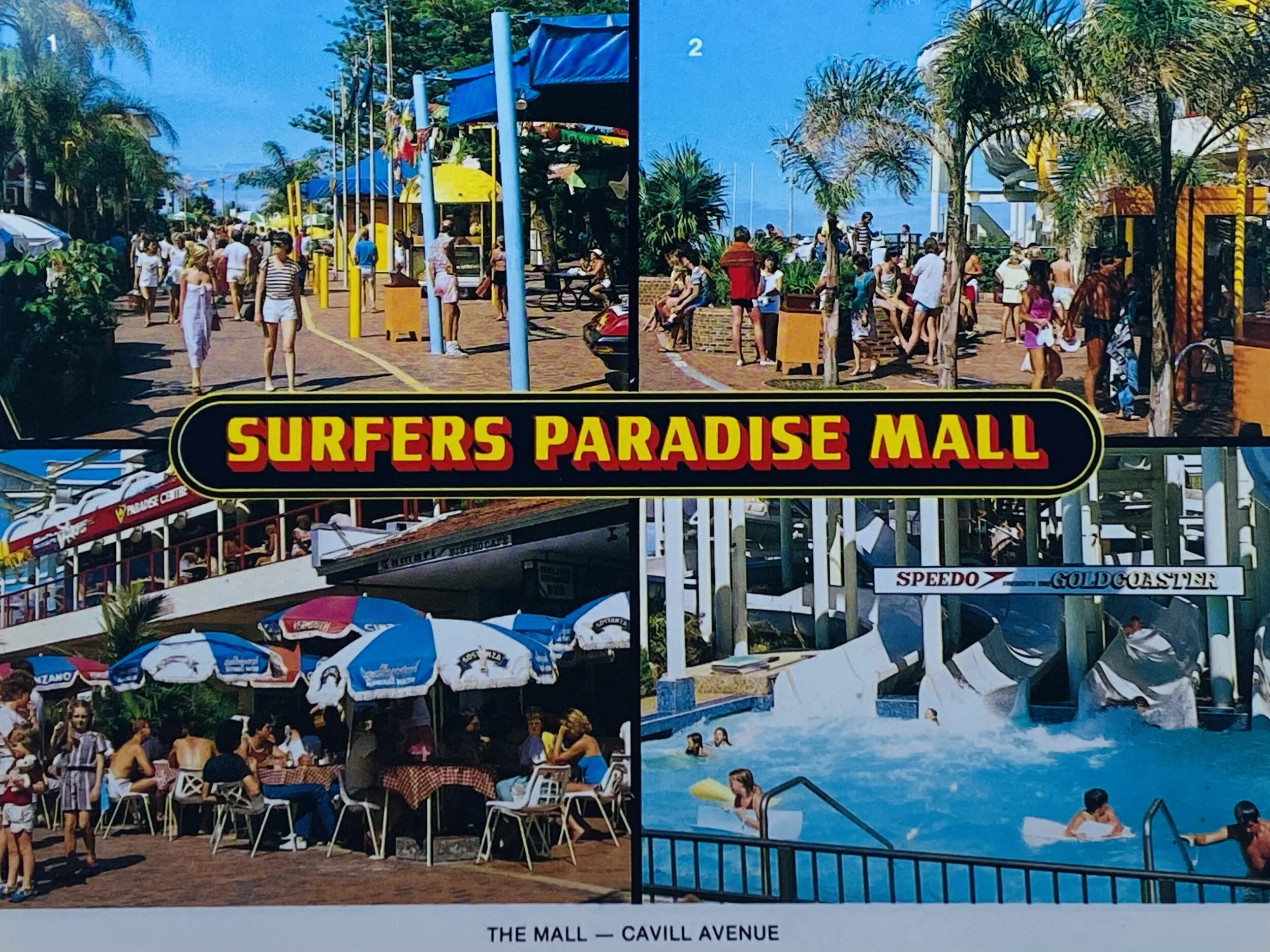
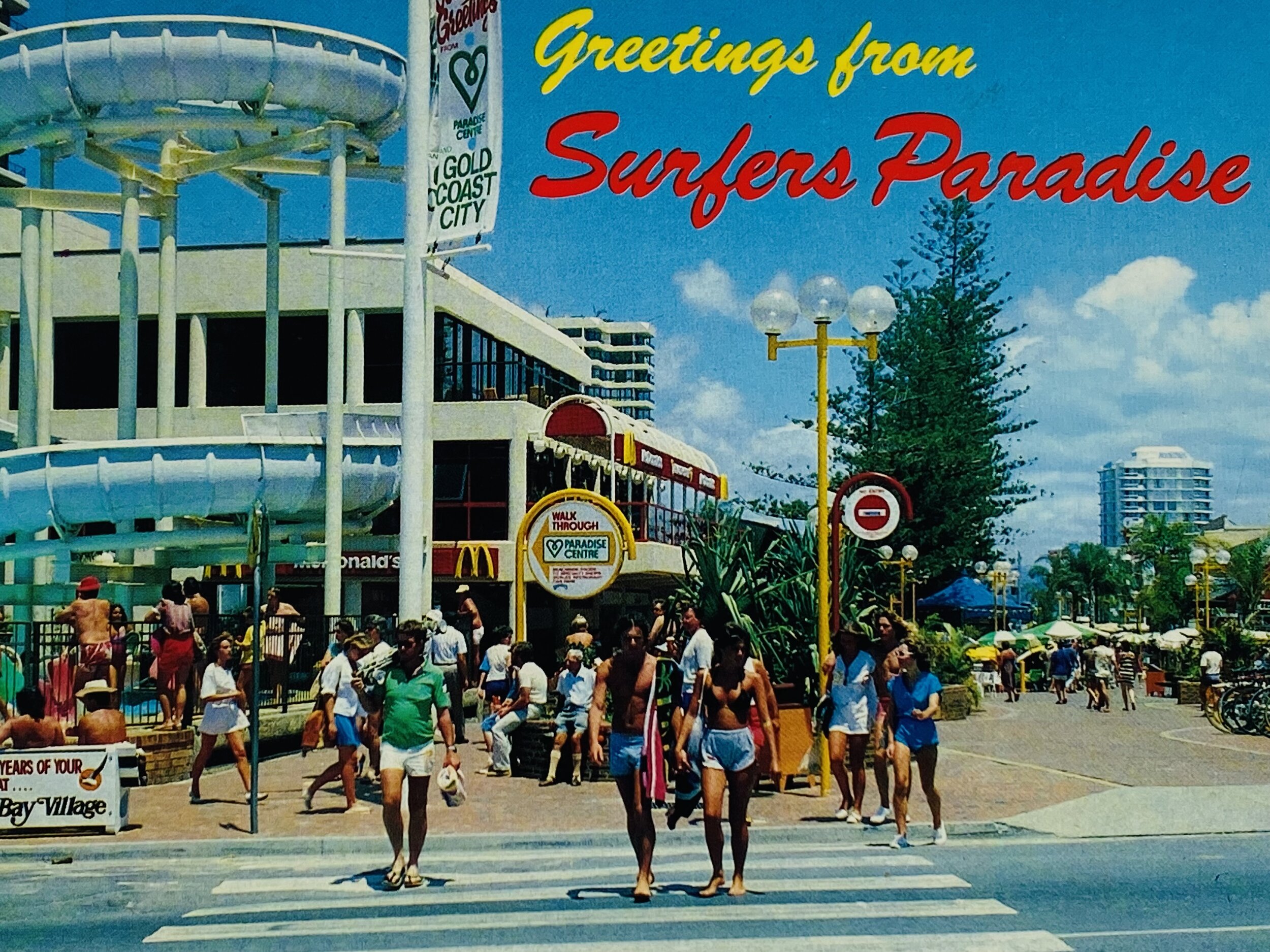
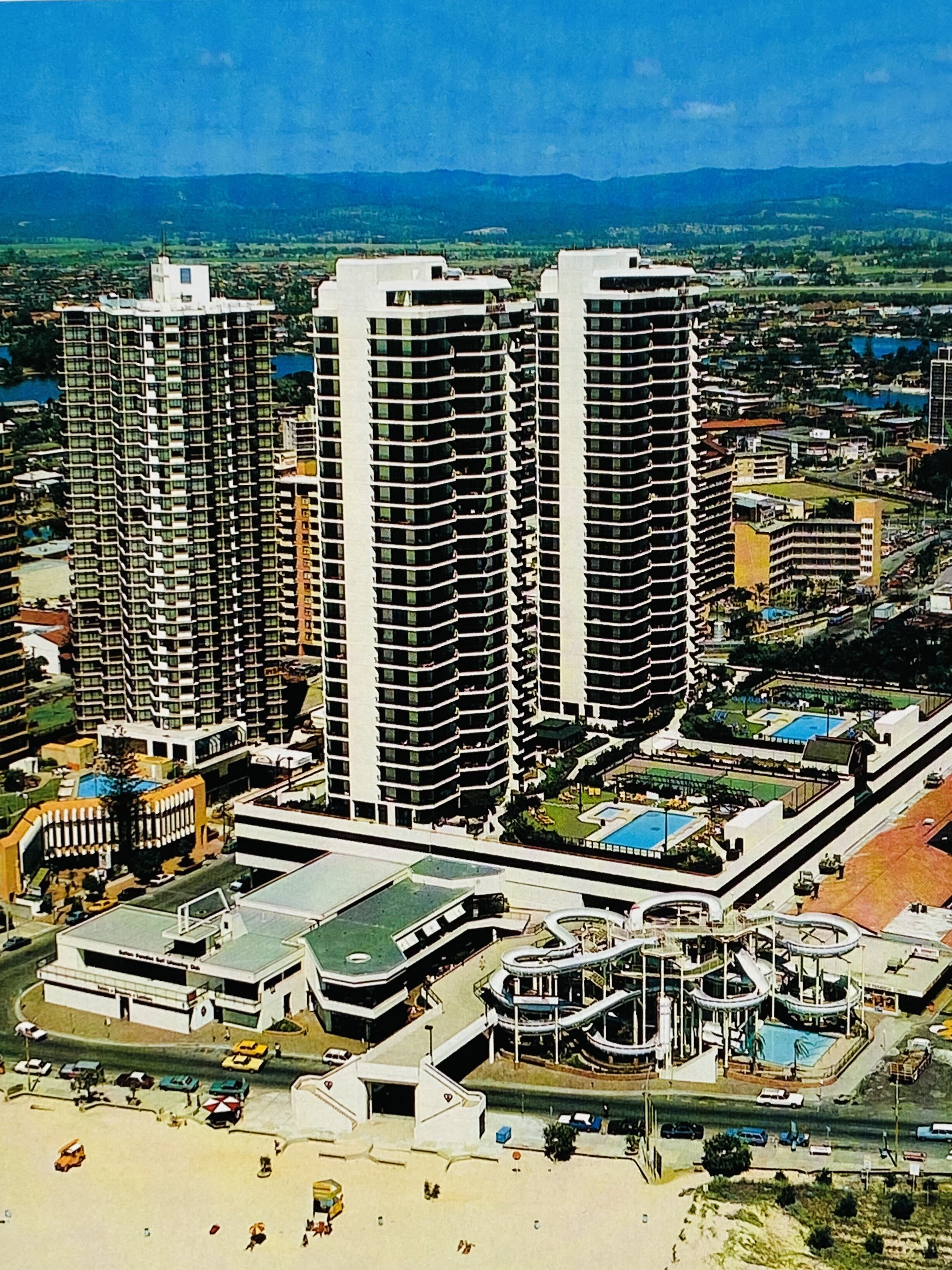
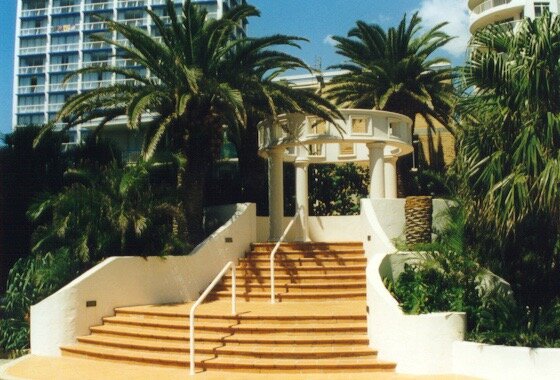
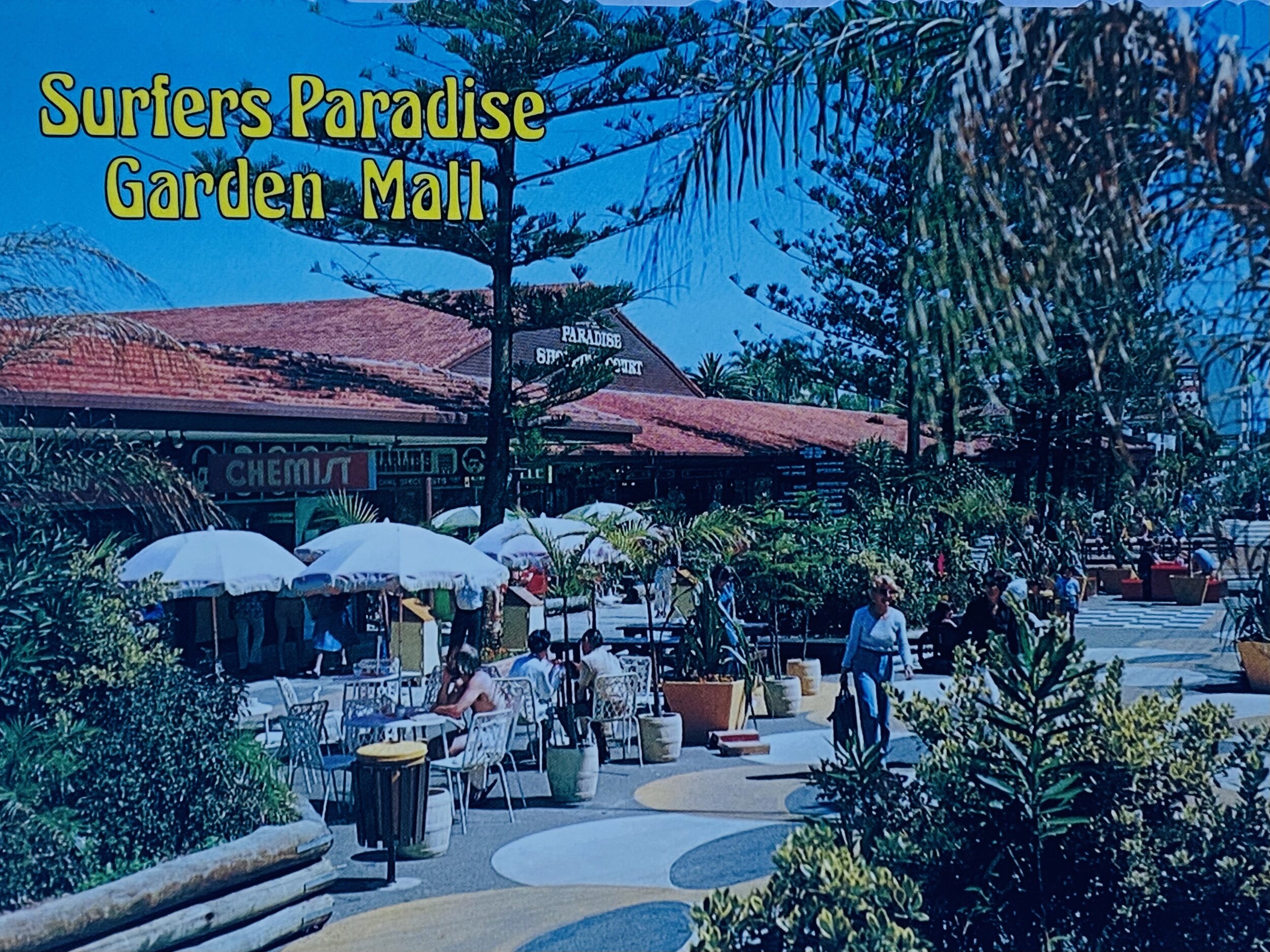
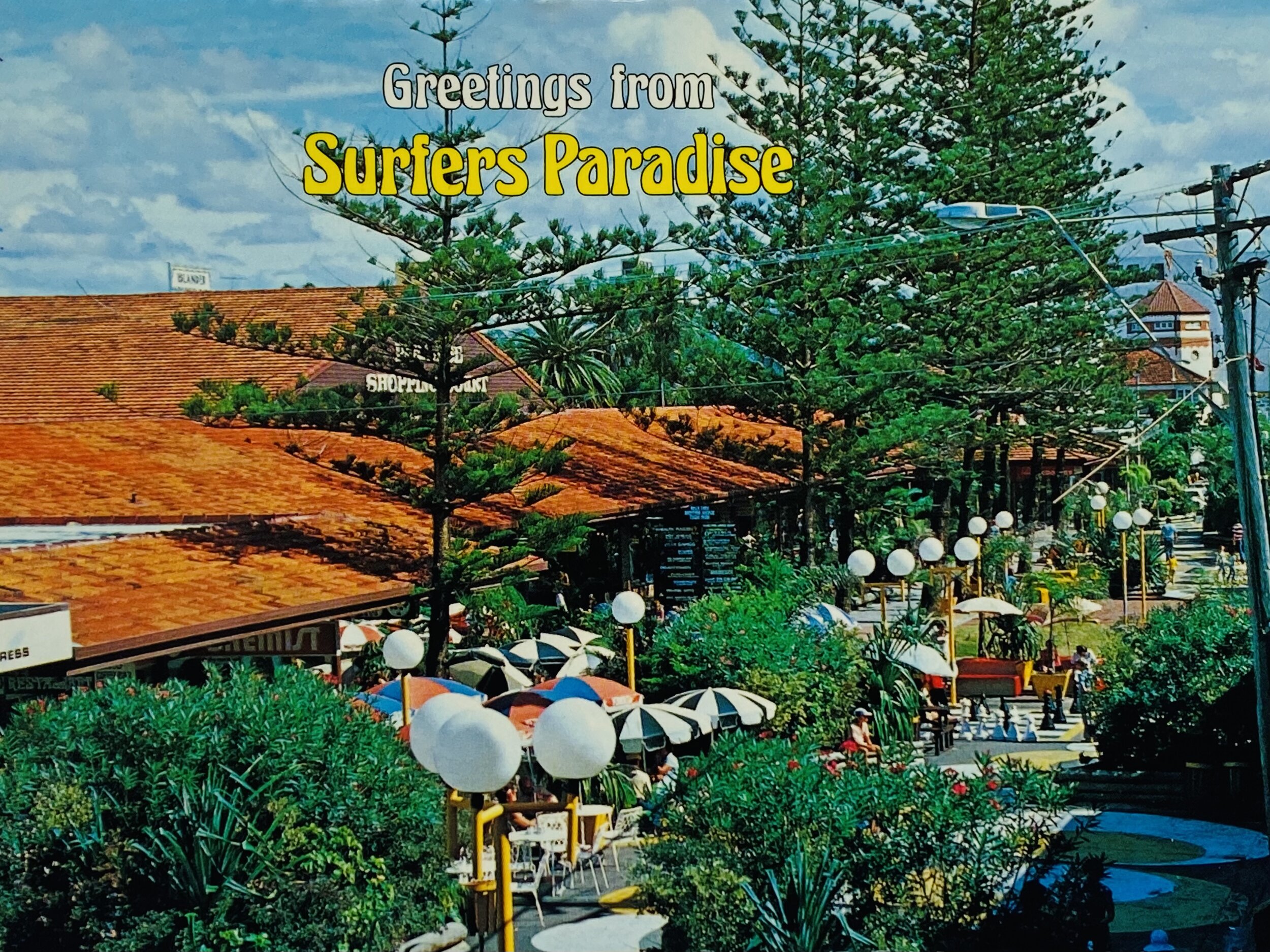
In the 1970s and 1980s, attractions like mini-golf courses and the waterslides of Grundy’s entertainment centre brought water, gardens and activity into the streetscapes, adding to the resort ambience of Surfers.

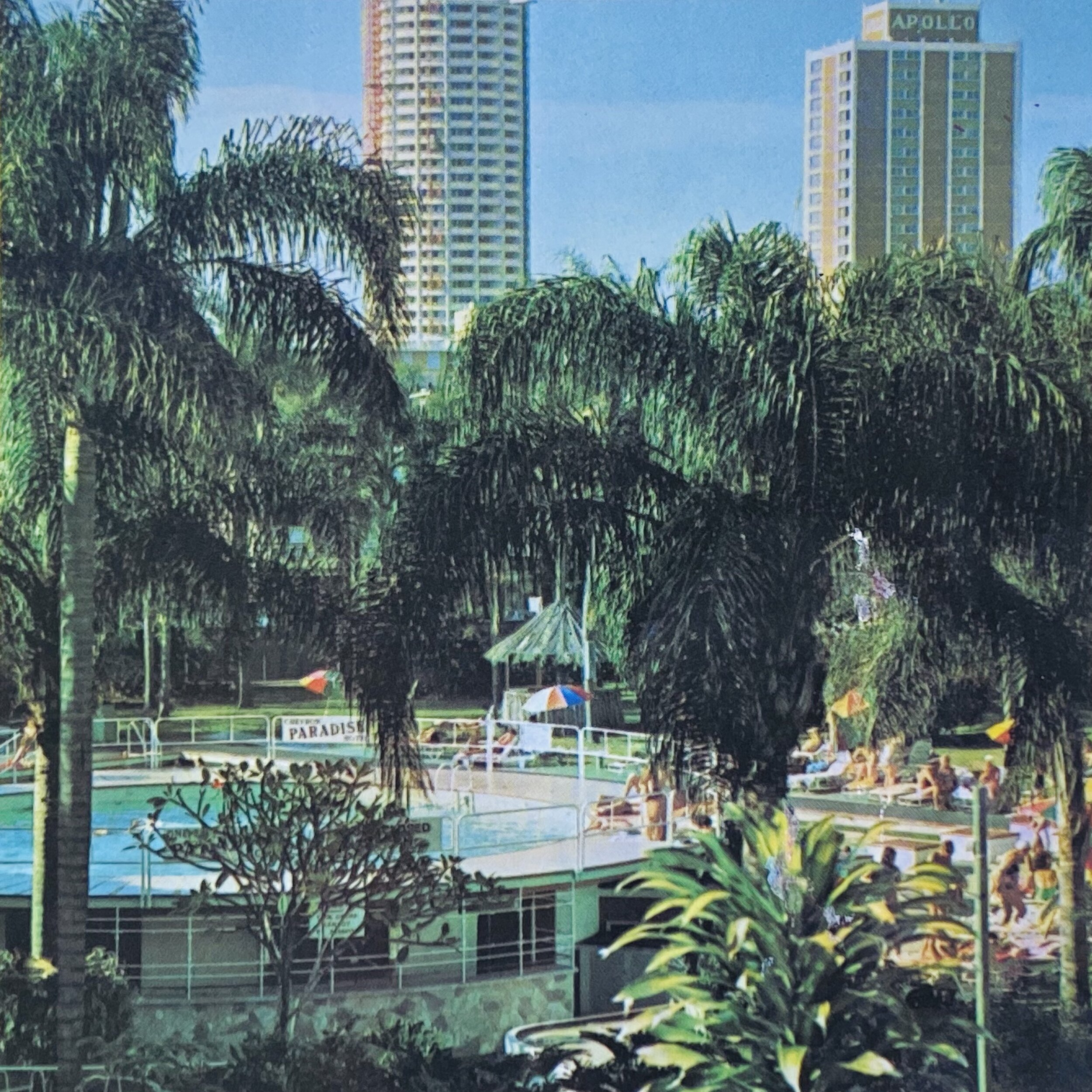
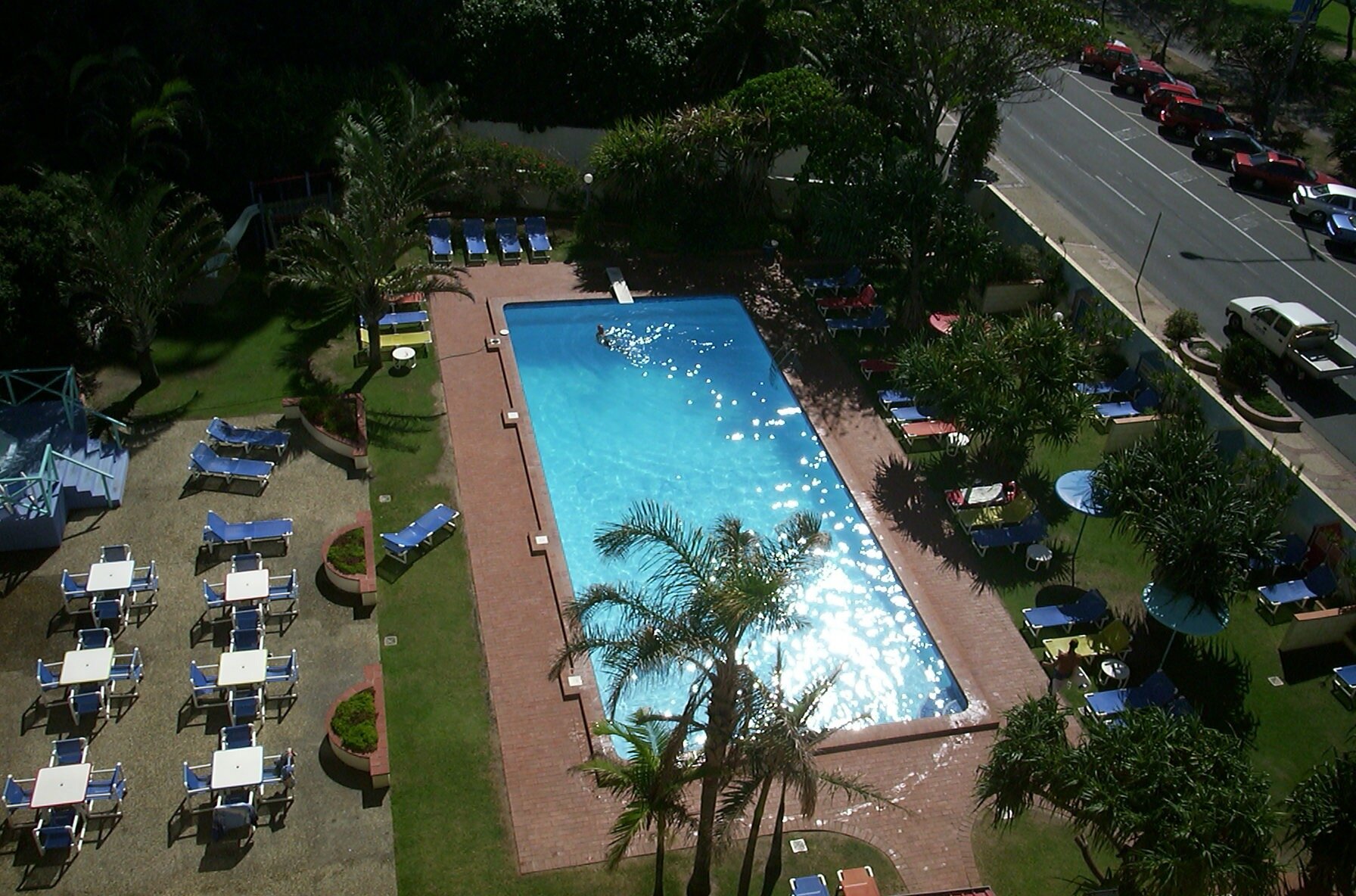
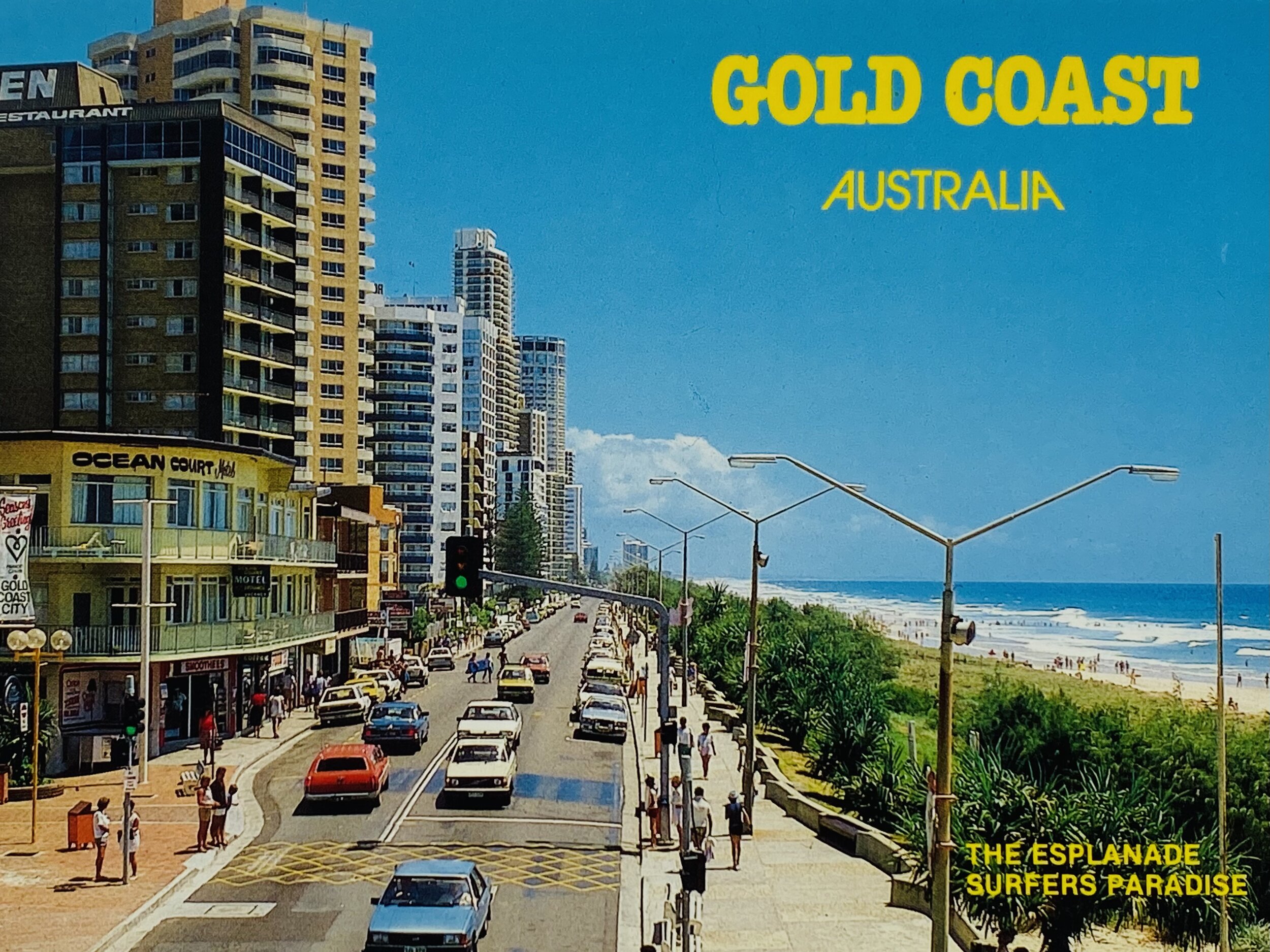
The first 1970s highrise hotels stretched north along The Esplanade. Buildings like Iluka, The Chateau, Apollo and Focus provided large pool and garden areas that were visible to people walking by and also from high above from apartments in these tall buildings. From 1974, private development and public works were guided carefully by the Surfers Paradise Central Area Plan known as ‘The Gold Book’ which set a vision, urban design codes and a series of 13 Action Projects like car parking stations, a convention centre, pedestrian network, riverfront boardwalk and even design standards for street furniture, signs and graphics.

From 1975, to address the nagging problem of car parking, the council required all new highrise accommodation developments to make 15-25% of their car spaces freely accessible and available for public use. Where adequate car parking spaces could not be provided on site, developers made cash in lieu contributions equating to the shortfall, and thereby contributing towards the funding of what was to become the Bruce Bishop Car Park and Surfers Paradise Transit Centre in 1991.

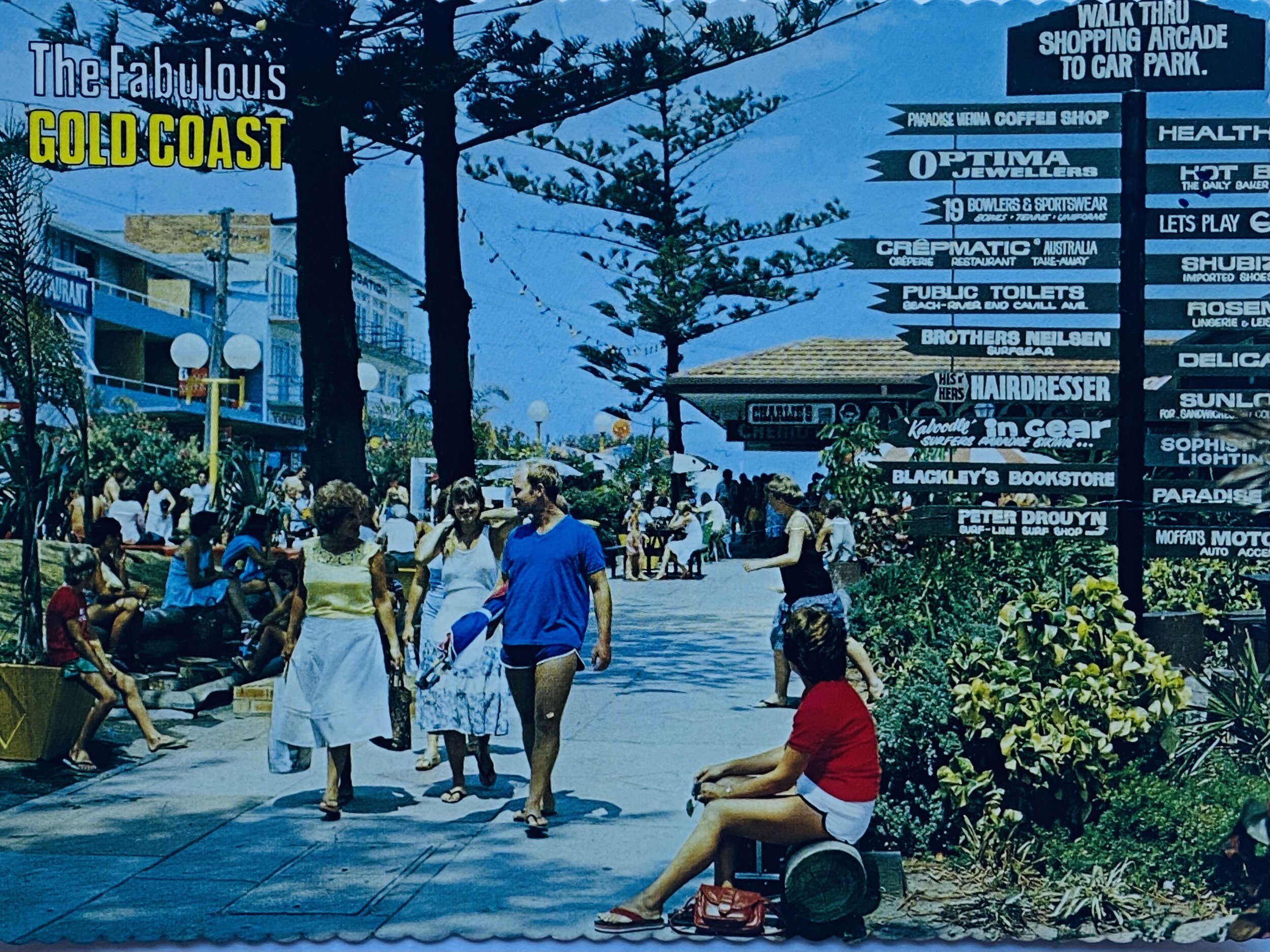
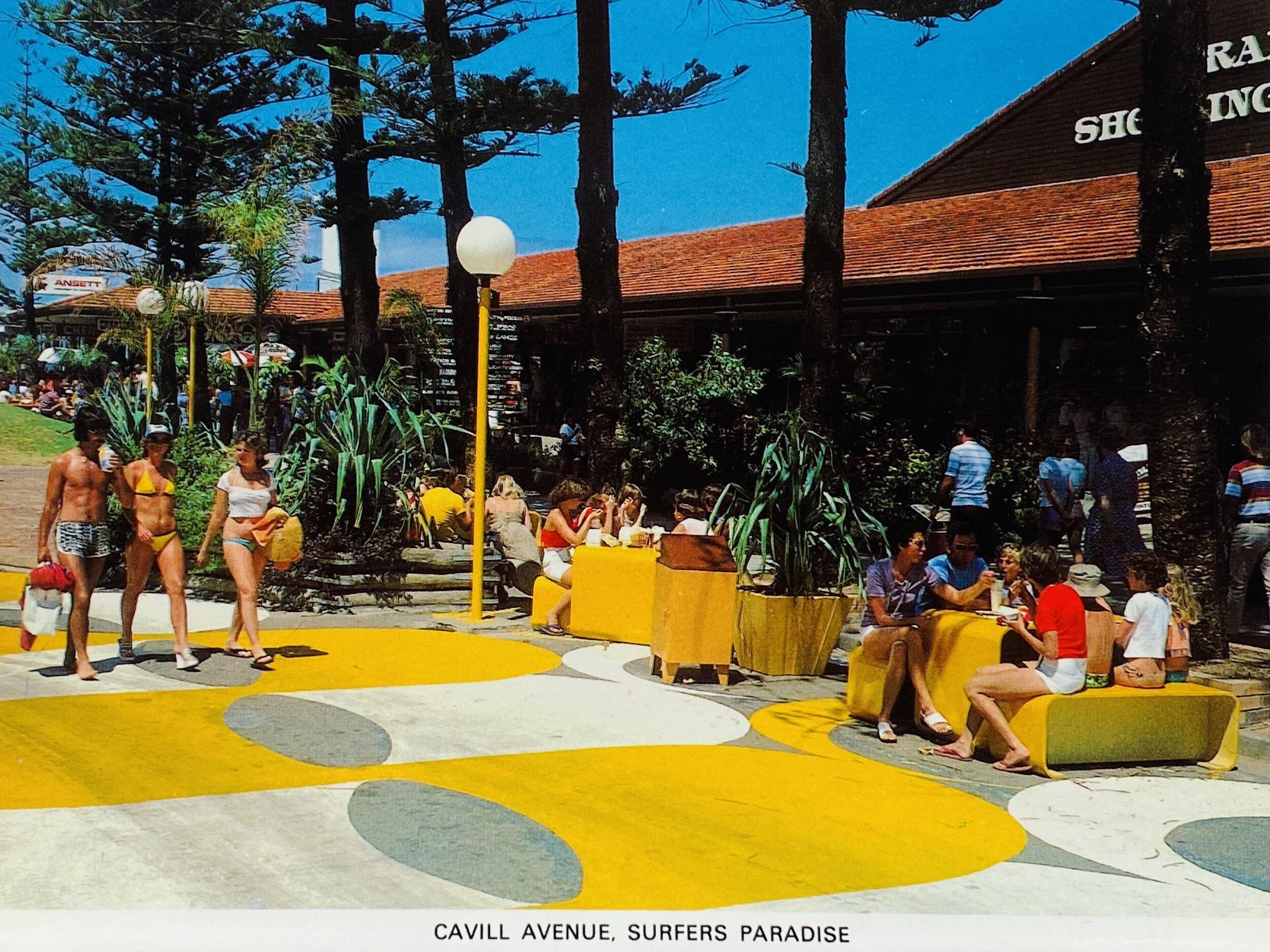
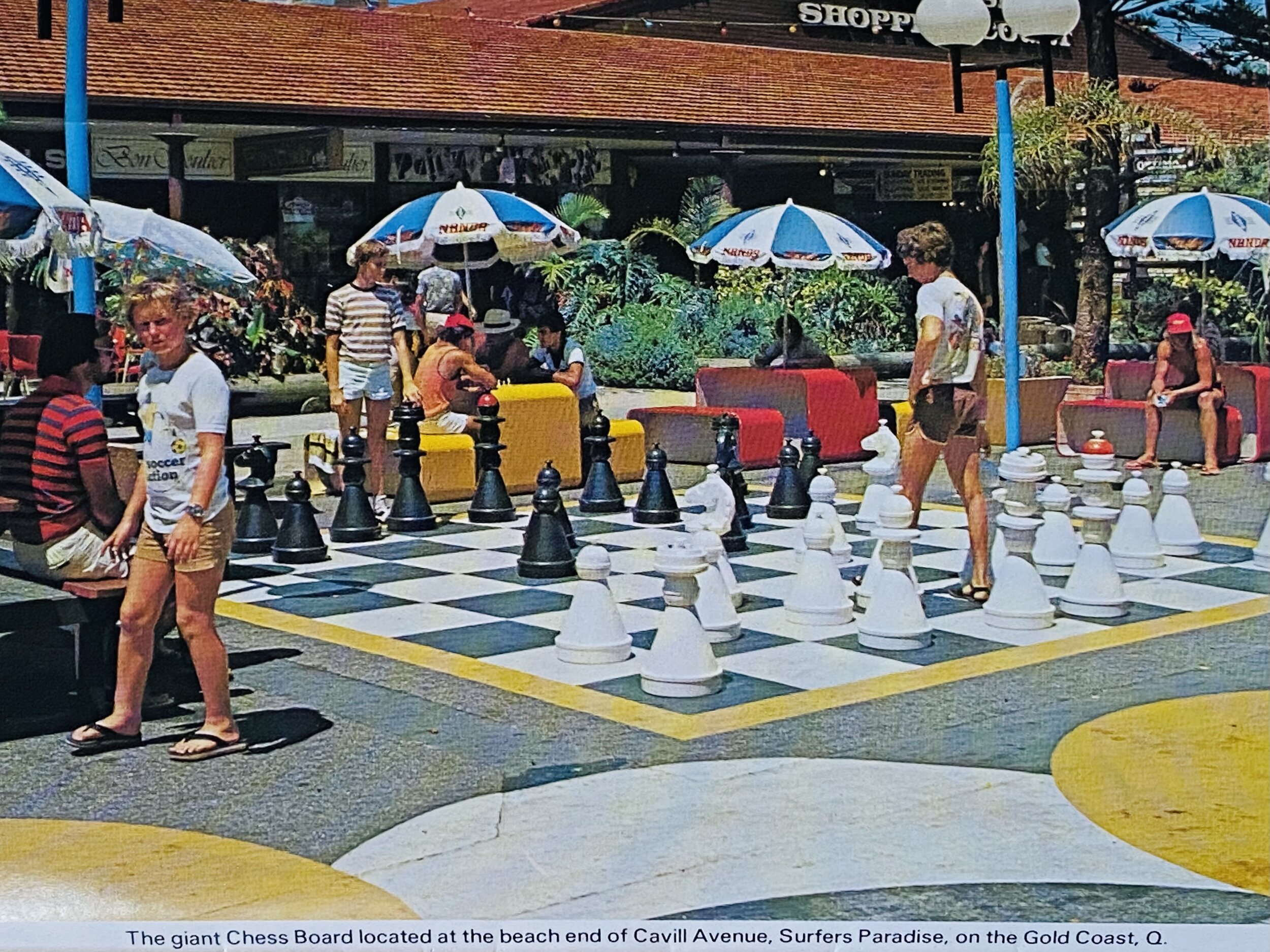
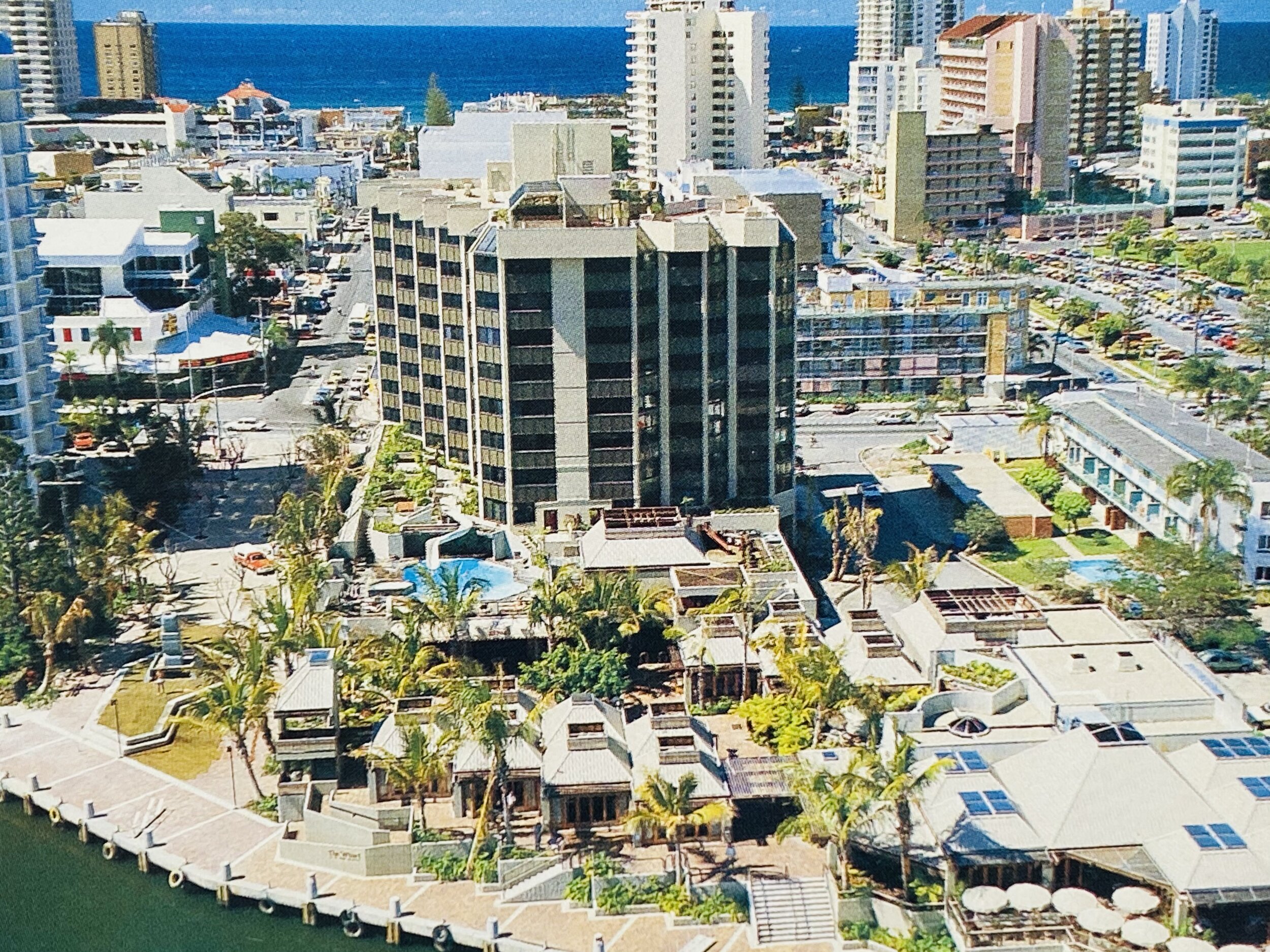
Development of the Paradise Centre in 1981 incorporated a new Surfers Beer Garden, but it was elevated upstairs and more like a tavern than a garden. In 1982, the beach end of Cavill Avenue was converted to a pedestrian mall to enhance the ritualistic activity of strolling. During daytime and evenings, people wandered between the beach and the river, and along the beachfront to gaze at the striking tall buildings, pools and gardens. It was also popular to cruise the long, straight esplanade by car, and even do laps with windows down, sightseeing. At the river end, Tiki Village Motel, and its Hawaiian garden, was replaced by a new Tiki Village Hotel with a pool and landscaped open space; but again, this area was elevated, privatised and rendered invisible from the riverside or Cavill Avenue.

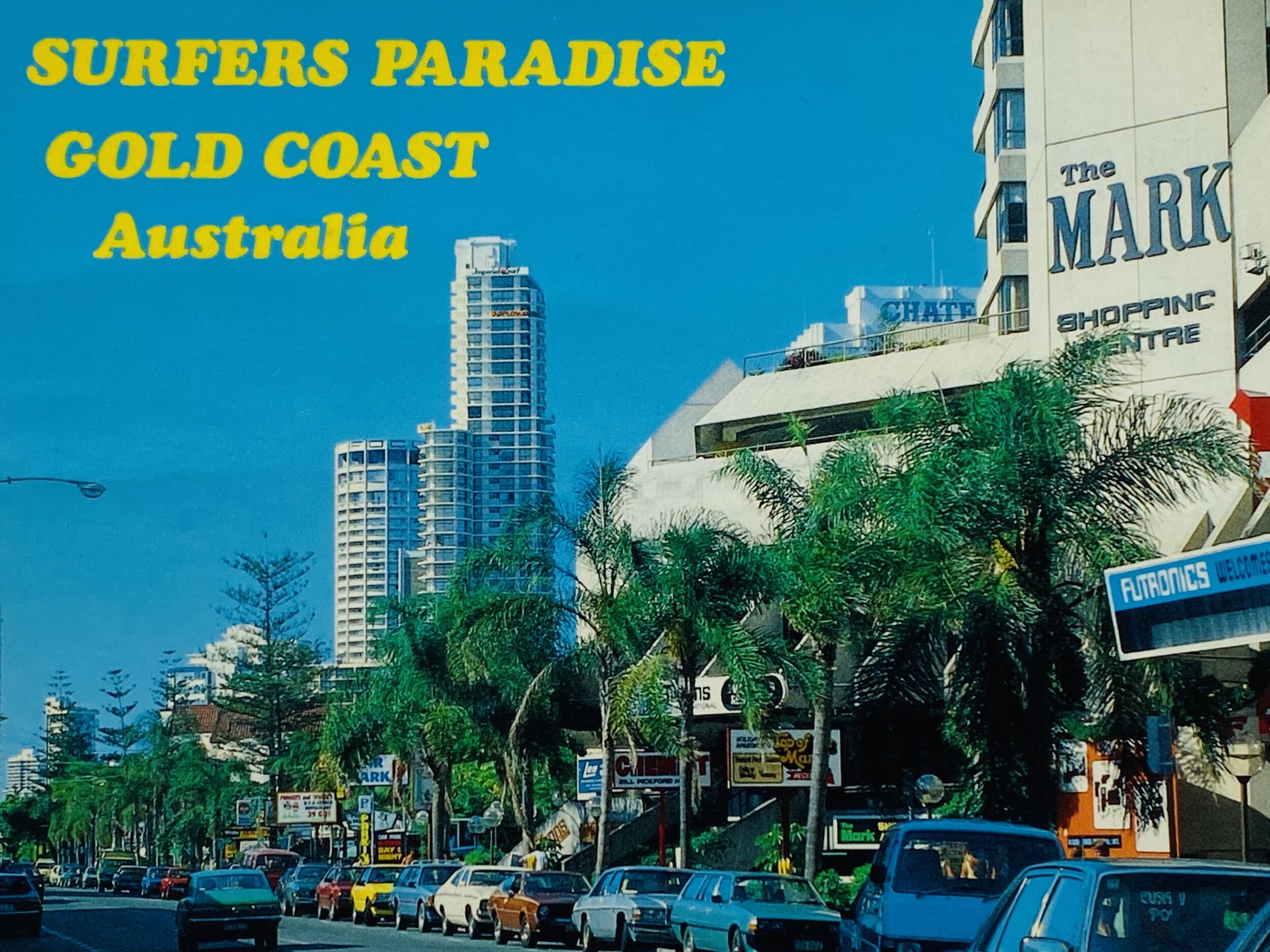
As complexes like The Mark and Raptis Plaza were developed, connective arcades enriched the sense of Surfers Paradise as an integrated resort. 1980s highrise buildings, like Golden Gate, Hi Surf, Imperial Surf and Peninsula, grew taller and extended farther from Cavill Avenue and the beach, consolidating the distinctive image of Surfers Paradise, synonymous with the Gold Coast, as a place quite different to other Australian cities.

The beach was still the main attraction, but the city also was thrilling and fun. Highrise accommodation gave a novel holiday experience for most visitors who came from lowrise suburban areas. Surfers Paradise was colourful and garnished with abundant tropical greenery. It was a great place to meet up with friends, to eat out, to wander and promenade, and after dark it turned into a lively nightclubbing scene where locals mixed freely with tourists, a party town ‘where the fun never sets’.
DECLINING NINETIES AND NOUGHTIES

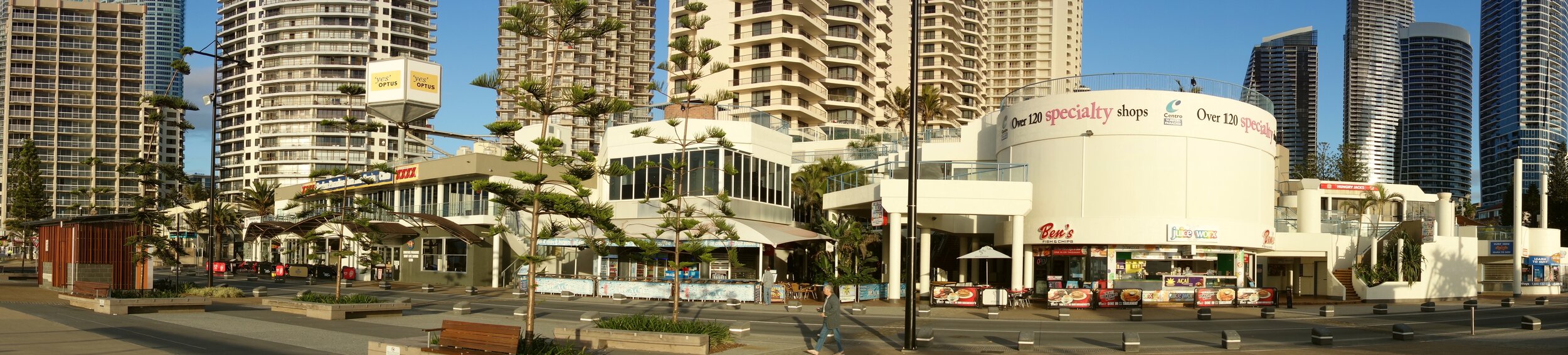
Global economic recession of the early 1990s brought a hiatus to development, and by the mid-90s, decline had set in at Surfers Paradise. Grundy’s waterslides were dismantled, and the beach end of the Paradise Centre was left vacant. Large sites that had been bought and cleared by foreign investors were deserted, like bomb sites, and became stains on the image of central Surfers Paradise.
DSC01869.JPG

The 1994 Gold Coast Planning Scheme introduced detailed Development Control Plans for most of the city’s activity centres —except Surfers Paradise. This regrettable omission was because the planning work was not adequately advanced to be incorporated at the time of gazettal. The central area was designated in the Comprehensive Development Zone wherein town planning consent was required, but by now, almost anything was allowable. This planning scheme incentivised amalgamation of sites and, in particular hotels with active, commercial uses in the first three storeys. There was a graduation of building height controls stepping away from the beach to lessen shadow impacts on the beach. The scheme provisions for International and Resort Hotels promoted very tall buildings with deluxe facilities and leisure gardens that would attract international tourists. This did indeed result in developments like The Moroccan, Crown Towers and Sun City, that bucked the general economic downturn. 

As the recession continued, many commercial premises in the heart of Surfers were vacated. At the same time, shopping centres like Pacific Fair, Robina, Helensvale and Harbour Town emerged to provide Gold Coasters with greater choices and hassle-free car parking.

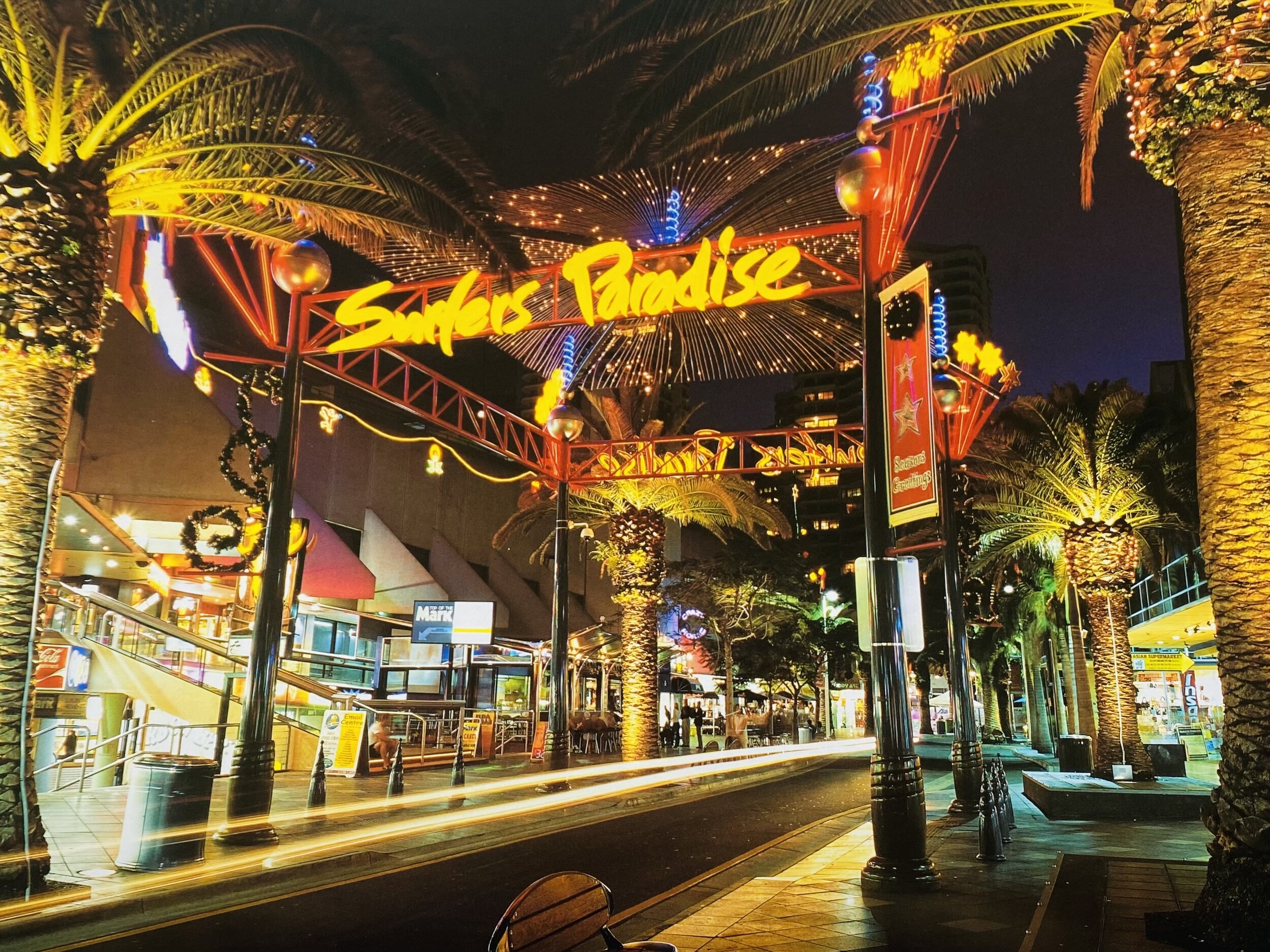
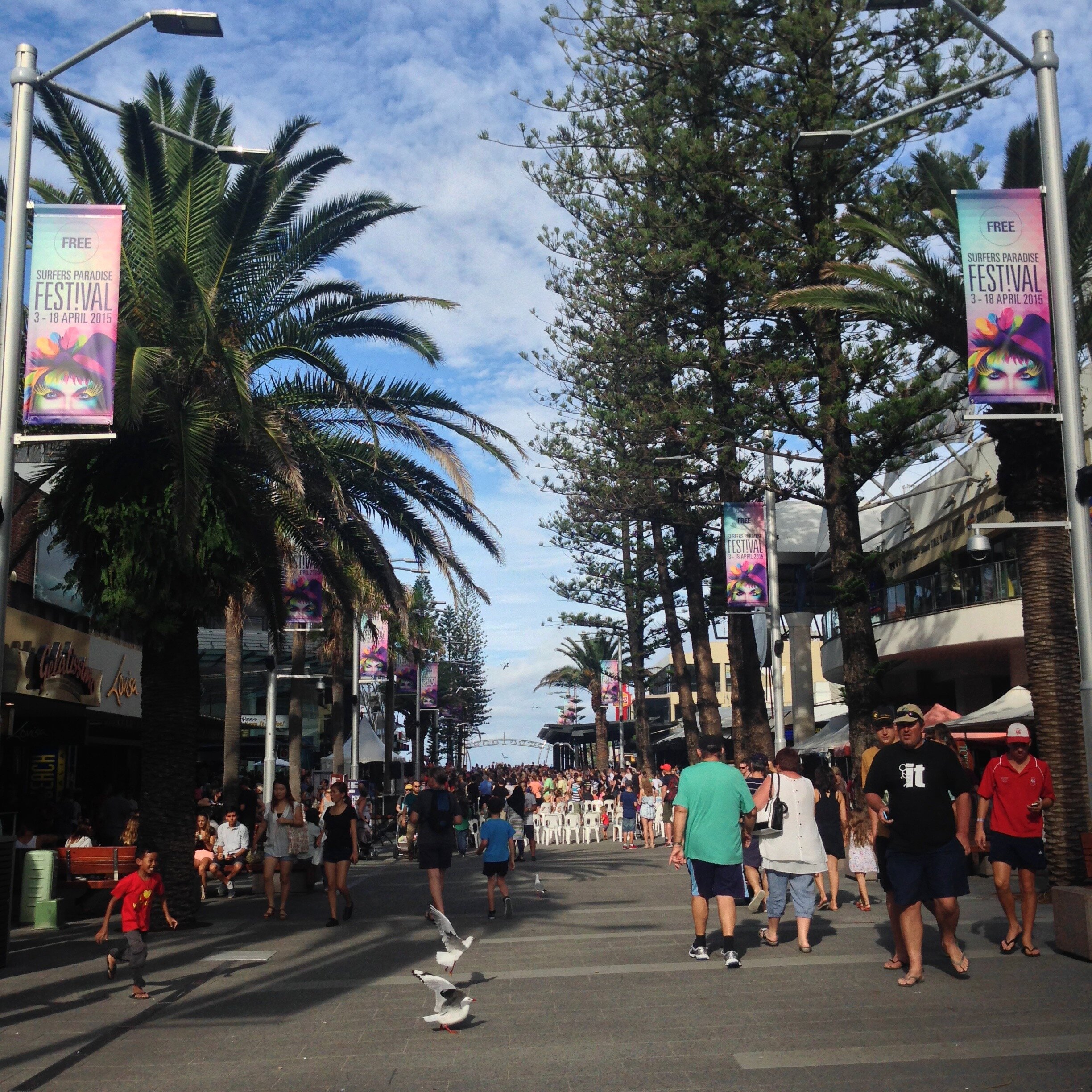
Through the nineties and noughties, a number of council and local business initiatives sought to revive Surfers Paradise. Cavill Mall had several face-lifts. Wayfinding signs, new footpaths, street furniture, Phoenix palm trees and several public artworks were installed in Orchid Avenue. The top end of Elkhorn Avenue was promoted as a fashion precinct like Rodeo Drive and tenanted for some years by global luxury retailers.

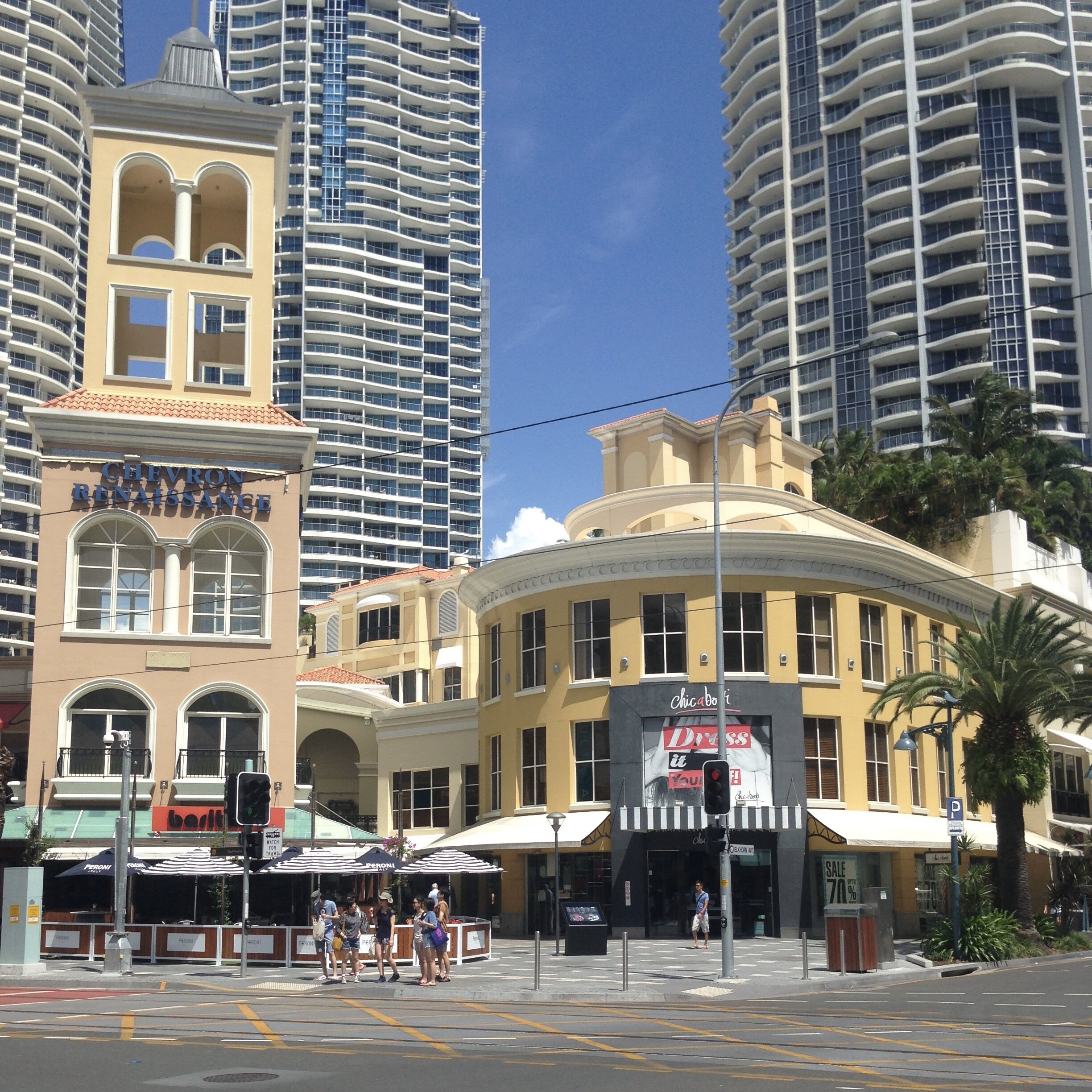
The 2003 Gold Coast Planning Scheme incorporated a Local Area Plan for Surfers Paradise. Landscaping at ground level was mandatory in all but the pedestrian epicentre of the precinct. Here, developments were expected to achieve seamless interfaces with and make contributions to upgrading of appurtenant public spaces. Chevron Renaissance, Circle on Cavill, Soul and Q1 were major developments that boosted their immediate localities, a bit like urban acupuncture, with active ground level thoroughfares, but the gardens for the paying guests and residents of the accommodation towers were all elevated out of sight above street view.

Over time, outdoor dining became regulated, bringing with it permanent physical barriers, and shade structures which annexed public spaces to the extent that in some places that they sought to deliberately alienate pedestrians.

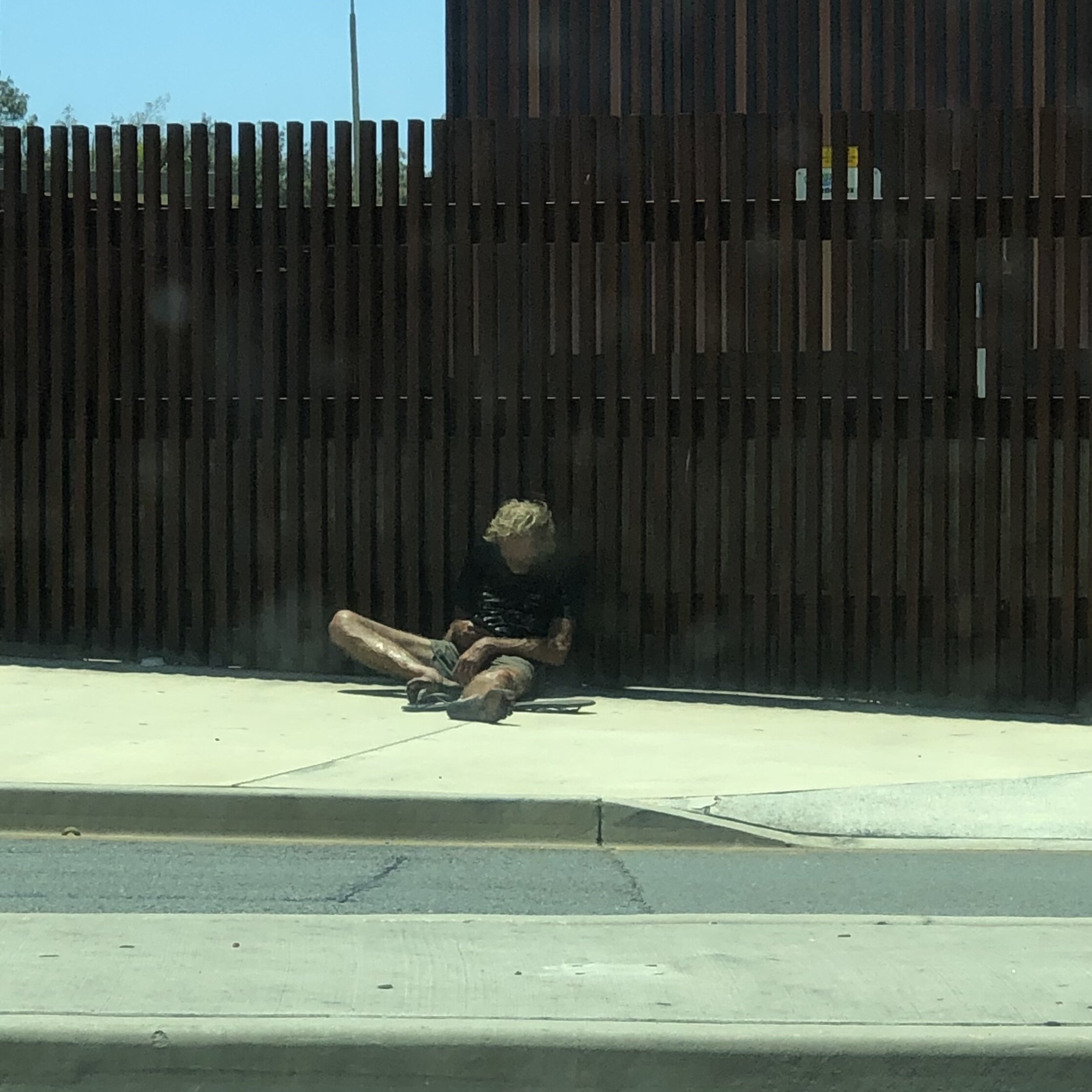
Increasingly problematic drug and alcohol related behaviour, and of course the annual Schoolies takeovers each November, demanded a lot attention and management.
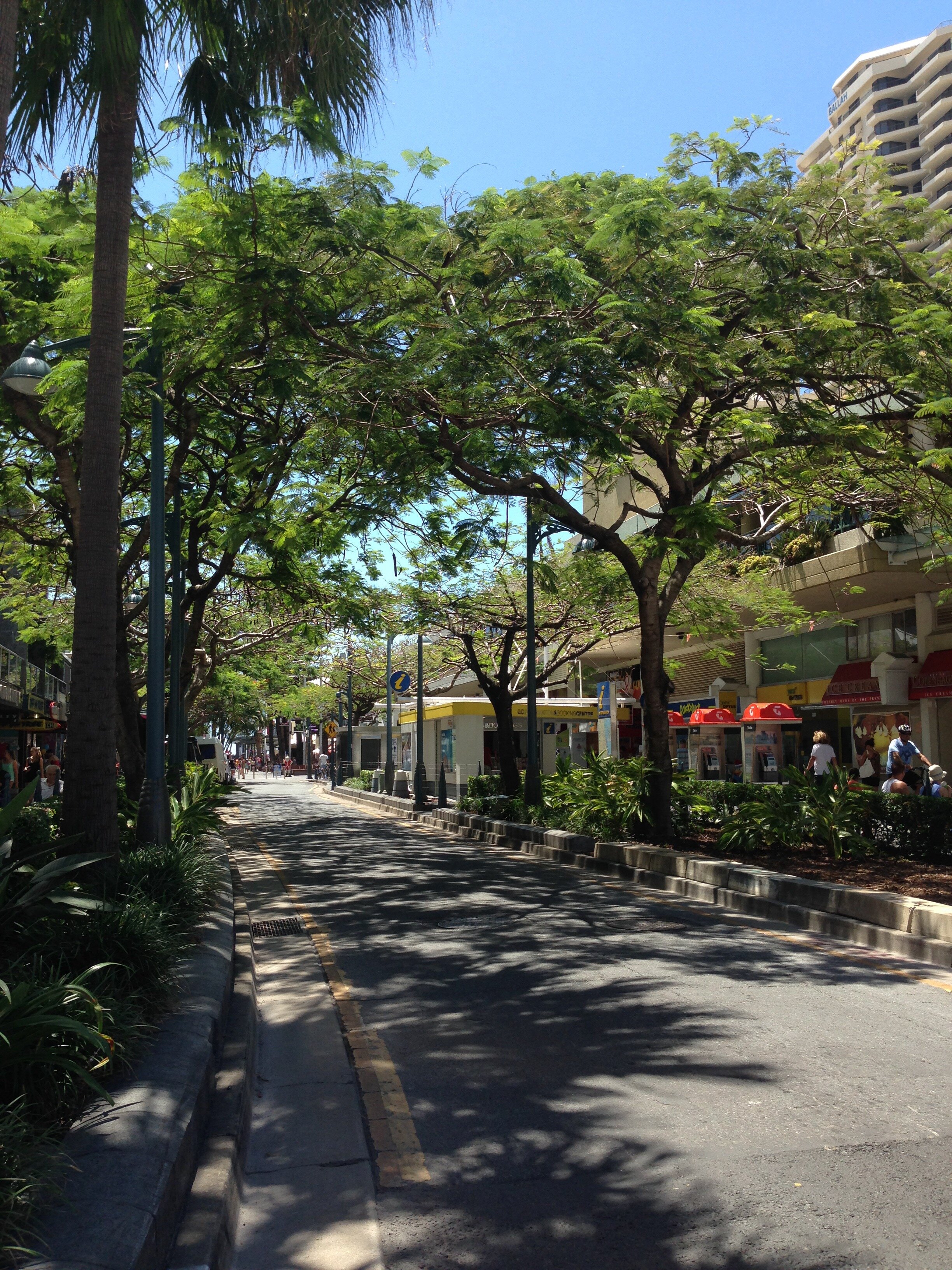
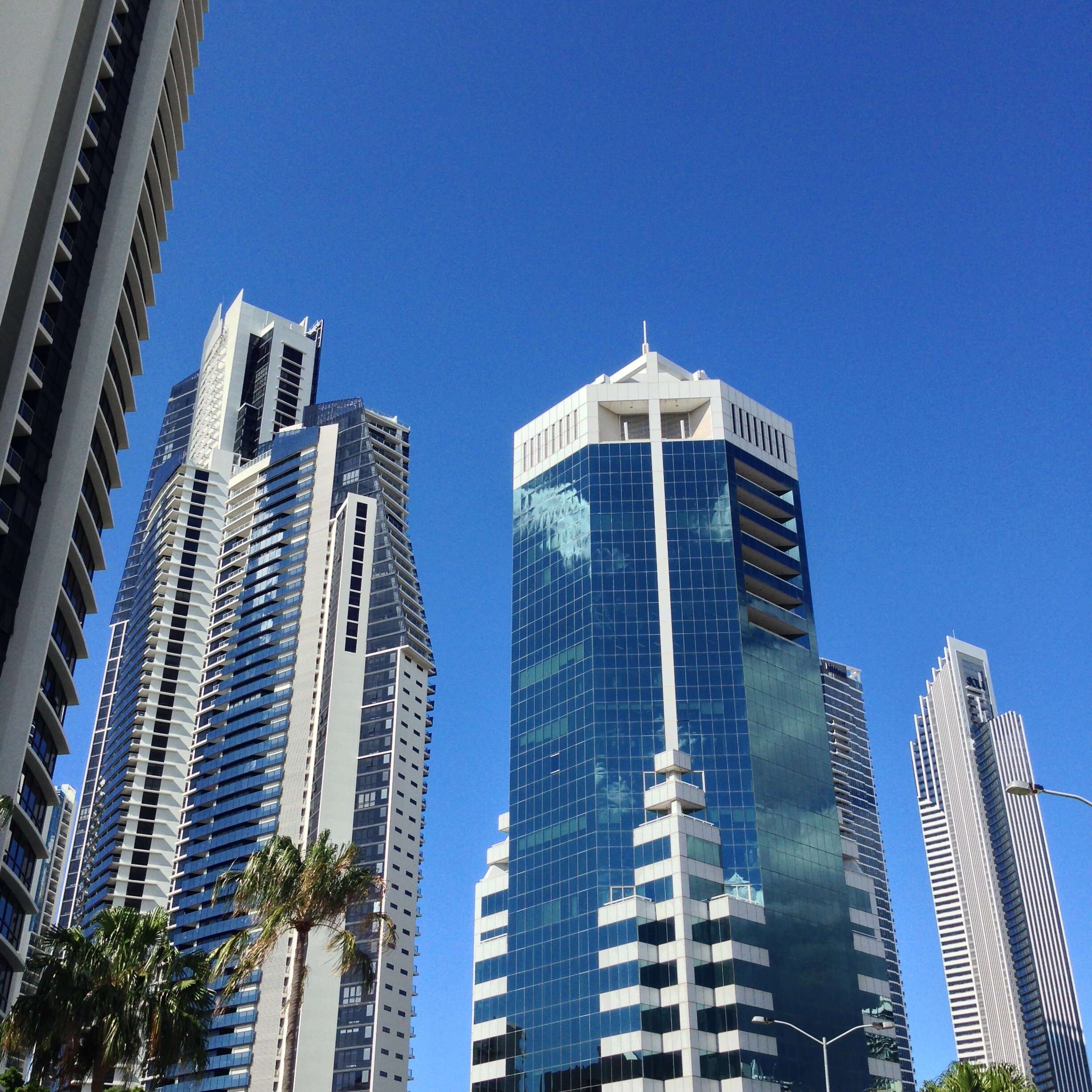
Contrary to the piecemeal decay of public space, the 2011 foreshore upgrade between Laycock Street and View Avenue created a pleasant, unifying and enduring improvement that has perhaps saved Surfers Paradise from more serious demise.

UNCERTAIN TEENS

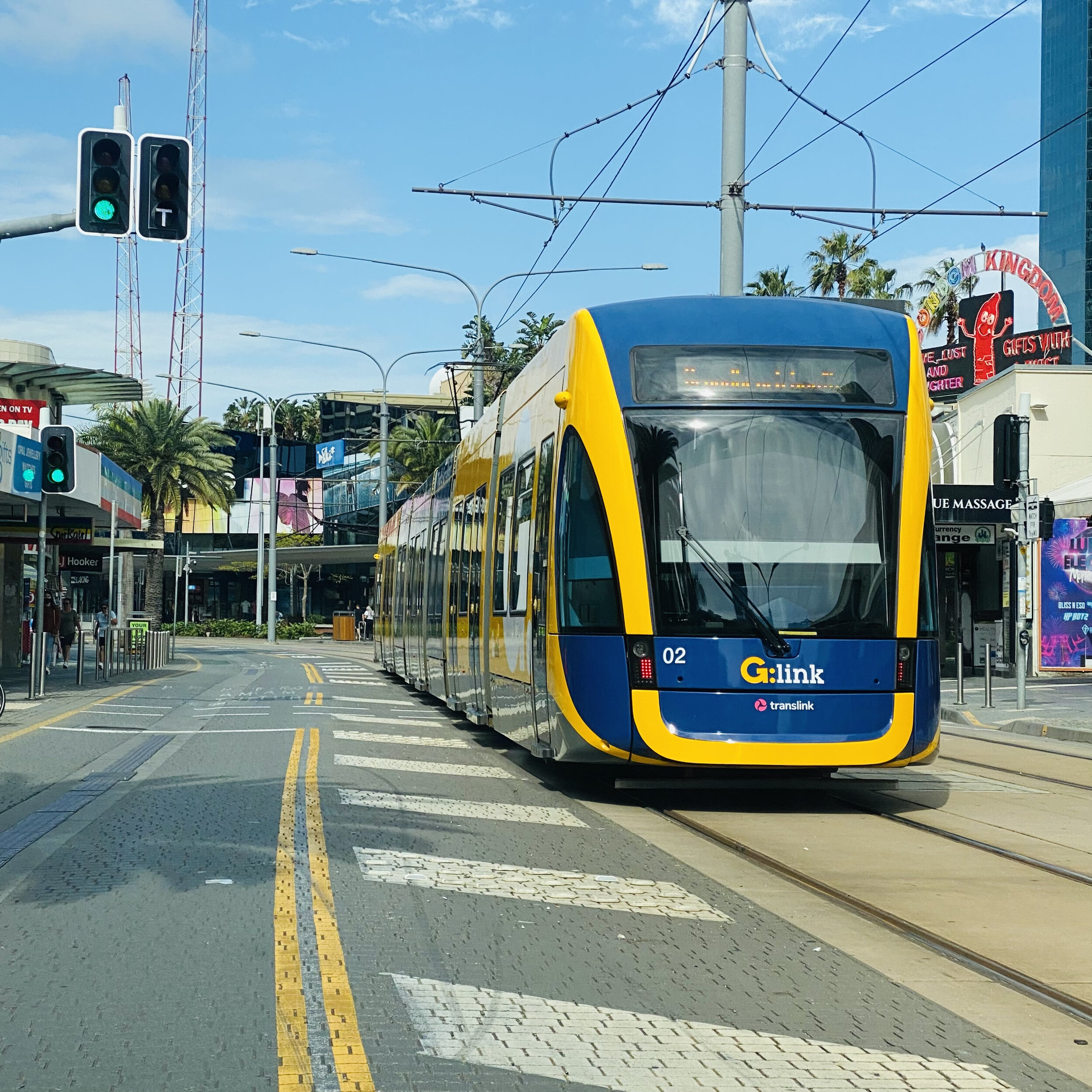
For much of the past decade, while the rest of the Gold Coast has burgeoned, Surfers Paradise stood still. Disruption caused by light rail stage 1 during 2012-14 was an almost terminal event. The light rail route was switched late in the project, from Ferny Ave to Surfers Paradise Boulevard, resulting in a scar through the heart of city, elimination of street parking spaces and irretrievable damage to the ambience and ease of the place. 

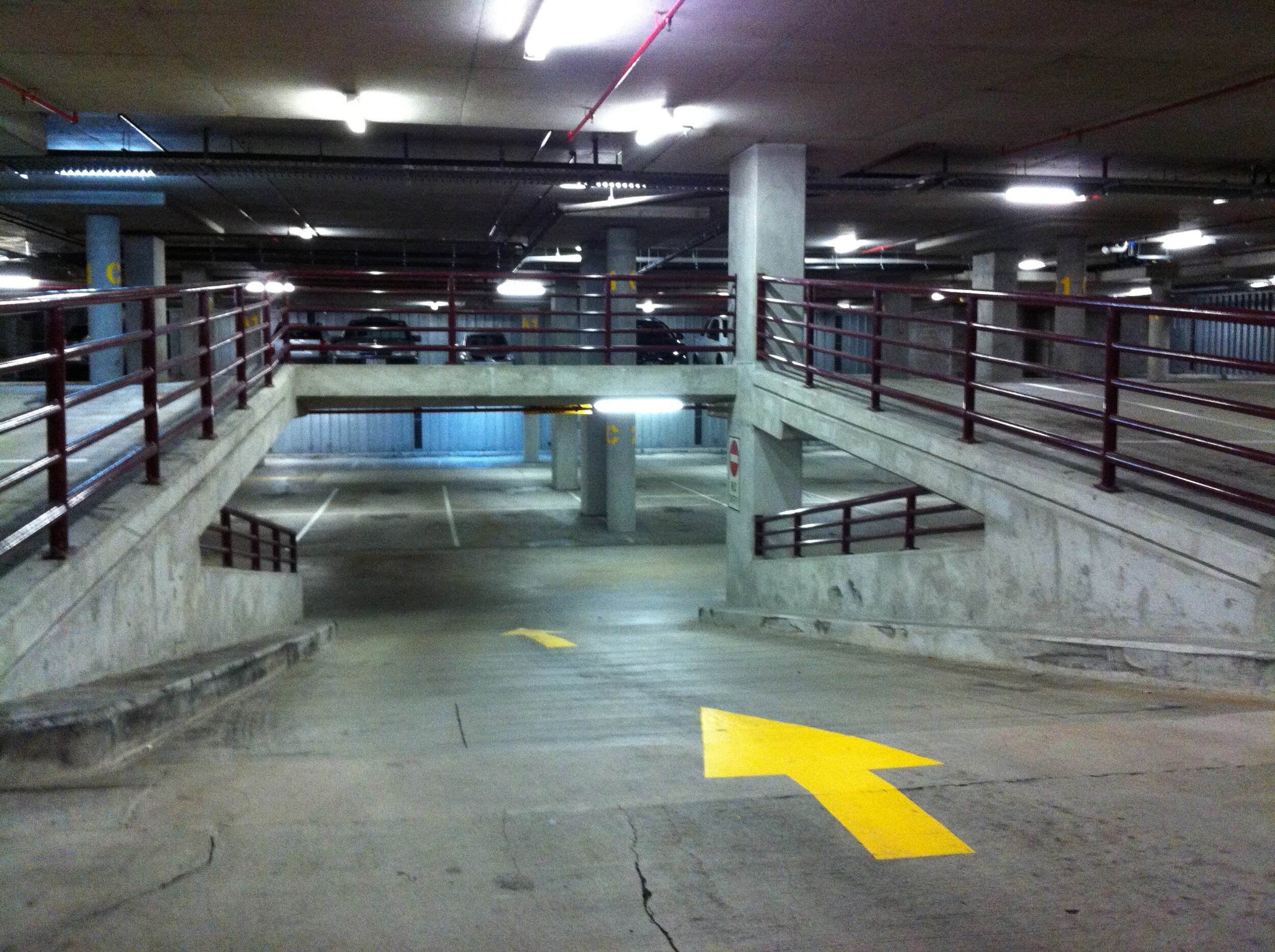
While the difficulty of car parking is often cited as a deterrent for locals to visit Surfers Paradise, basement car parking capacity of many buildings in Surfers Paradise is only ever filled during peak holiday periods, however no attempt has been made to liberate these vacant spaces for public and visitor use.

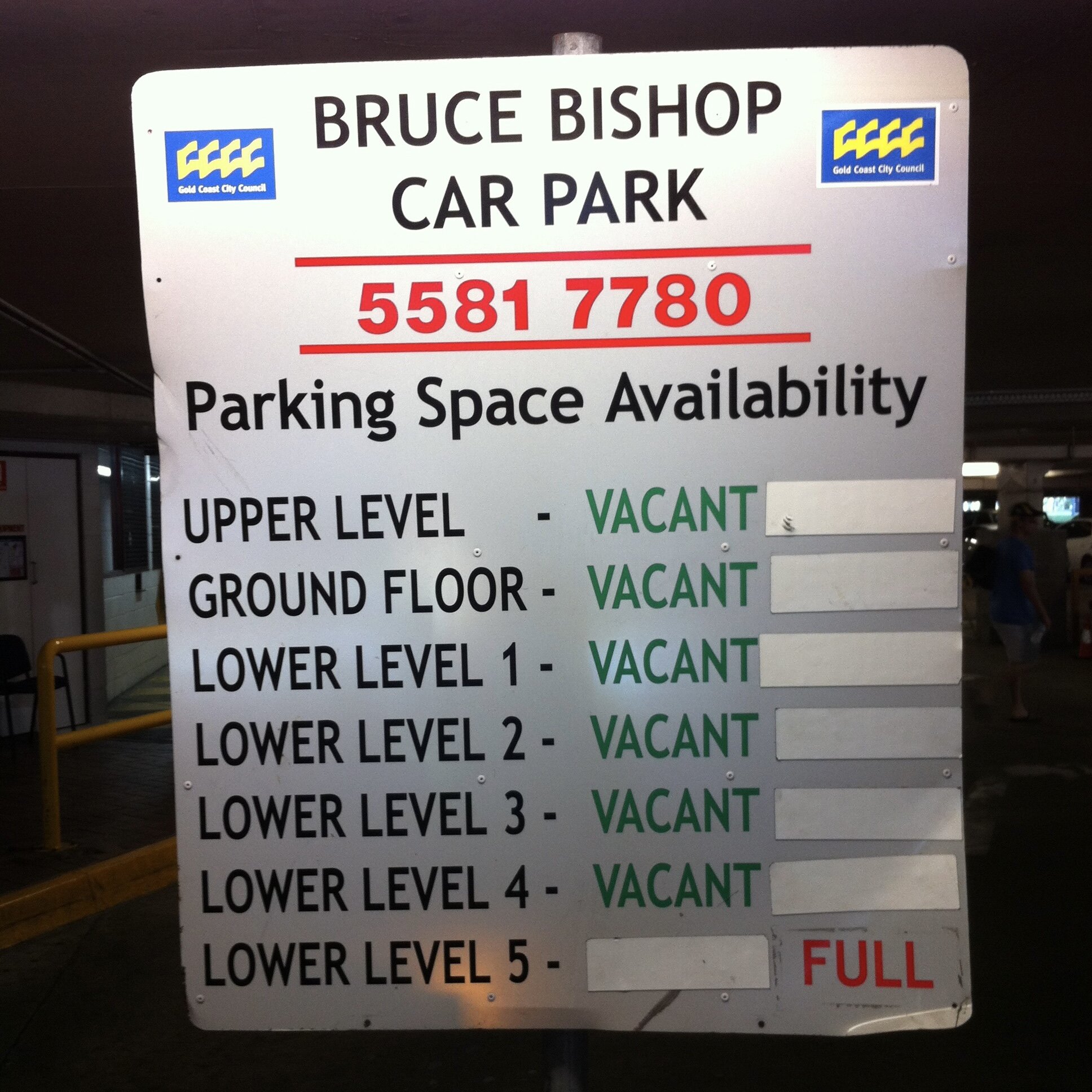
It is likely that Bruce Bishop public car park, with cheap parking fees, has never been filled to capacity. Underground levels 4, 5, 6 and 7 have rarely been opened. In 2015, the council erected digital billboards to attract more users but little else has been done to make entryways to the car park apparent and appealing. In 2017, the council controversially decided to sell the car park and adjacent bus transit centre to fund development of the cultural precinct (HOTA) at Evandale. The car park is still operating, so the impact of this decision remains to be seen if a commercial development proceeds with reduced spaces and increased parking fees.

A new City Plan in 2016 did away with Local Areas Plans across the city. It also ushered in a change in vision for tall buildings. Instead of slender, articulated towers with landscaped gardens, the new trend was for more serious style towers as seen in Manhattan, flush to front boundaries, and with shop or café spaces at ground level. The idea being to increase population densities and enliven streets with the buzz of people dining in sidewalk cafes and shopping.

For more on the evolution of Gold Coast tall buildings see: The view from up here: changing visions for the Gold Coast and Living High Instagram Gallery

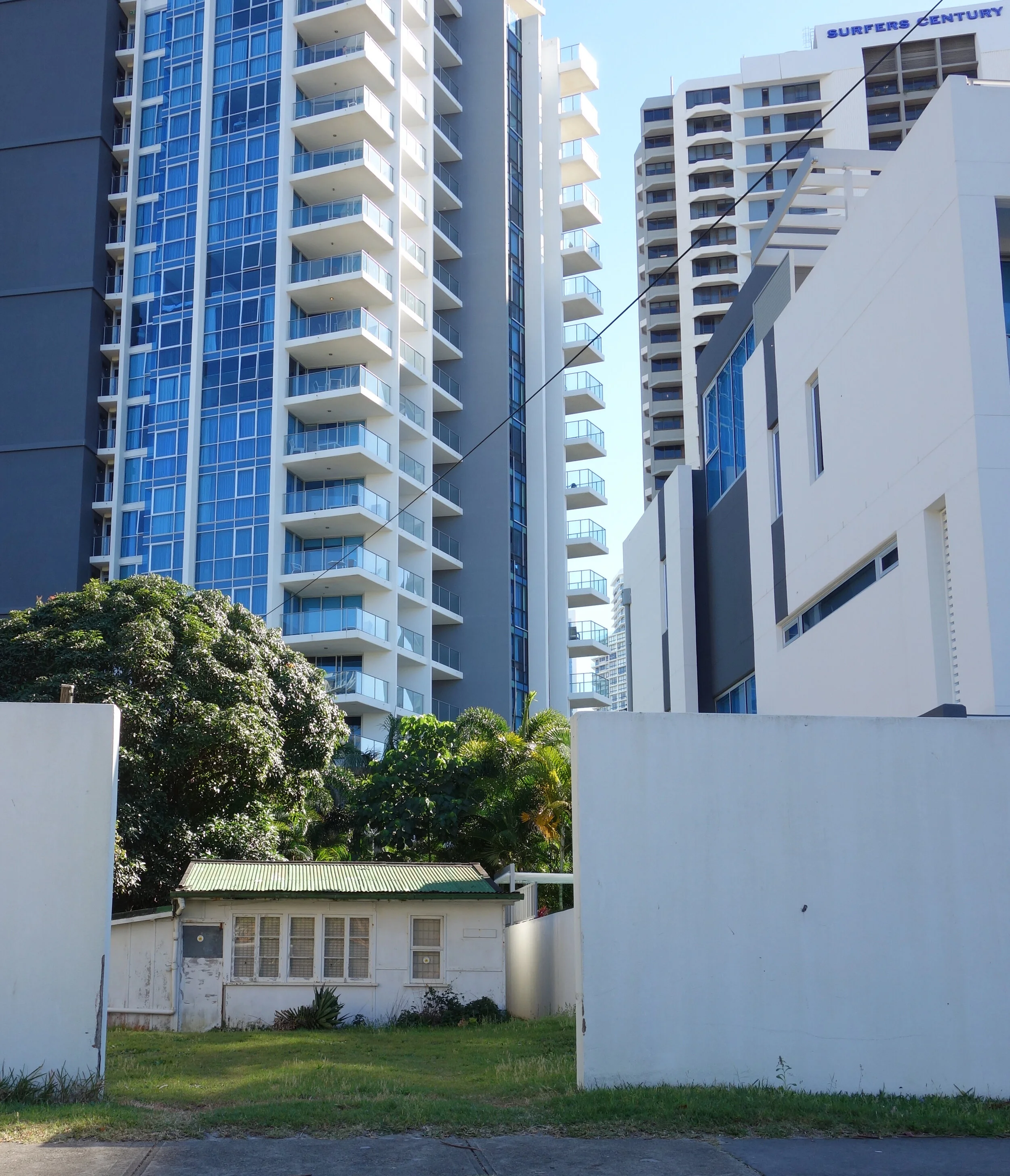
Deregulation of highrise building design has supercharged speculation and development activity along the coastal strip with a new breed of colossal buildings above multi-level podium car parks on very small sites. In Surfers Paradise today there is no height limit or Impact Assessment requirement for new buildings, which means that applicants do not have to give public notice, proposals are assessed for performance against rubbery design criteria, and third parties cannot submit objections or appeal council decisions.

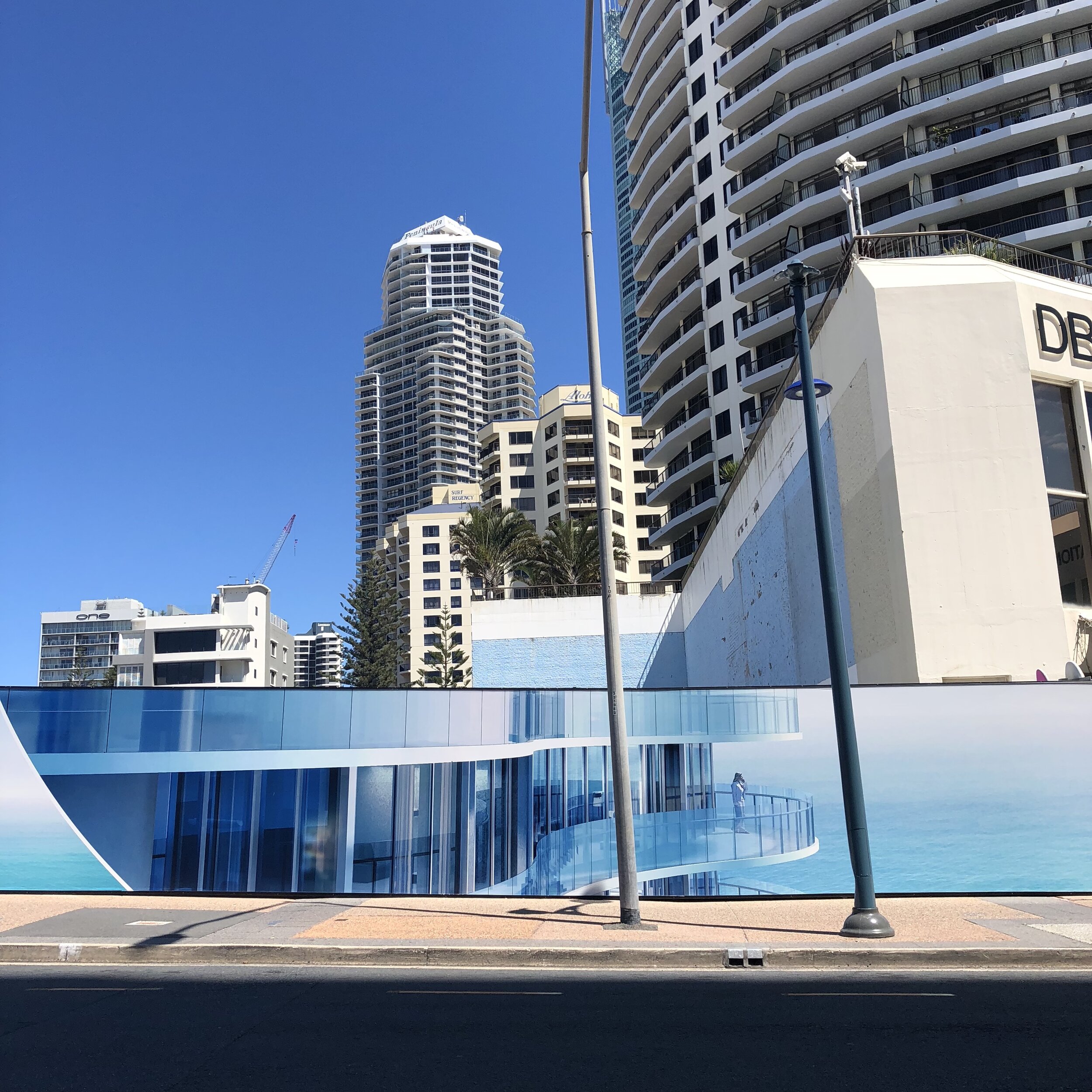
Impression of Ocean, 84 The Esplanade, Surfers Paradise, Congratulations to the graphic designer who succeeded admirably in representing a 300m high building on a 2m high hoarding. Photo by author, March 2018

Impression of Ocean, 84 The Esplanade, Surfers Paradise, Congratulations to the graphic designer who succeeded admirably in representing a 300m high building on a 2m high hoarding. Photo by author, March 2018

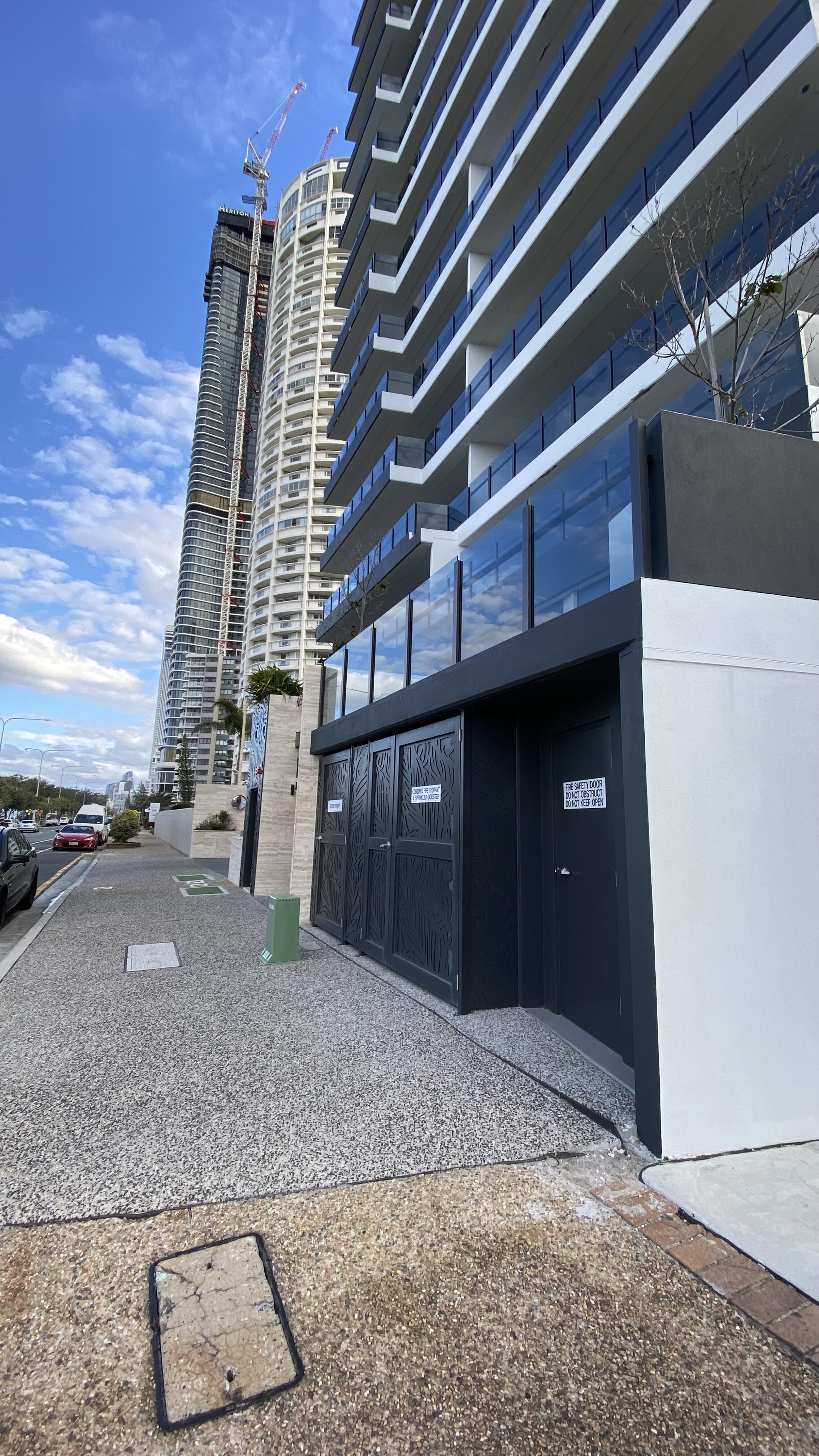
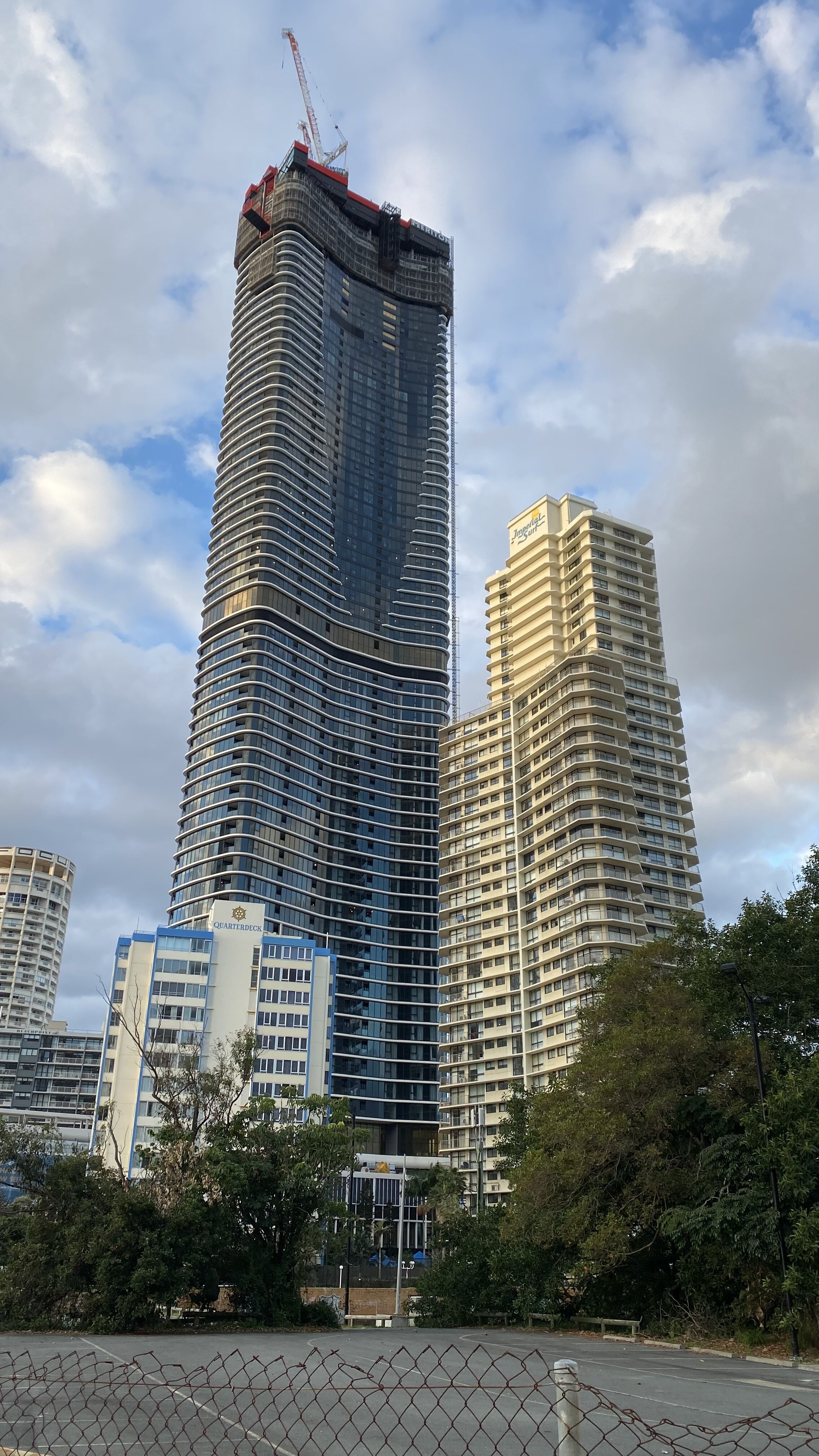
A profound impact of this change is that the council no longer demands provision of ground level greenery. Communal open space areas typically consist of a lap pool, barbeque space, sun lounge and potted plants, but high above ground level on top of several storeys of podium car park, barely visible, if at all, from the street. Boundary setbacks are zero to negligible. Neighbouring properties, streets and in many cases, the beach, are shadowed for much longer periods. Dark-tinted glass facades, with few or no external balconies have become the norm for buildings above 15 storeys. These create windshafts and funnels with uncomfortable gusts at street level. To experience this phenomenon, try walking down Old Burleigh Road past the three towers of Jewel, or the 76 storey Ocean building nearing completion on The Esplanade, even in a light breeze. You will not want to do it again, if you can avoid it. At the ground level, commercial spaces incorporated to generate activity on streets, sit empty.

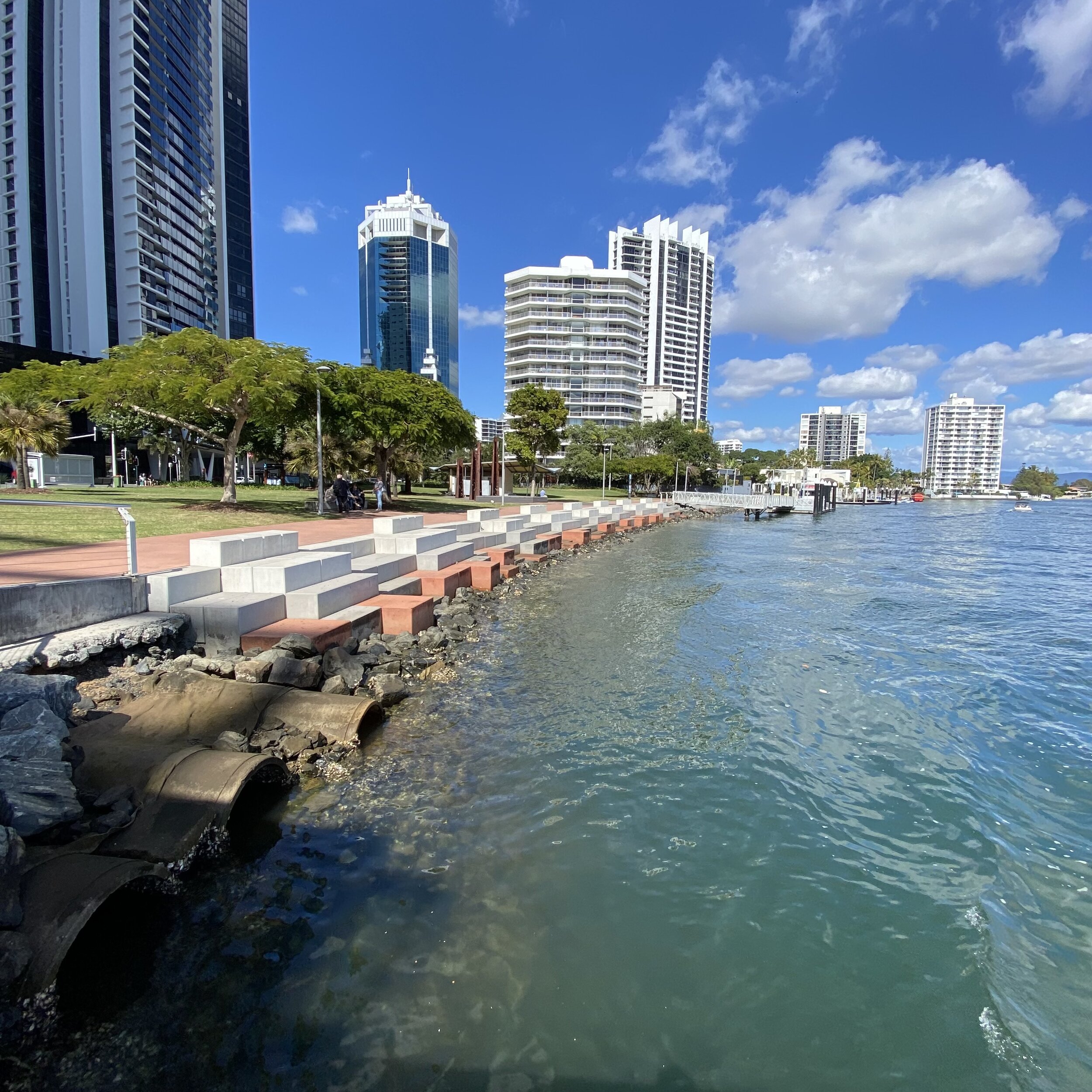
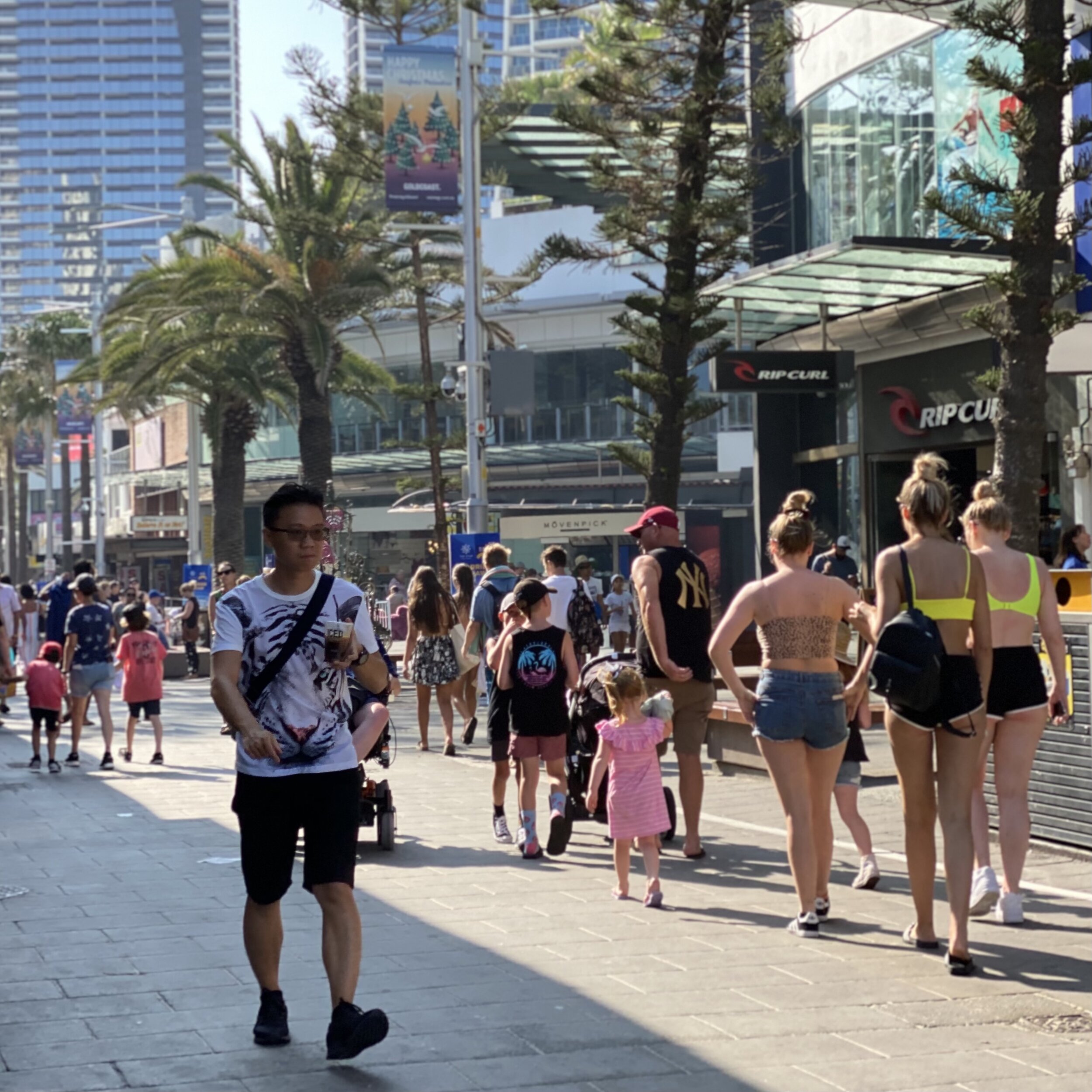
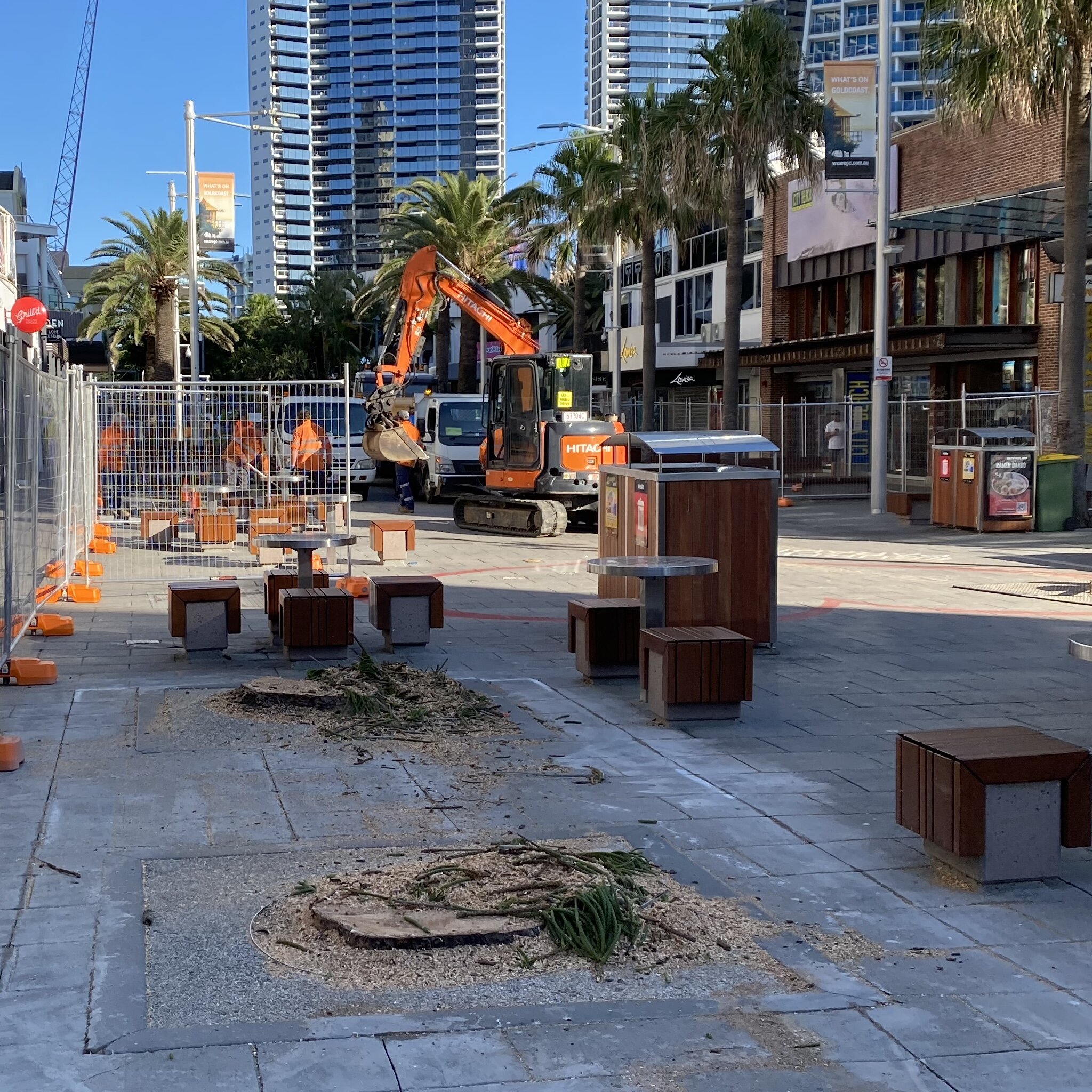
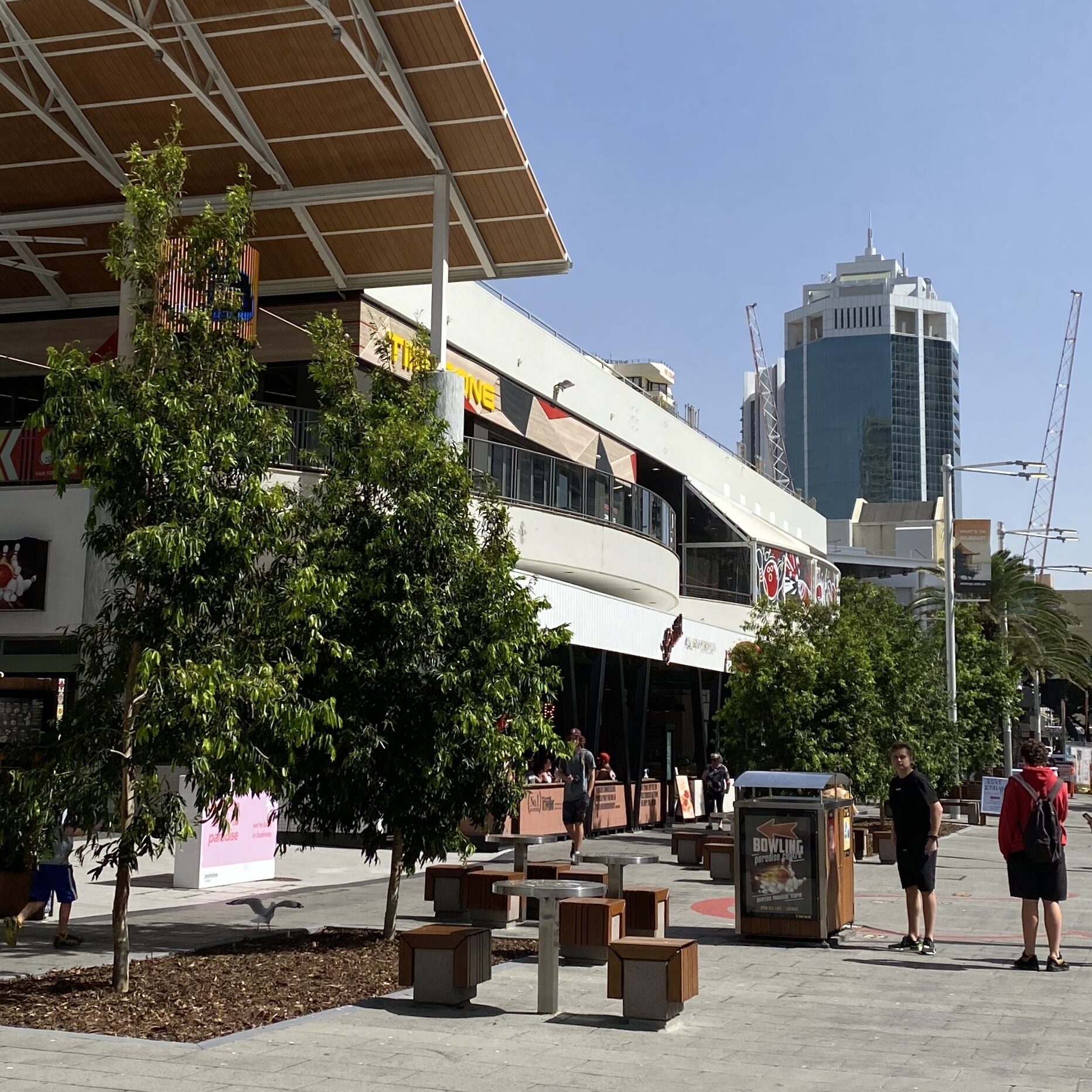
Recent public realm projects in Surfers Paradise have been a hotchpotch of disparate works and installations. A utilitarian reinforcement of the river edge and replacement of the public pontoon for the new Hopo ferry service tidied up the riverside of Appel Park. There has been significant investment in security camera systems and digital billboards. There has been more removal than planting of street trees, including the distinctive row of Norfolk pines in Cavill Mall that had been left to wither through successive hard-paving and bitumen makeovers. Fairy lighting was installed on almost every remaining tree. And then more fairy lighting. And then more, to the extent that it now looks like Christmas over 365 nights per year, and like too much cosmetic surgery, the sparkle and glow only serves to highlight the state of deterioration.

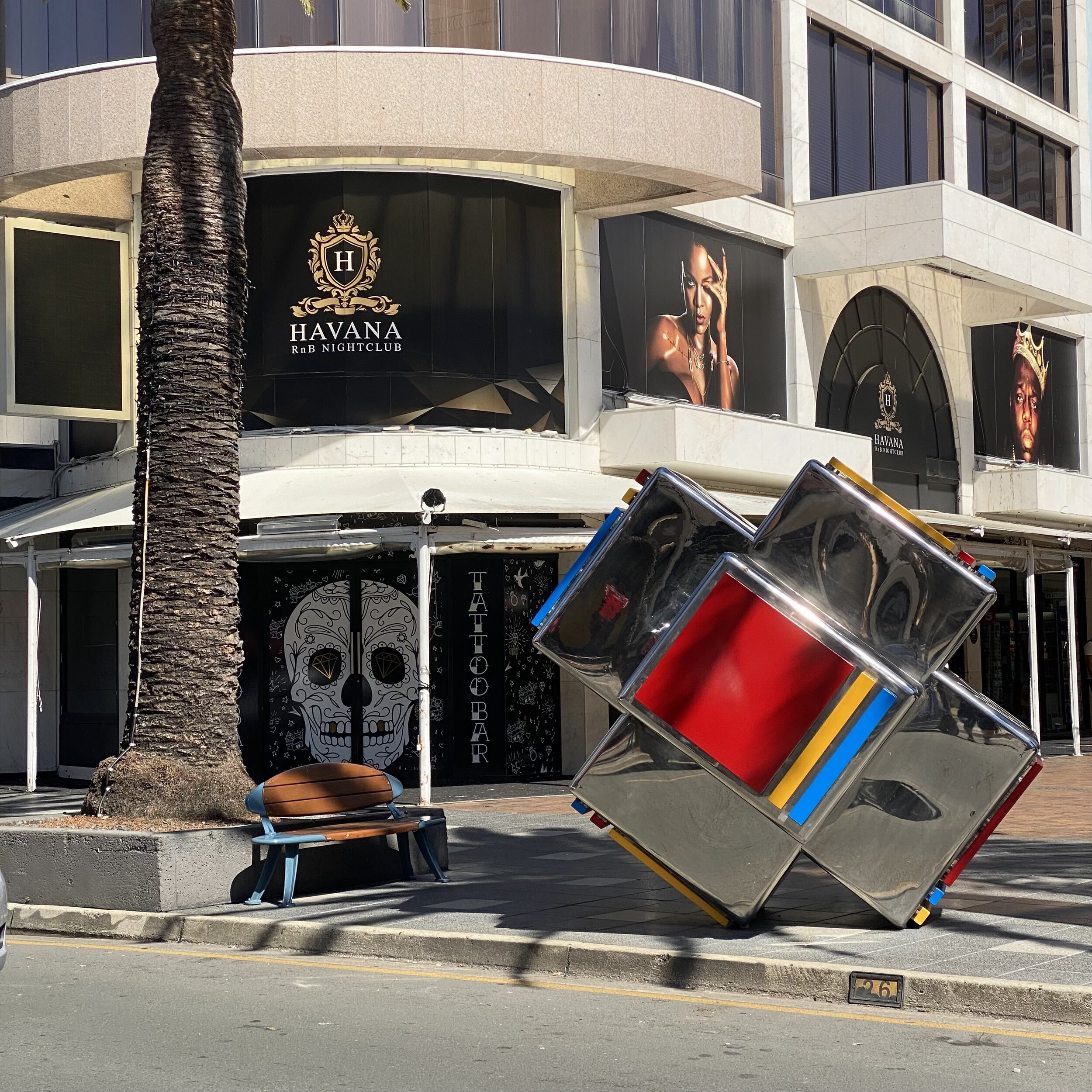
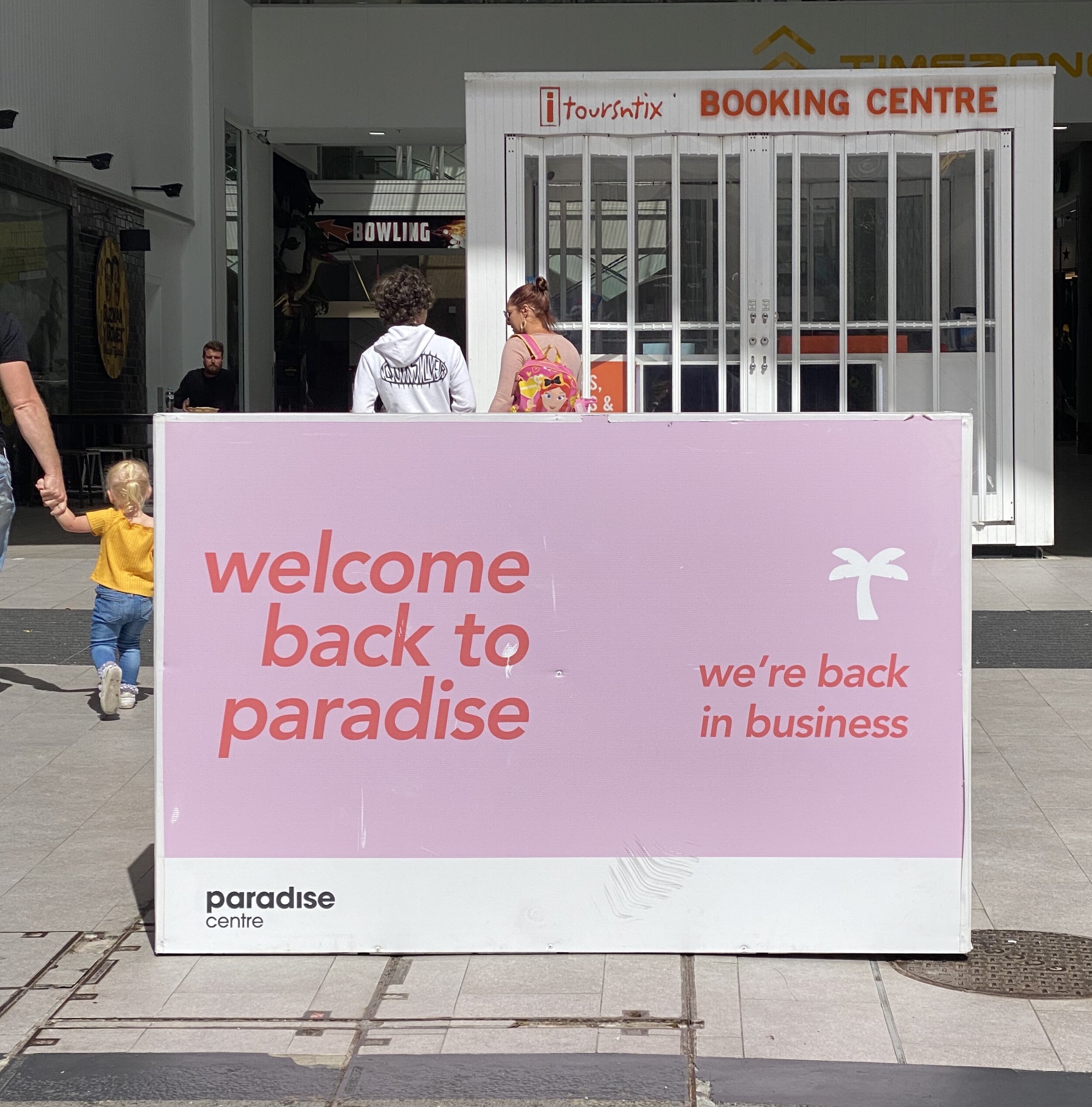
Re-brandings and tourism promotions, and a variety of festivals and events have been staged to activate the precinct. The Commonwealth Games came and went in April 2018, however the residual legacy is a red fibreglass sculpture called The Spectacular.

In May 2019, Gold Coast Bulletin featured an opinion piece Why Surfers Paradise should be next in line for a serious upgrade. “It’s beautiful and iconic, but Surfers Paradise could badly do with a facelift. And there’s one simple way we could transform the area… Here’s a thought for starters. What if the road between the Soul roundabout and Hanlon Street in Surfers Paradise could be done away with, and the area transformed into a large piazza for outdoor dining? …It could be a way of bringing dining to the beach’s edge, while revitalising a famous area that is need of a fresh sugar hit.”

Prior to the 2020 council election, a review of local government boundaries took many people by surprise by annexing Broadbeach with Surfers Paradise into a new super Division 10, just as Broadbeach was ascending and competing with its own distinctive character, having historically been subordinate to Surfers.

Ahead of election, Mayor Tom Tate announced a revamp for Surfers Paradise to make it more colourful, fun and pedestrian-focused. He said, “We’re going to refresh the heart and get it pumping again.” (Gold Coast Bulletin 30 October 2019) A draft masterplan was floated to invite community input. The consultation outcomes report provides good insight into sentiments about the current state and ideas for refreshment. The most important master plan improvements were identified as:

  1. Better pedestrian connections, mobility and public safety

  2. More shade/street trees

  3. More seating/meeting and active public spaces

Around the same time, the council published a guide for podium and ground plane built form (i.e. the lower 16 metres), to encourage better design for medium and highrise developments to integrate with street level and enhance pedestrian experiences. This could have positive influence if the council incorporates it into the City Plan for mandatory application to the central area of Surfers Paradise (and Broadbeach and Coolangatta).

In October 2020, the council approved a $30 million development of more shops at the beach end of Cavill Mall. Mayor Tom Tate claimed it will make Paradise Centre a ‘showpiece’. When asked about his vision for healing Surfers Paradise’s ‘rotten heart’, he said, "You take the good, you try to fix the bad, and that's what we're doing now." Cr Tate said the city already operated more than 600 CCTV cameras, but he would like to see more CCTV and more lightning. "Whether we upgrade other areas in Surfers Paradise, I think the area councillor is looking at doing a master plan." ABC Gold Coast 28 Oct 2020. To the objective observer, it does seem like the council is buying time because they don’t know or can’t agree on what to do.

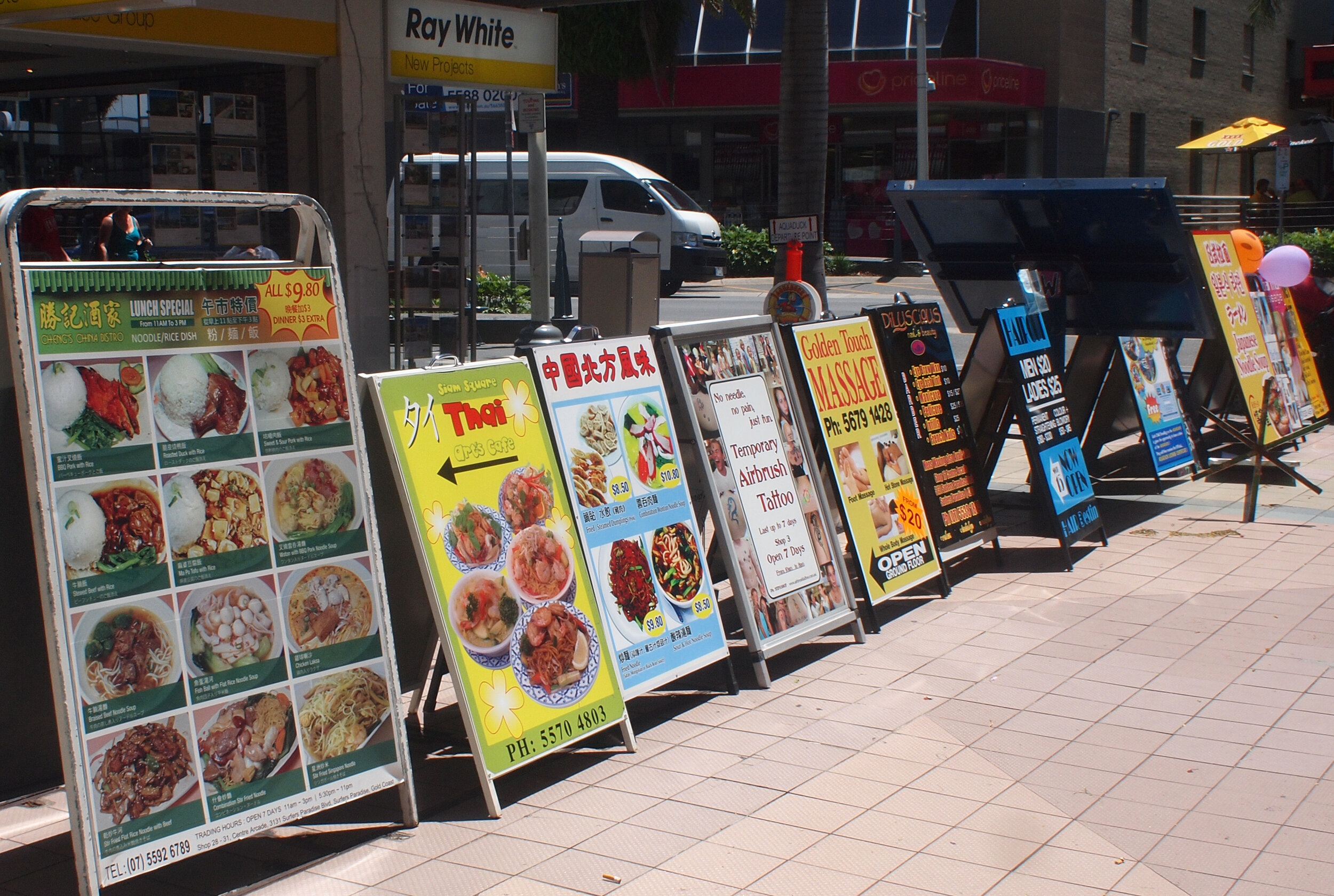
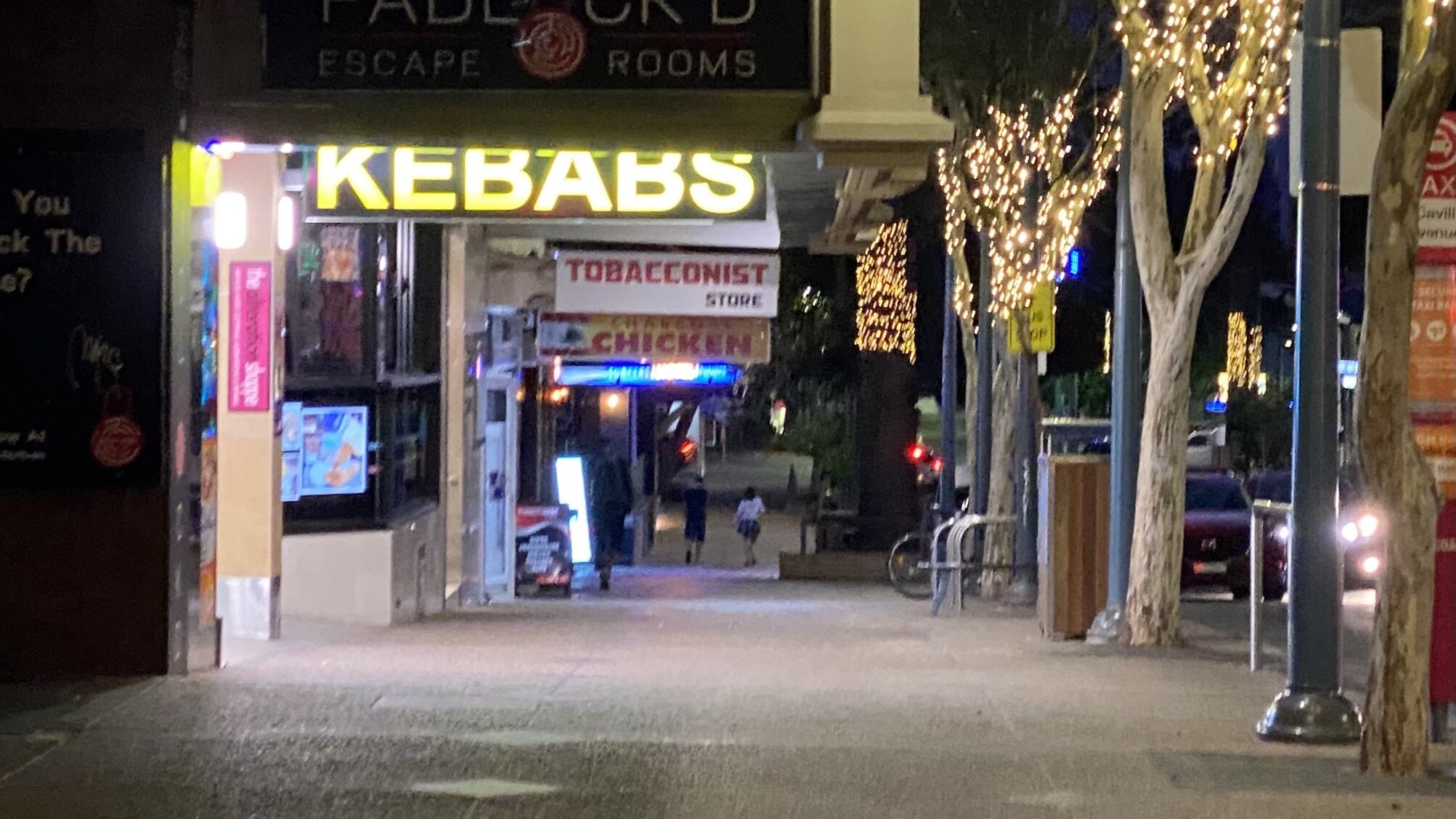
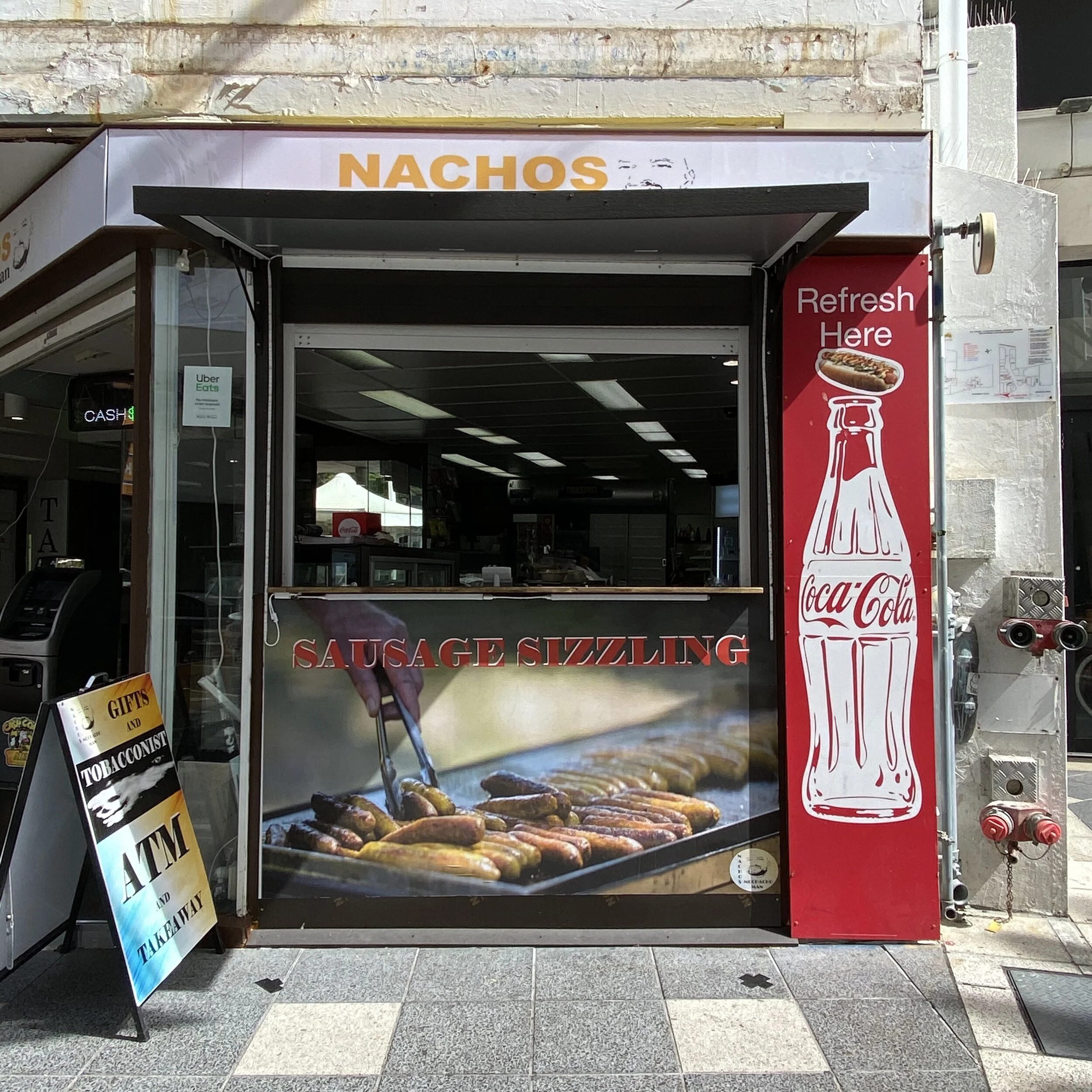
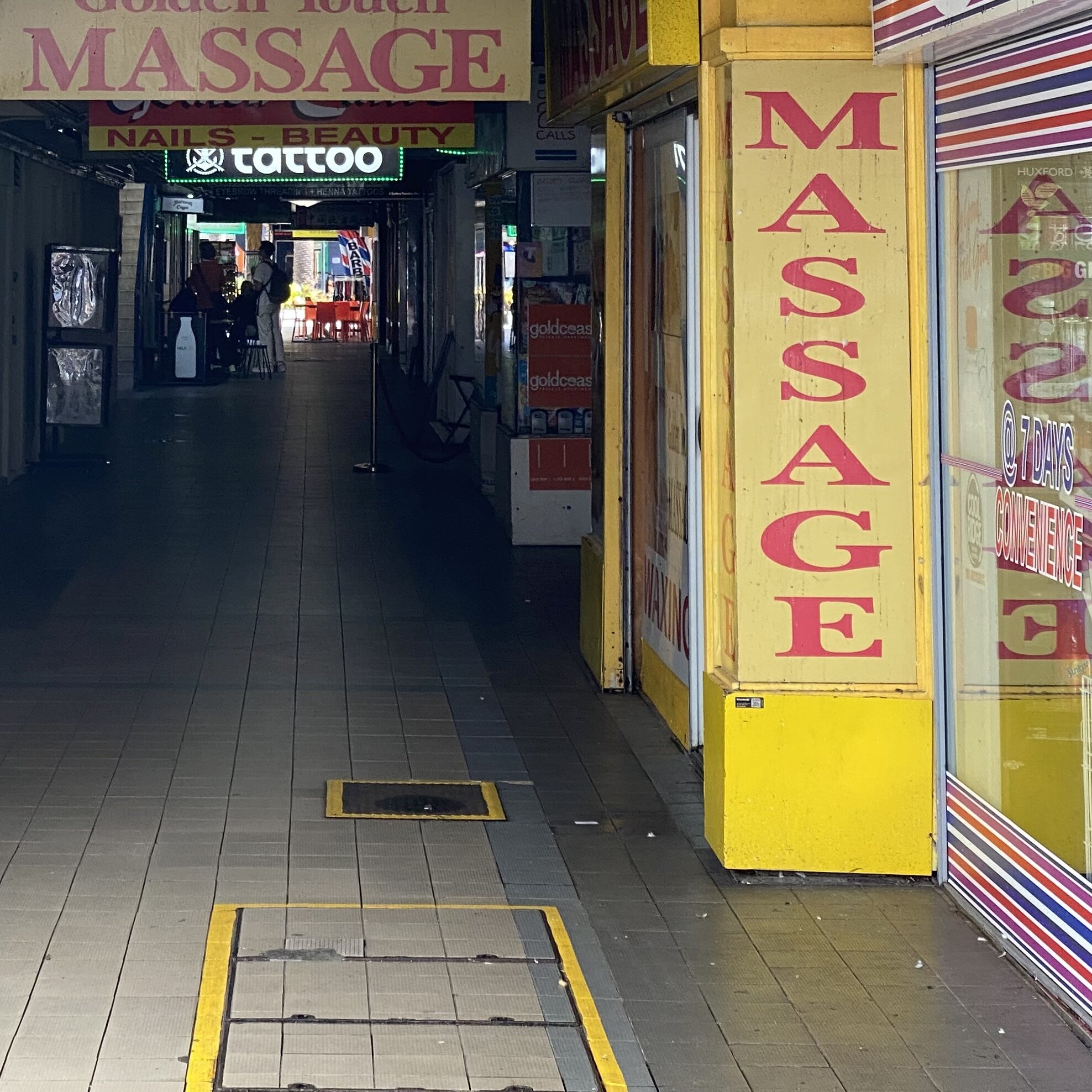
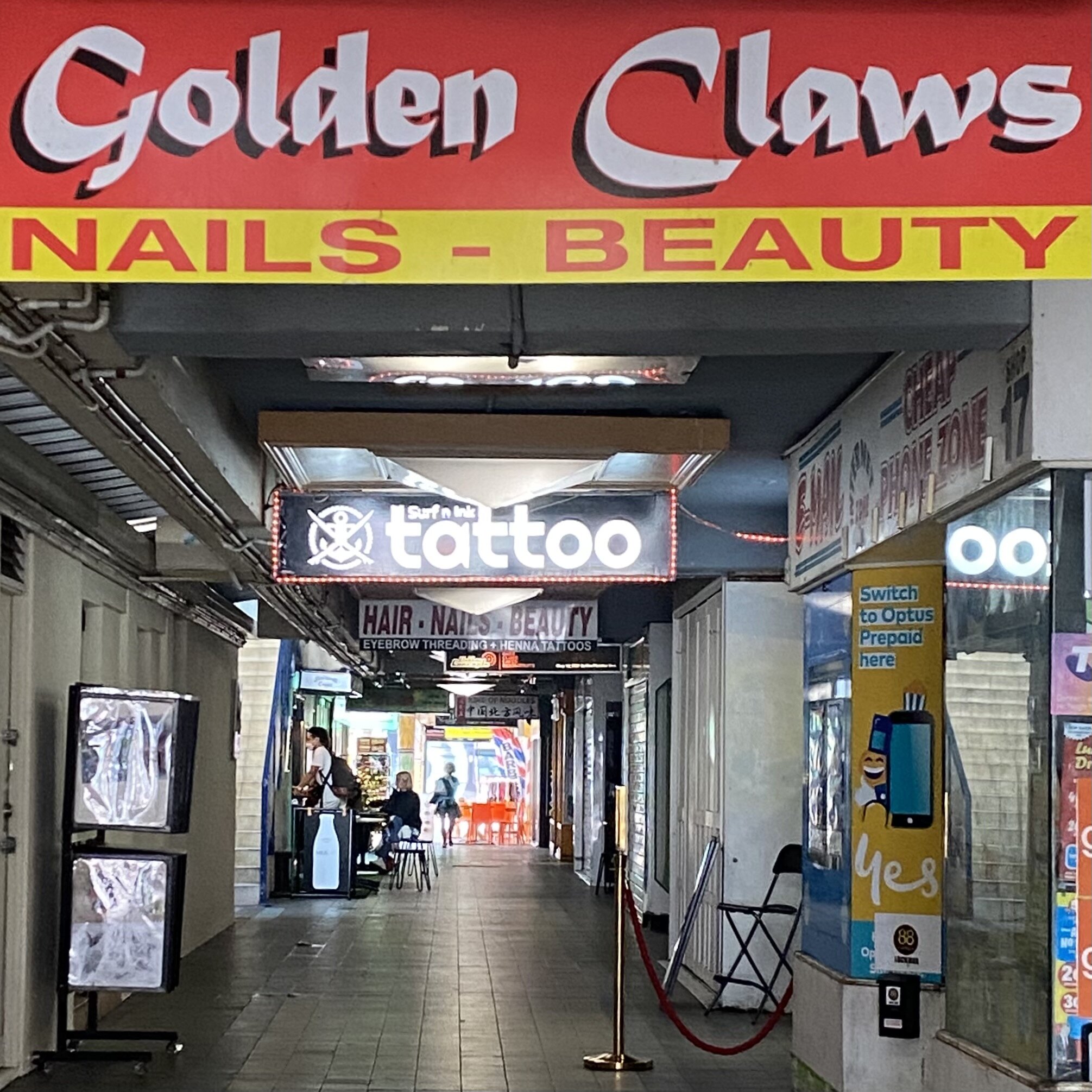
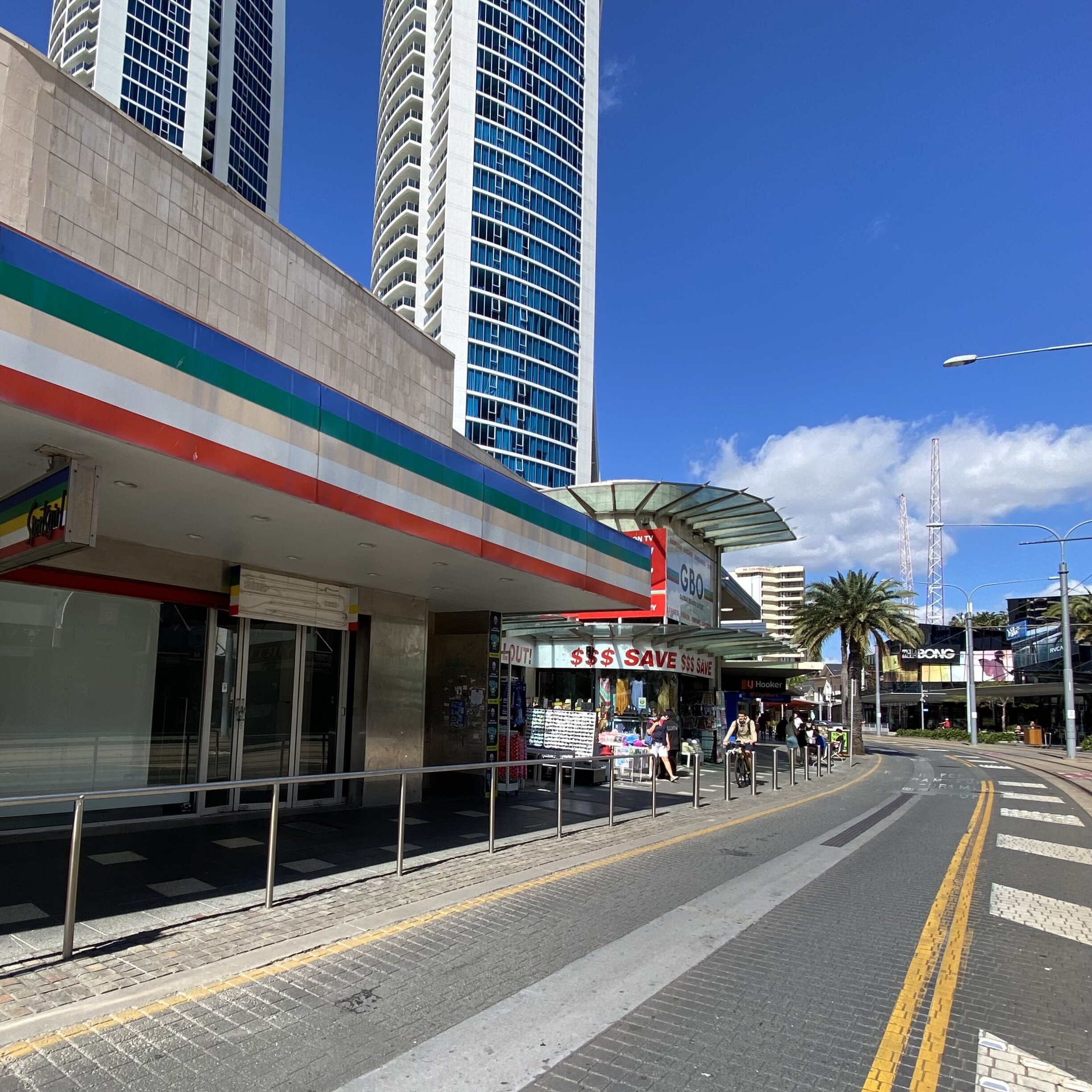
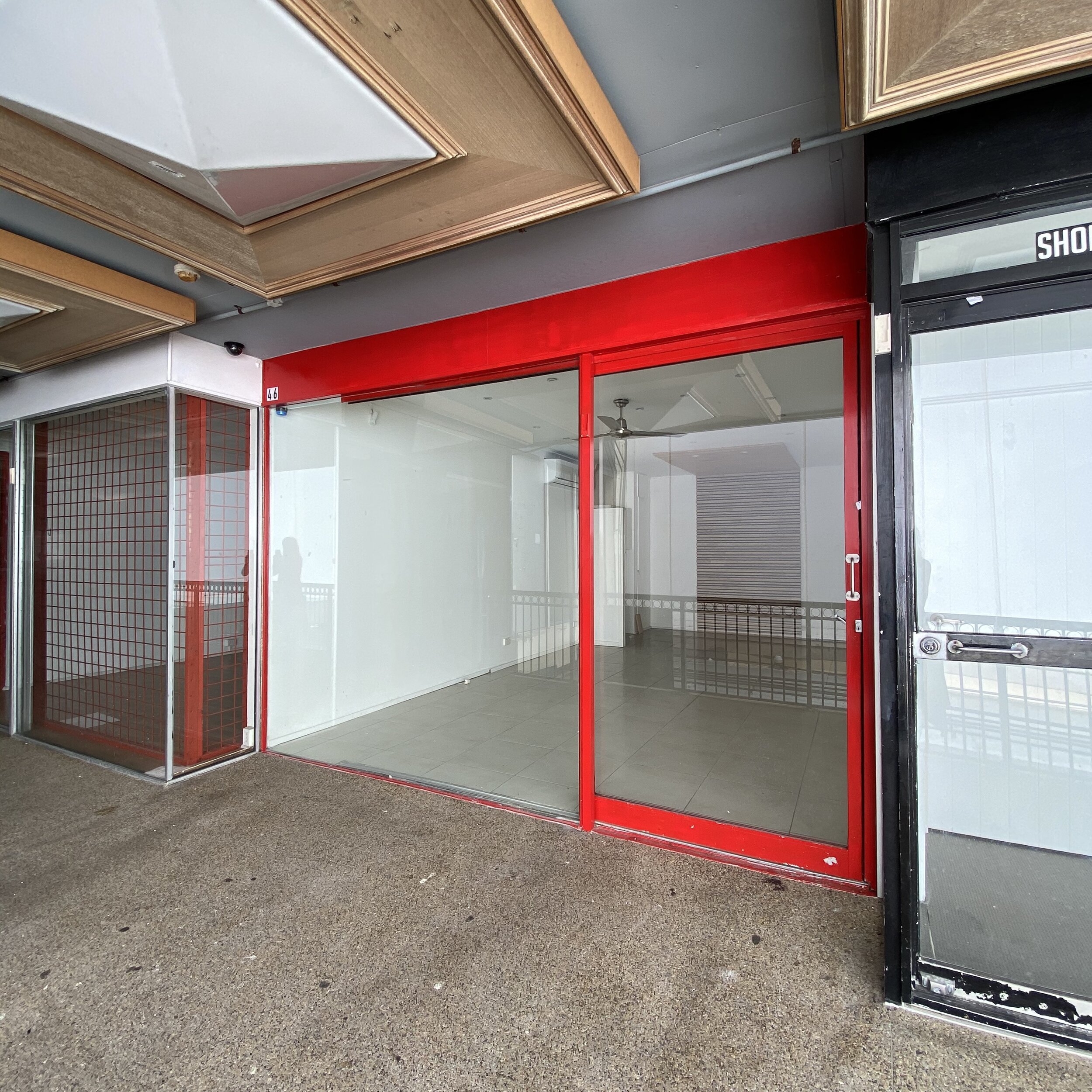
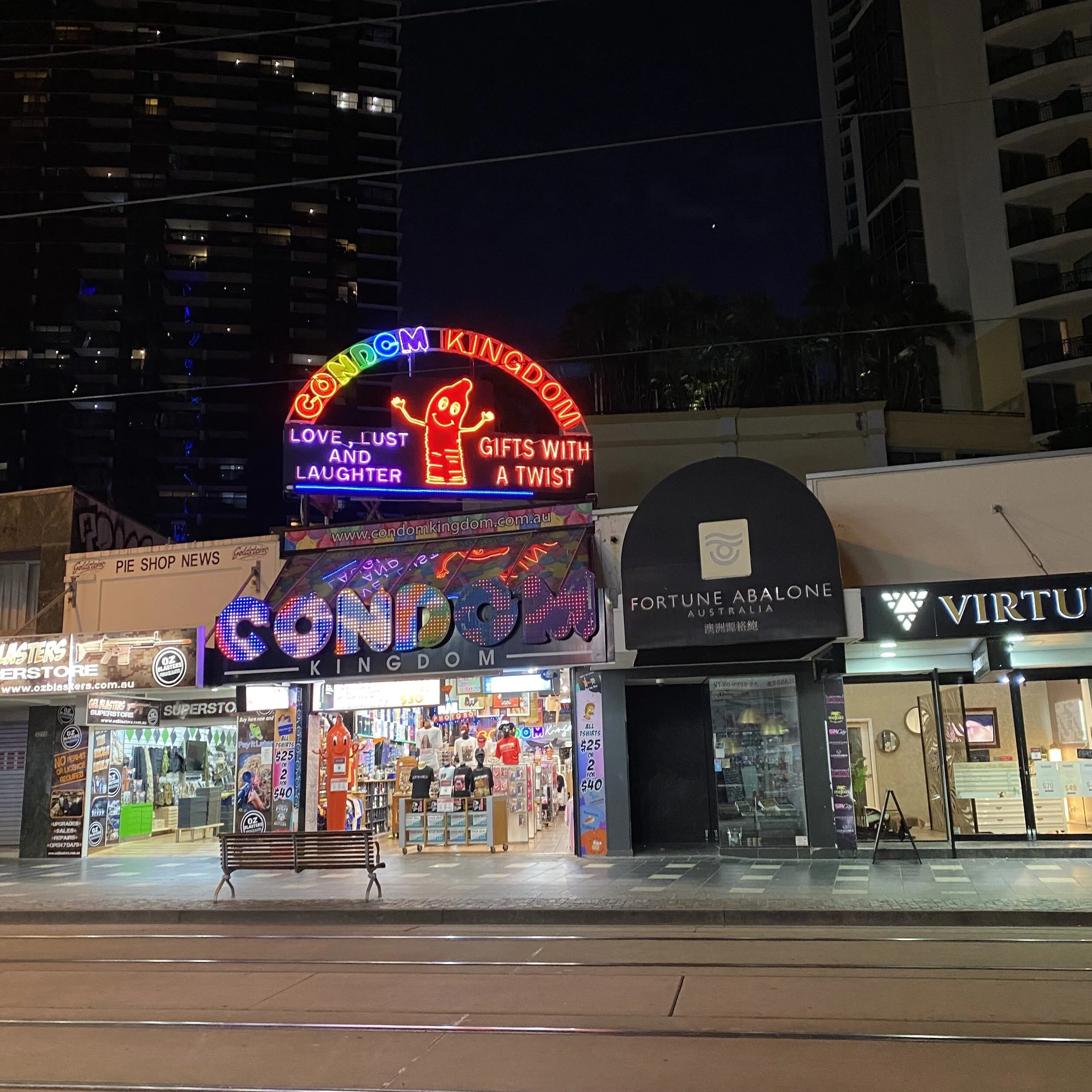
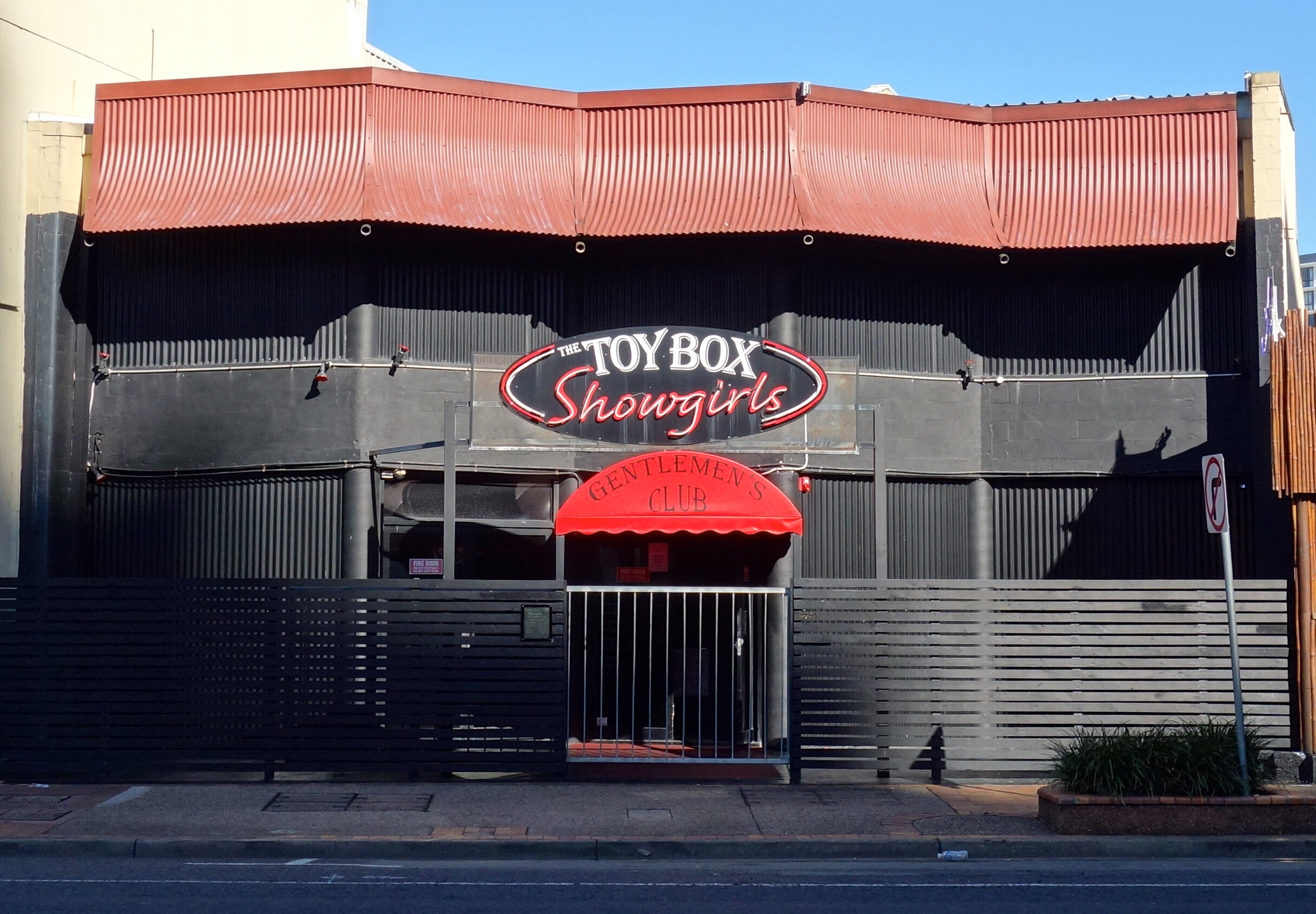
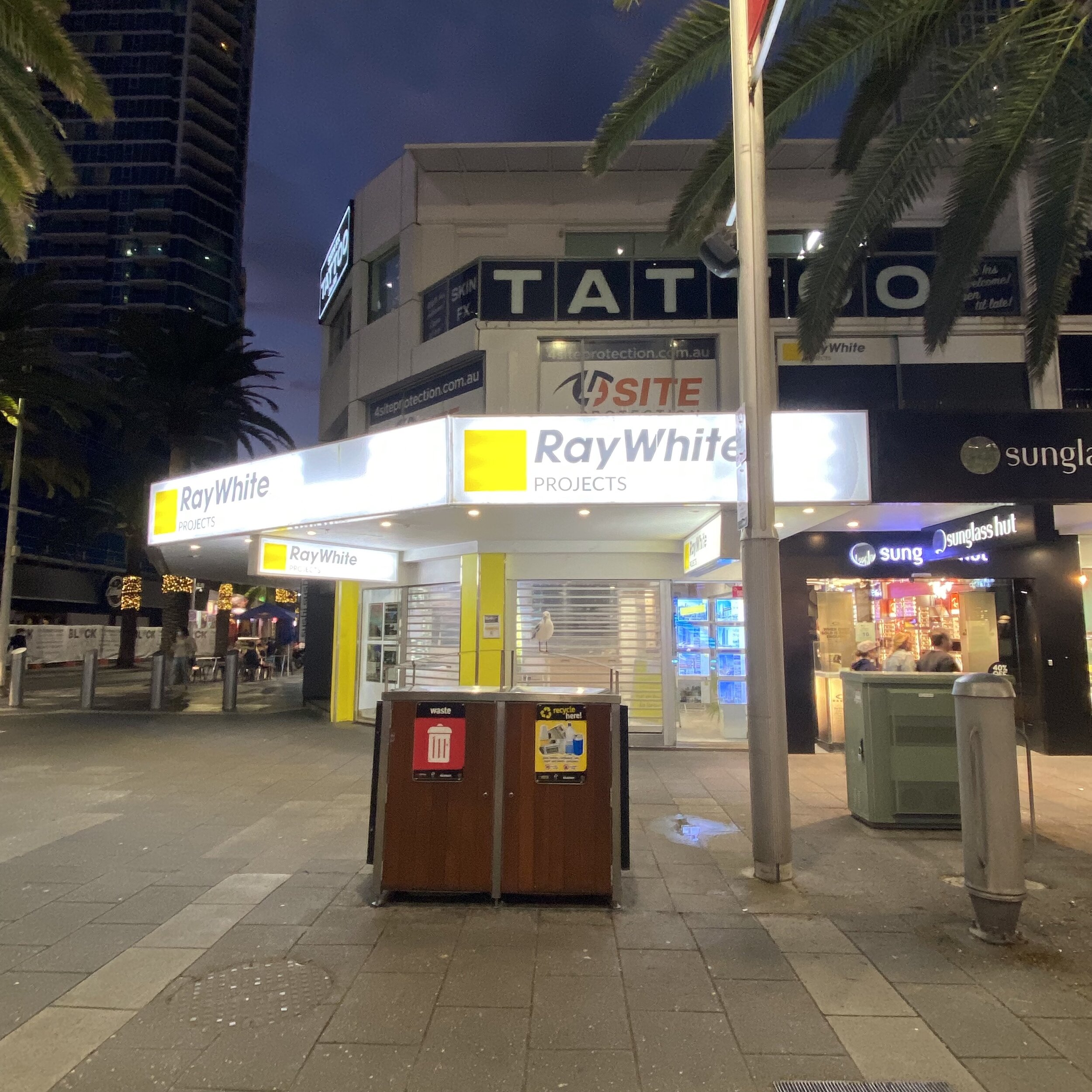
Original arcades that haven’t been subsumed by new developments feel seedy and unsafe. There are more vacant than occupied premises. The range of restaurants and retail outlets has narrowed. Kebab shops, manicure, massage and tattoo parlours predominate.

Right now, Surfers Paradise feels neglected. Conversations and social media comments reveal that many tourists feel duped, that their experiences of Surfers Paradise don’t match the promoted images. It is failing to capture return visitors and most Gold Coasters avoid it like the plague.
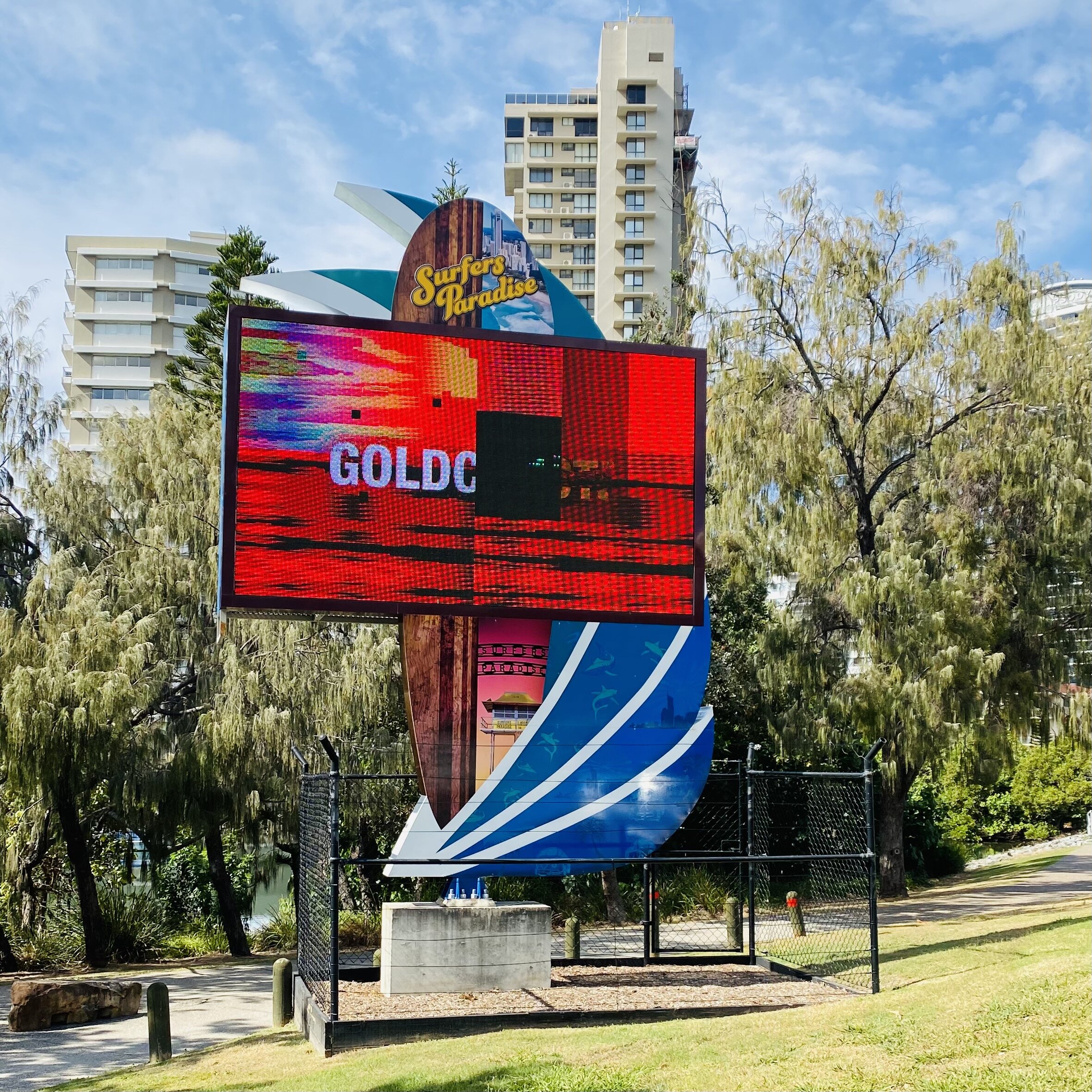
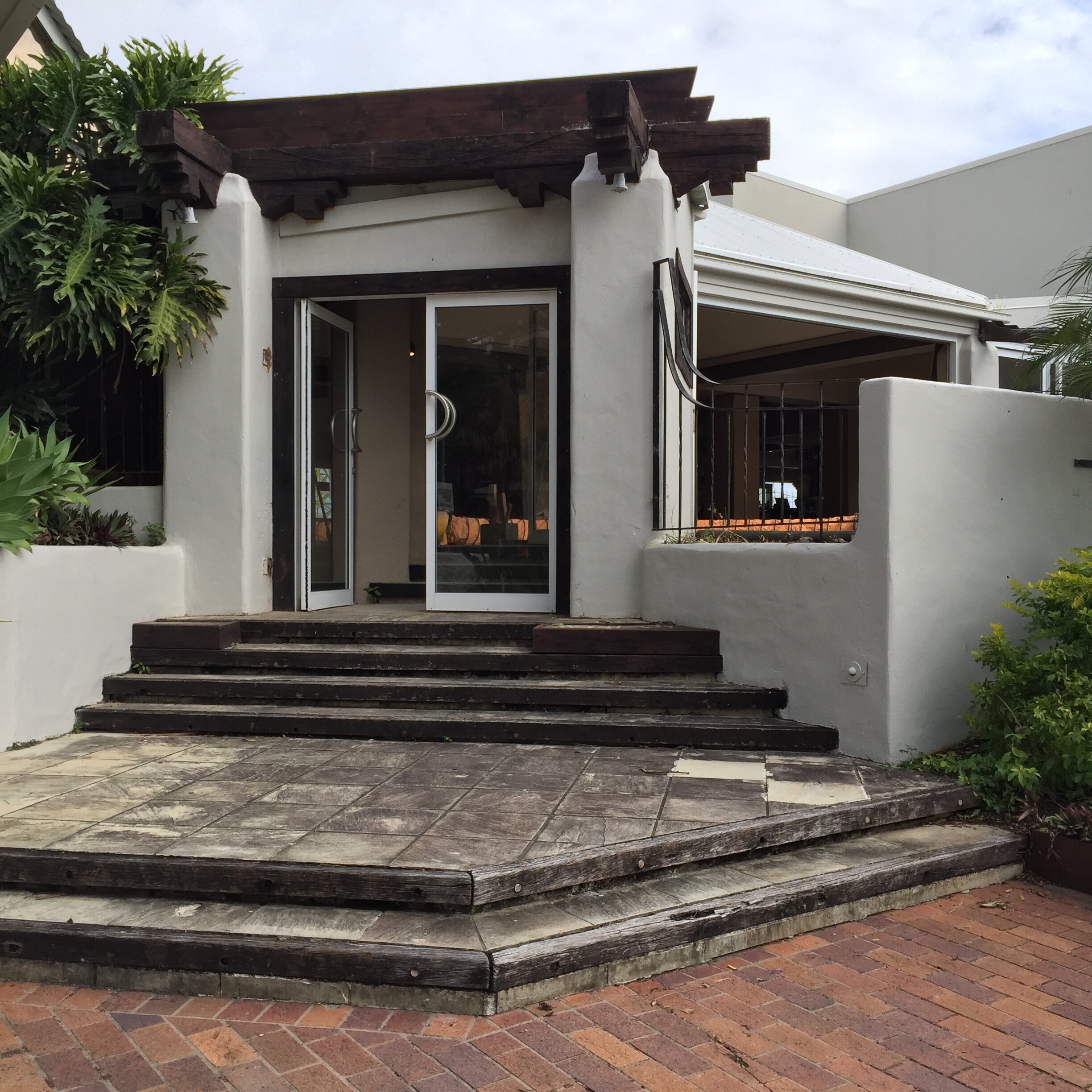
In its 60th birthday year, Kinkabool, the Gold Coast’s first highrise building, was given a fresh façade with three colours blue – a small gesture of renewal as a sign of hope that some people haven’t given up on renewal of Surfers Paradise.
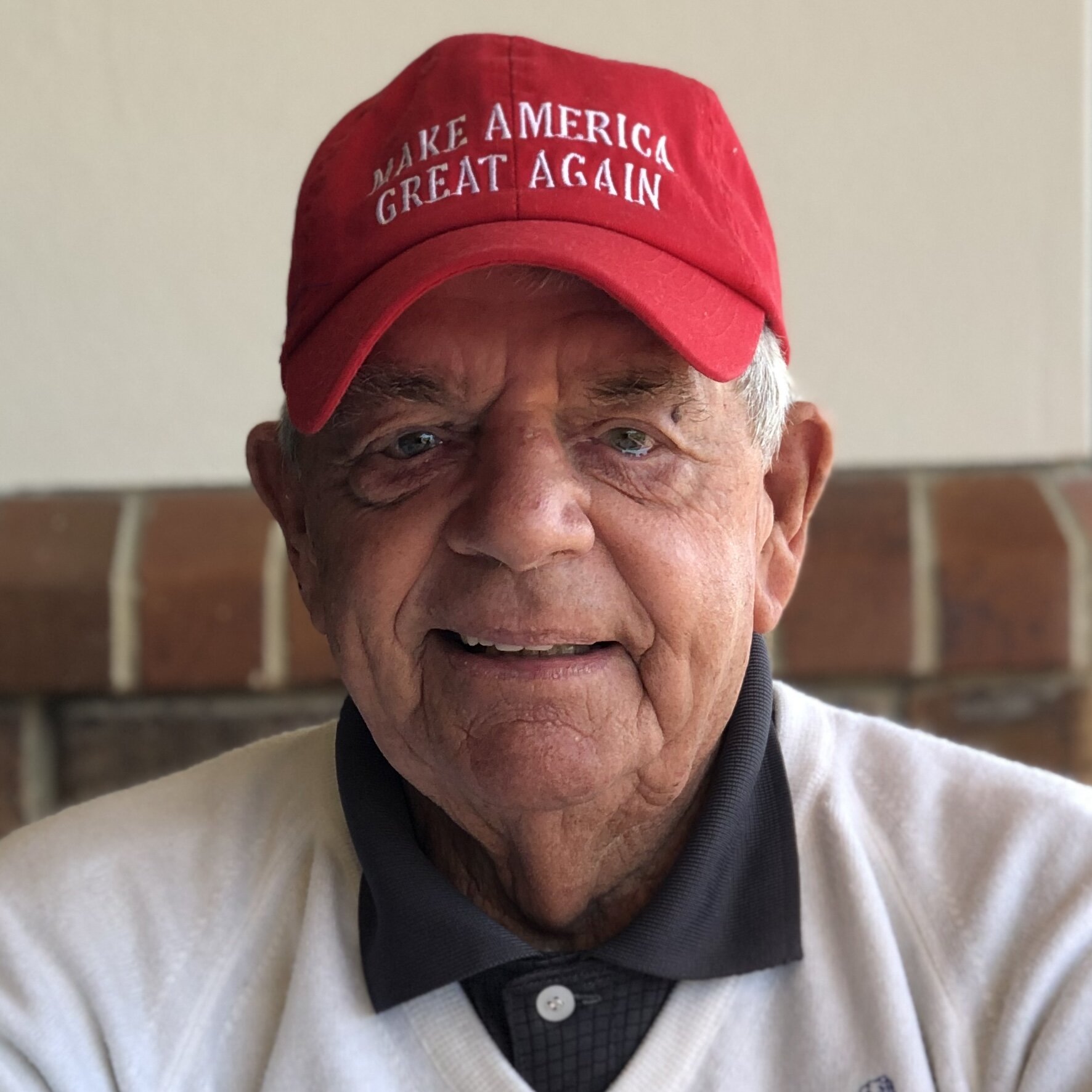
Architect, Desmond Brooks has more big ideas to make Surfers Paradise great again. Photo by the author.

Architect, Desmond Brooks has more big ideas to make Surfers Paradise great again. Photo by the author.

Opinion pieces in the last two Weekend Bulletins have pretexted a need to initiate serious tourism infrastructure projects urgently to be ready for the post-pandemic influx of holiday makers. In the first, Desmond Brooks was featured with a novel idea to close a section of The Esplanade and transform the foreshore into a South Bank-style lagoon. In the second, the columnist suggested blowing up Orchid Avenue, turning it into a Rodeo Drive specialty retail precinct and sending the nightclubs to Fortitude Valley.


HOW DO WE SOLVE A PROBLEM LIKE SURFERS PARADISE?

Surfers Paradise deserves critical attention. There is something intrinsic about this place that is fabulous and magnetic, as I recognised, even when the ‘the rot’ was setting in more than 25 years ago. In 2001, I published an Urban Design Master’s Thesis, ‘Invisible Landscapes: Interpreting the unconventional landscape of Surfers Paradise’ which distilled the essence of its image and peculiar cultural identity. My research showed how the Gold Coast is physically, socially, economically and politically unconventional when compared to other cities. And that Surfers, the tourist heart of the city, was the most potent distinguishing feature of this strange paradise.

With waning popularity and a conspicuous covid-caused absence of international tourists, now is an opportune time to set a path to a new destiny. Instead of shooting from the hip with tourism infrastructure projects aimed to fix Surfers in one shot like a silver bullet, I’d like to see a different mindset and new mobility, garden and community-centred approach that concentrates on making Surfers great for Gold Coasters, with a confidence that if locals love the place, tourists will follow. Surfers Paradise 2.0 should build on its unique history and attributes – not as a nostalgic or supercharged reincarnation of its 1960s form, but a different kind of paradise that is just as wonderful - and sustainable.

Community Engagement Summary Report, draft Surfers Paradise Business Centre Place Based Master Plan, 30 Oct – 26 Nov 2019

Community Engagement Summary Report, draft Surfers Paradise Business Centre Place Based Master Plan, 30 Oct – 26 Nov 2019

Let’s honour and implement the collective wisdom gathered from the 2019 Masterplan consultation, which identified three most important improvements.

1. Walkways, Cycleways, Greenbridges

Active transport investment to boost walking and cycling is a no-brainer. We need to make connective pathways along walking and cycling routes ASAP. For local businesses in Surfers, easy connections with nearby residential suburbs will open up greater patronage. And when people are out and about, places become safer through natural, public surveillance.

Missing active transport links Oceanway - Surfers South to Broadbeach Riverside south wherever possible to Cascade Gardens, Star Casino, Pacific Fair and Broadbeach Riverside north to Budds Beach and Macintosh Island-2.jpg

Most important are the missing Oceanway and riverside links, and strategically positioned cross-river greenbridges to connect Surfers Paradise with Evandale (HOTA) and the residential areas of Chevron Island, Paradise Island, Isle of Capri and Broadbeach Waters to the west.

The council’s Active Transport Plan 2012-2027 identifies a future greenbridge linking the bottom of Cavill Avenue, through Tiki Reserve and crossing the river to Austin Gilchrist Park on Chevron Island. While this appears as a logical connection, it ignores a greater opportunity that warrants feasibility assessment. The fulcrum (and stumbling block) of all strategic and transport planning for Surfers Paradise is the Thomas Drive bridge intersection with Ferny Avenue. For decades, resolution of this pinch point has been avoided and inhibited by the great expense it will entail, but like heart bypass surgery, it’s the artery that needs to be fixed for the rest to work together successfully.

Imagine a new bridge from Thomas Drive East, stretching over Ferny Avenue to the intersection of Elkhorn Avenue and Surfers Paradise Boulevard. Without the need for a signalled intersection, traffic will flow better even with only two vehicle traffic lanes. More through traffic should never be encouraged because it doesn’t benefit the commercial area and diminishes amenity for residents. But with safe and easy lanes for pedestrians, cyclists, skaters, scooters and people with wheelchairs and prams, this would help to make Chevron Island a desirable model for urban mobility and sustain a village-scale lifestyle. The elevated bridge design could also enable a riverside boardwalk underneath, connecting Appel Park to Budds Beach.

2. Shade Trees and Gardens

Since I discovered a 2005 council report called ‘Surfers Paradise Rainforest’, I have been enamoured with the idea of re-greening Surfers Paradise, like an oasis. It does seem paradoxical that the locality was originally extensive and diverse littoral rainforest. Given the right treatment, rainforest species will thrive and create a wonderful, subtropical urbanism. Imagine the beauty of green, shaded streets and parks and gardens, and the symbolic gesture of bringing back indigenous vegetation. The campus of Griffith University Gold Coast is a fine example where native species have been planted to form leafy, cascading gardens, shaded walkways and canopied meeting spaces.

Let’s not be inhibited by people who think that this vision is too difficult, or too expensive to realise and maintain. Heavily paved space can be transformed effectively using urban landscape products like City Green. Even the light rail corridor could be planted with shade trees. Proper preparation of the underground does entail greater installation cost, but if planned and designed carefully, trees will live long lives and preclude the need for constant streetscape renewal works. 

It will take sustained commitment, resources and the right landscape design skills to achieve an ambition to transform Surfers Paradise into a glorious, green oasis, but it’s very doable in our fertile subtropical climate.

3. Community Hub and Plaza

For a long time, I have imagined that a hub with a community library, small history gallery, visitor information centre and youth arts space could boost the formation and binding of local community in Surfers Paradise. This could be brought together in one or a cluster of the many empty buildings or arcades. With collaboration and commitment to building local culture, this could really help the vibe and generate a sense that something interesting and new is happening in Surfers Paradise.

Aristotle advocated that excellent outcomes are achieved through wise selection from many alternatives. Let’s strive for excellence in the quality of Surfers’ public realm. Radical delivery of active transport infrastructure, urban greening and a place to become a community heart, will bring beneficial impacts and even unforeseeable dividends for the Gold Coast community, environment and economy. This not just tinkering around the edges. These are fundamental civic elements that are sorely lacking now. For as long as I shall live, I will hope for and help people with skill and political will to come together and make these public realm improvements happen. I’m certain that Surfers Paradise can be great again, and in new ways, that will enchant people like Mary and me to come back, and even stay.

NEIGHBOURHOOD FRAMEWORK BROADBEACH TO BURLEIGH HEADS CORRIDOR

SURVEY CLOSING - HAVE YOUR SAY https://gchaveyoursay.com.au/nfbb

The Gold Coast grows so fast that sometimes we are left wondering how to reconcile the changes. Yet, it remains important that we think about and engage with processes that shape the city. The community survey for this middle stretch of the Coast that I call home closes today so I dutifully responded, but there wasn’t much room to elaborate so I have jotted some additional notes below.

As a persistent badger for completion of the Gold Coast Oceanway, I note that the framework document omits to mention the Oceanway and state upfront that this beachfront path is integral and essential to transport and liveability objectives for lightrail stage 3 (GCLR3), and for the amenity and mobility within and between neighbourhoods.

My other comments are general, within seven headings intended simply to identify key issues for reference as the planning process gets underway.

Feel free to copy, adapt or contradict what I say…

PROTECT NATURAL GEOGRAPHY

Prominent geographical features – ocean beach headlands and associated ridges (Nobbys, Miami, Burleigh) are important elements of the Gold Coast’s character and natural heritage. Despite some regrettable built and approved precedents along Goodwin Terrace and Marine Parade, it is important to limit building heights and density to PROTECT (more than simply acknowledge) views to and from these features.

Plus - any opportunity to incorporate additional areas of nature conservation or scenic open space, and improve public access to these, should not be overlooked.

COMPLEMENT OCEANWAY

It was welcome news last week that the State Government will lead construction of the beachfront Oceanway, parallel to GCLR3 along Mermaid and Nobby Beach. Council works should complement and coordinate with Oceanway design and delivery.

To frame vistas and distinguish the highly urbanised coastal identity alongside this flat, mid strip of the highway, I would like to see groupings of the traditional Norfolk pines, complemented with ocean viewing platforms and plantings of casuarina, banksia and pandanus at the beach ends of east-west oriented streets.

PLANT STREET TREES

Along the Gold Coast Highway, pursue every opportunity to transform the corridor into a green, shaded, subtropical tree-lined boulevard. This really is possible with careful and intentional planning and design - like Melbourne Street in South Brisbane.

Along the east-west streets plant shade trees that will improve the pedestrian comfort and connection to the highway, and soften the appearance of the neighbourhoods which are becoming dominated by high concrete walls and garage doors.

PROMOTE MEDIUM DENSITY HOUSING

Improve housing choice by promoting well-designed, medium-density, midrise buildings. Here more than anywhere at the Gold Coast, is ideal, with flat, easy walkable topography, grid street pattern and proximity to open space and services – see my previous essay advocating for effort to promote this form of housing.

IMPROVE DIGITAL INFRASTRUCTURE

There’s little point in labouring strategies for promoting local employment in this fortuitous location. With a great living environment and fast, reliable digital infrastructure that attracts businesses and enables people to work from home, productivity will generate naturally and retail, dining and commercial services will follow.

BUILD PUBLIC CAR PARKING STATIONS

To improve access and parking availability of the retail and dining precincts, plan for future multi-level, multi-use public car parking stations, smartly designed like in Yeppoon town centre. These will also help to ease problems in surrounding residential streets where lightrail passengers park-and-ride. Obvious locations to start with are Miami North and Christine Ave which intersect with main roads and potential future bus routes heading west.

RECONSIDER GCLR3 STATION AND ROUTE LOCATIONS

The Nobby Beach station might work better further north at Wave Street. It would be useful to see and compare design options.

South of Christine Ave, I envisage the GCLR3 tracks could use the lower GC Hwy and terminate at Burleigh State School. This would leave open the possibility that stage 4 could veer west to join up with Varsity station and trains travelling north-south. It would also create public transport opportunity for people living in residential communities west of the M1 – Reedy Creek, Elanora, Mudgeeraba and beyond.


MID-RISE, MID-DENSITY LIVING

A missing option in the Gold Coast housing market

When I rise, as the sun also does almost every day here, I often remind myself that this city offers lifestyle qualities that are beyond the wildest dreams of most of the world population. However, the urban design enthusiast in me sometimes frets about the impact of some recent and emerging developments. I worry that the whole experiment of urban life is failing at the Gold Coast, and we are on a fast track to destroying the very things that attracted us to live here in the first place. 

What I cherish most about the Gold Coast are the sunny climate and the beach. Perhaps as a consequence, I have been enamoured with highrise development as a way to maximise the number of people who can holiday, live, work, or study as I do, within a hop, skip and jump to the beach. I have an Instagram account called @LivingHigh, a hashtag #gctallbuildings, and an archive of photos taken over the last 25 years, which I curate as a kind of online history of Gold Coast highrise buildings.

Since the 1970s, in the national psyche the Gold Coast has been synonymous understandably with resort-style highrise hotels and apartment buildings. I have previously written about the evolution of tall buildings in this city in an essay for the Australian Institute of Landscape Architects titled ‘The view from up here: changing visions for the Gold Coast.’ What always remains constant is a pre-occupation with tall buildings by news and advertising media that overshadows attention on other housing typologies which are also critically important in the city’s residential mix.

I recently visited a friend who lives in an enviable new medium-rise apartment complex at Varsity Lakes. Another friend in Tallebudgera Valley proudly showed me his new solar panels that power the family home, in a garden that produces more vegetables than they can eat…though he did complain about patchy internet and mobile phone coverage. I also paid a pleasurable visit to friends who are renting a unit in the former Commonwealth Games Village at Southport. They love the ambience, with proximity to shops and the lightrail leading north to Brisbane or South to Pacific Fair.

There are many ways to live happily at the Gold Coast, and when you travel around different parts of our city, it’s plain to see that it isn’t just a tourist town anymore. The scales have definitely tipped in favour of permanent communities, a fact that has even been confirmed by the Betoota Advocate.

The population of the Gold Coast is well on the way to the projected 1 million by 2040. Most of these citizens will have various lifestyle preferences, needs, and budgets, and all will inevitably want and expect a range of housing options to suit them.

The COVID pandemic has forced changes to how we live and work. Many people are now working from home with the aid of online meeting tools like zoom. And this looks likely to continue. Urban strategists must now re-think plans for telecommunications and transport infrastructure, employment centres, and housing supply.

Not surprisingly, there is renewed interest in the virtues of suburbia. I really like the motto of the Suburban Alliance: ‘Better Suburbs = Better Cities’, and their focus on the opportunities of more distributed and decentralised cities. Reading their vision and strategies again prompted me to remember the late Professor Patrick Troy, who led the Urban Research Unit at the Australian National University.

Since the 1970s, Prof. Troy was a consistent advocate for low-density suburbia. This was despite opposition by newer generations of urban strategists like me who entered the profession in the 1990s with a strong bias for urban consolidation. We condemned  suburban sprawl, primarily for the road traffic and fossil fuel consumption that it generates. We believed in reducing car dependency by orienting residential development in higher densities around transit nodes and places of employment.

I have fond memories of growing up in suburban Melbourne, but since I was 21, I have purposefully chosen inner-city lifestyles. While the housing market is more expensive than suburbia, I prefer the walkability, immediacy, and vitality of these denser urban locations.

But my preference is not the norm. Troy’s claim that the vast majority of Australians aspire to own and live in a separate house in its own garden is indisputable, as all the statistics show. At the State of Australian Cities Conference at the Gold Coast in 2015, Spencer, Gill and Schmahmann of SGS Economics and Planning presented an analysis of the density of cities, concluding that “Australia could perhaps lay claim to being the most sub-urbanised country in the world.”

Prof. Troy argued for suburban settlement patterns that enable people to grow gardens for food production, recreation, waste recycling, and micro-climate moderation. Instead of trying to accommodate growth by forcing disinterested populations into highrise and high-density transit-oriented development, he believed that it is more effective to improve the qualities and efficiencies of suburbia. And yet, urban policy makers have continued over recent decades to overlook opportunities to enhance the sustainability of suburban settlement. Low-rise, low-density housing estates have been allowed to creep at the edges of cities, with smaller lots, cheaper infrastructure charges, and few of the redeeming characteristics of the properly designed and provisioned suburban communities that Prof. Troy idealised.

At the other extreme, highrise, high-density development strategies in targeted growth areas are pursued aggressively to address persistent claims of urgent demand for new housing. However, these huge buildings on their tiny sites are producing environmental outcomes that many feel are undesirable: confined, soulless, and harsh streetscapes without ground level greenery to mitigate wind drafts and soften the ambience.

Meanwhile, medium-rise, medium-density residential development has reduced. Developers have been reluctant to explore and supply housing at intermediate densities. In some cities, it’s so conspicuous now that there’s even a term for it: “the missing middle”. Most State and some local governments working in partnership with built environment institutes and development industry associations have attempted to promote the uptake of medium-density, medium-rise development. They do this through design competitions and publication of good design guidelines. However, because of the excessively profitable deregulation of low-rise suburbia at one end of the market, and high-rise towers at the other, there is little incentive in the market to drive developers to even contemplate medium-rise, medium-density housing in garden settings.

At the Gold Coast, it is now uncommon to see development of the three-storey walk-up style unit complexes that were prevalent during the 1980s and 1990s. In places where the City Plan has intentionally promoted medium-rise development, such as Labrador and Palm Beach, the densities proposed and approved are categorically high. The cumulative impact is creating streetscapes and neighbourhoods that feel cramped and devoid of greenery. Four to ten-storey buildings at medium densities with ground level gardens are few and far between.

Prophetically, this was a key proposal of mayoral candidate Mona Hecke’s campaign for the election in March this year during the on-set of the pandemic. A small but lucky audience of local Urban Development Institute of Australia members got to hear her presentation about planning and development for a better city. Mona advocated to improve design of tall buildings and new suburban estates, and promote more medium-scale four to ten-storey apartment living, particularly between Broadbeach and Burleigh. Mona’s approach was to concentrate on making the Gold Coast the best it can be for locals, which by virtue will also make it attractive to tourists and other investors. Detail of this and more is in Mona’s response to the UDIA candidate questionnaire.

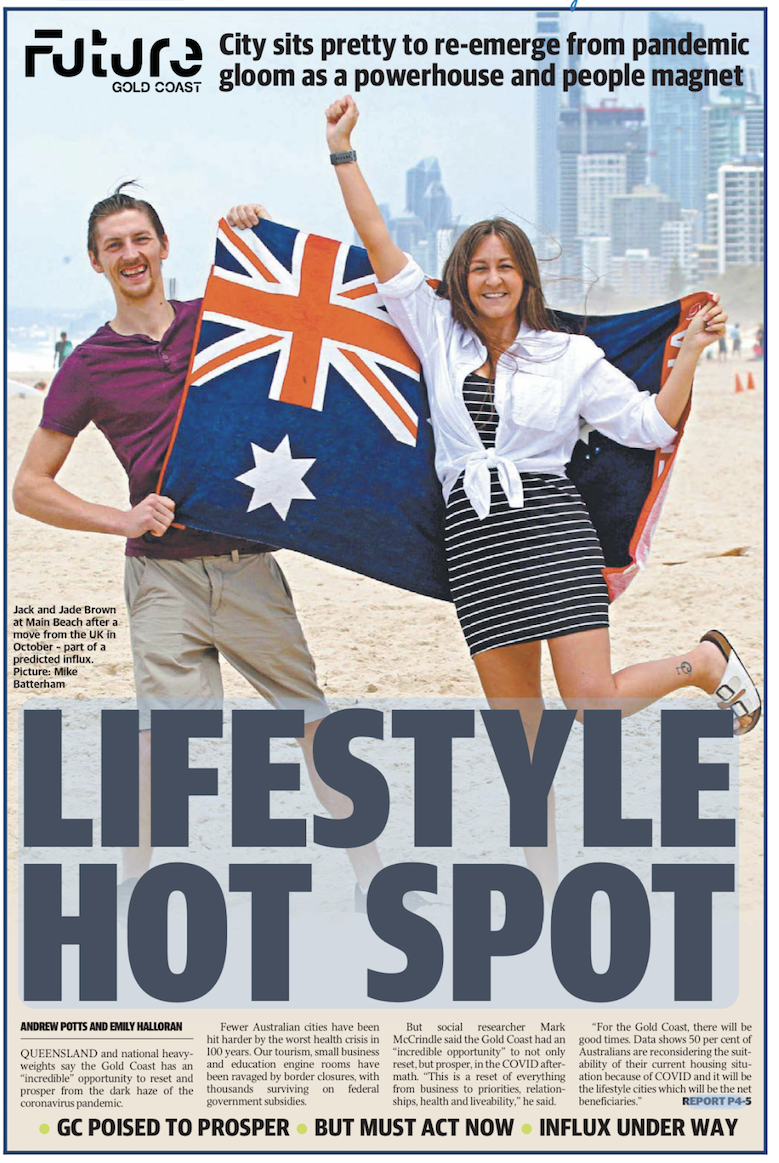
A recent frontpage news story with the headline ‘LIFESTYLE HOTSPOT’ quoted reassurance from a social researcher that “For the Gold Coast, there will be good times. 50 per cent of Australians are reconsidering the suitability of their current housing situation because of COVID and it will be the lifestyle cities which will be the net beneficiaries.”

Gold Coast Bulletin 9 November 2020, p1

Gold Coast Bulletin 9 November 2020, p1

The Gold Coast has an enviable climate and natural environment, and with reliable, fast telecommunication data we can live here and work anywhere in the world. Tourism, the industry our city has relied so heavily upon, has slumped and will be slow to recover. Rather than try to regain business as it was before March 2020, let’s make the COVID experience be a defining moment to reset the Gold Coast on a path to greatness. Now seems like an opportune time to shake off our dominant image as a tourist city and declare it to be a lifestyle destination.

Paradoxically, despite the development industry booming through the COVID crisis, we also have a housing diversity and affordability problem. Helping a friend search for a unit recently I experienced first-hand the current “squeeze on rentals” as dozens of prospective renters turn up to inspect units advertised at exorbitant prices.

Local political theatre, played by development industry and news media personnel, presents fear of a housing supply shortage. They lobby the sympathetic council for relaxation of development constraints to let them build denser apartment buildings and more greenfield subdivisions. Nobody, except community welfare organisations, wants to hear about, let alone consider, a wider range of policy levers and incentives that could be employed to achieve greater housing diversity, affordability and occupancy. They fail to acknowledge that there are more than 30,000 vacant dwellings in the city. And they have a particular blind-spot for what is potentially the one of the most effective remedies: medium-rise, medium-density mixed use and residential development.

The intermediate typology of medium-rise, medium-density housing in garden settings, is not foreign to the Gold Coast. I have started a new Instagram account titled ‘Gold Coast Mid Rise’ to record existing examples of good medium-density housing because I think it is ideal and we need more of it.

Instagram Gold Coast Mid Rise #GCmidrise

Instagram Gold Coast Mid Rise #GCmidrise

Filling the gap of this typology in our housing market could help to cure a range of our urban dilemmas. It can help to relieve pressure for less sustainable urban forms of new suburbia and super-dense highrise buildings. It can be clustered near public transport and services. With good design and garden setbacks it could create leafy, green, well-ventilated and walkable neighbourhoods. I know it would suit me, and my friend, and many others as a desirable housing option. Let’s add it to the repertoire for Gold Coast housing choices!

HOME IS WHERE THE ART ISN’T

The case for a network of artspaces at the Gold Coast

How are you spending your coronavirus stay-at-home-time? I’ve been catching up on neglected chores and appreciating the time to quietly reflect and be creatively productive. I’ve also been watching TV, and this afternoon I came across an old episode of The Simpsons which inspired the title of this post.

It’s a story about the sale and theft and repossession of ‘The Poetess’, a famous painting which Homer becomes obsessed with at the Springfield Museum of Fine Arts. To raise funds, Mayor Quimby closes down the museum and The Poetess is sold by auction to a private buyer. But then the painting goes missing. At the conclusion of a twisted investigative plot of desires and deceit, ‘The Poetess’ is found and returned to the City of Springfield. The mayor puts it on display it at the football arena that was built with the money raised by selling public art.

Homer’s experience prompted me to reflect on the state of the arts in our own city, and the different perspectives and competing ambitions that we hold in relation to culture and the arts.

The most visible emanations of public investment in the arts at the Gold Coast in recent years have been HOTA, the Commonwealth Games Festival 2018 and, dare I mention, the two controversial public artworks: Hi-lights at Yatala, and the steel ferns which are yet to be planted.

I will save my thoughts about public art projects for a later post, and I’ll skip over Festival 2018 because that’s just a feint memory now. The most significant development by a long stretch is the permanent Home of the Arts (HOTA). I was privileged to have made an early formative contribution to HOTA as the author of the overall cultural precinct design brief.

Seven years on, HOTA is really taking shape now. The landscape is growing nicely over the outdoor stage, the blue-green bridge has linked Evandale to Chevron Island, and a new six-level art gallery now rising within the precinct and scheduled to open in 2021, will pronounce HOTA as the epicentre of the cultural life of the Gold Coast. The construction cost of $60.5m is less than half the projected budget of $120m for the multi-faceted 14-storey art tower in the winning design competition proposal. But then, that was predicated on the council’s intention to source funding contributions from the Federal and State Governments.

The new art gallery will be an exciting and momentous achievement for the Gold Coast to finally have a place where our vibrant visual arts can be proudly displayed and celebrated. A video animation of the interior design reveals a conventional look-and-see approach for display of art collections and exhibitions.

Many of the cultural production elements that the creative community had asked for which were specified in the original design brief have not been accommodated within the scaled-down budget and project scope. Consultation undertaken in 2011 identified demand and desires for the gallery to include: a writers’ salon and community publishing facility; a techspace for digital art experimentation; an art, history and design library; a retail outlet for Gold Coast Made products, training and meeting rooms and, most importantly, maker-spaces for interns and artists-in-residence.

It is not unusual for large capital projects to be refined in this way, it’s called value-management, a technique to secure maximum output from limited resources. Nor does this mean that some of the omitted elements will not eventuate. Some could take place elsewhere - in pavilions within the HOTA precinct, or maybe even atomised throughout the city, extending the cultural infrastructure beyond Evandale and closer to where people live.

That thought brings me to a chronic Gold Coast problem. There is a gaping hole in professional training and studio opportunities for artists. Studio practice courses at Griffith University have been discontinued and while some enterprising artists have set up studios in industrial areas, most struggle to establish operational sustainability.

In other Australian cities, training and studio opportunities for artists are much greater. Take Canberra for example, a city with a resident population of 400K. In addition to the national university and arts institutions and various art colleges, there are more than 100 art spaces of various types and sizes. Many of these have been publicly supported with start-up funds and some receive recurrent subsidies to operate.

For artists who want to live at the Gold Coast, most default to working out of their garage or bedroom. This may seem quite appropriate while we are in a public health lockdown, however, in the normal course of life, home isn’t the only place where the art-making should occur. Some creative practitioners function well in isolation. But we know that the rigour of group studio spaces, where artists, designers, craftspeople, photographers and filmmakers can mix with others and make work in a supportive professional environment, can elevate the quality of their creative practice.

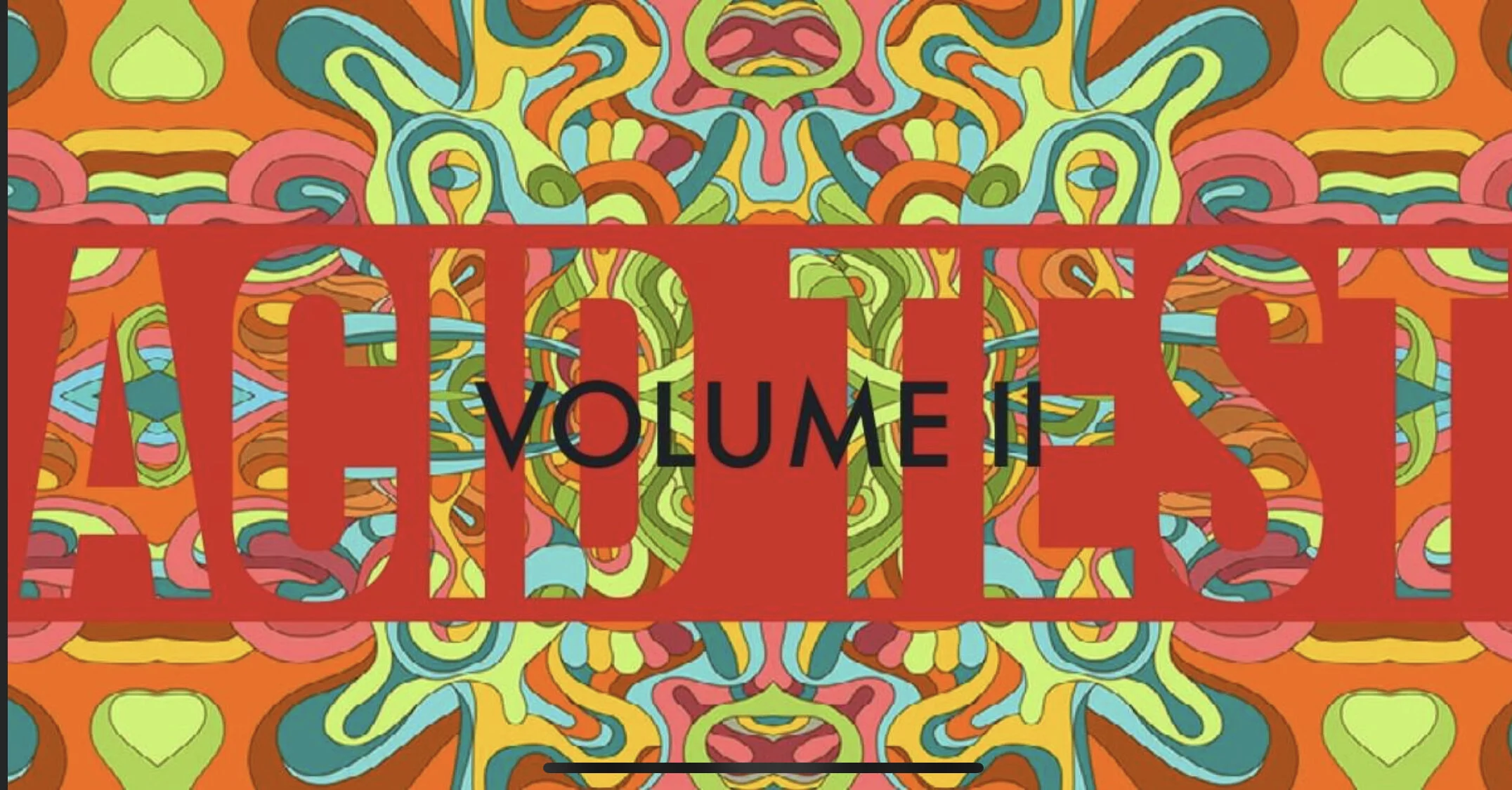
In March, in the middle of an industrial estate at Nerang, a mix of more than 20 visual artists and musicians came together to display work and perform in ACID-TEST art show Vol.2. I visited on a Saturday afternoon with my friend Mona Hecke and recorded this brief interview with Michelle, the producer, about the importance of supporting local artists.

Despite the great vibe and obvious success of this initiative, conversations that day revolved around the challenges to set-up and be creative in places like this. The start-up and organic nature of such initiatives requires flexibility and affordability, without the frustration of onerous rules, fees, and town planning regulations. Some artists are involved with co-working spaces but most of these are typically business-oriented and fit-out for digital production and office type activities. Artists often need more gritty, experimental spaces. Artists also tend to not be so business-minded. They need assistance to jump through the hoops, over the hurdles and find ways to fund establishment and manage the operation.

To foster local culture, creativity, and the arts I’ve been imagining it would be easy, cost-effective, beneficial, social, and democratic to draw artists out of their bedrooms and garages into local group work and display studios in empty retail, warehouse, and public buildings.

Tim Minchin says “the difference between a good functioning democracy and not, is art” and there seems to be universal agreement across all economic sectors that creativity is key to future productivity.

While we are staying home trying to stay confident about gainful work prospects post-coronavirus, let’s think about how to foster a network of artist-run studio spaces, all over the city. It seems like a real opportunity that could help to recover and enrich the cultural life and economy of the Gold Coast.

GOLD COAST ARTIST-RUN STUDIO SPACES

Currumbin Waters - Dust Temple, 11 Past 11 Studio

Currumbin Valley - The Communal House

Reedy Creek - Creative Hearts Gallery

Burleigh Heads - Mo’s Desert Clubhouse, Mint Art House, Relative Creative, TBC Gallery

Miami - The Walls, Hotel Miami

Mermaid Beach - 19 Karen

Isle of Capri - One Arts

Nerang - Level One Seventeen

Southport - Creative Hearts Gallery

Please send names of places I have missed, to add to the list.

THE CONVERSATION AU

A post about sustainable living by Sheelagh Storey in the  People United Facebook Page page this morning jogged me to remember how, in the shortness of time, it’s easy to get drawn into following the quick superficial grabs of commercial newsmedia. The quality of content on sites like The Conversation AU and ABC News is far superior.

Sheelagh shared this article about sustainable cities which is particularly pertinent to mayoral candidate Mona Hecke 2020‘s goals for our Gold Coast.

It’s commonly assumed that Gold Coast City’s approach to urban planning is laissez-faire. But this is not historically accurate. Former Mayor Dennis O’Connell at the City Plan community forum in Labrador this week, reminded the crowd about the progressive Planning Schemes that he presided over in 1973 and 1982. The 1982 scheme in particular, introduced the first ‘strategic plan’, and it facilitated and controlled the highrise development which our city became famous for. I was a town planner when the 1994 Gold Coast Planning Scheme came into effect. That scheme set a clear vision for the city. It was regarded as the rule book that developers large and small complied with - unless they wanted to do something contrary to the strategic plan, in which case a process that involved wider community input was triggered. I don’t recall the levels of angst around town planning that exist today. After amalgamation with Albert Shire in 1995, and into the 2000s, Gold Coast City Council did a lot of visionary thinking. The 2003 Gold Coast Planning Scheme focused on the premise of ‘Building Sustainable Communities’. It was underpinned by big strategies that were developed through lengthy, difficult, but ultimately rewarding, community consultation processes, and which required longterm commitment.

As one of the hundreds, perhaps thousands of dedicated urban planning and design professionals who contributed to these visionary strategies, I have been dismayed to witness regression of our city planning and development over the last two council terms. The silent and incremental withdrawal of commitment to longterm strategies for sustainability, in favour of quick development profits and inferior urban outcomes, is truly regrettable.

  • I am sad that the 1997 Gold Coast Urban Heritage and Character Study is long forgotten and little care and attention is given to the qualities that make our city special. There was also a Nature Conservation Strategy, produced and adopted at the same time but I can’t trace that online anymore.

  • I lament that the 2003 Guragunbah Local Area Plan to turn our biggest floodplain into a greenheart for the city is now all but forgotten. The council has not only failed to progress the greenspace planning and development. They have been approving new development to creep further and further into the floodplain.

  • I regret that the 1998 Northern Wastewater Strategy which was a 50-year plan for treatment of water through creation of wetlands as a transitional alternative for the sugar cane fields has been abandoned. This was to deter the need for massive engineering projects like the $300m pipes under the Broadwater to pump wastewater to the ocean, it was also a means to create longterm cost savings and to retain greenspace and regain nature in the city so that the entire SEQ region does not become an endless housing metropolis.

  • I resent that the 2011 Rapid Transit Corridor Study which had integrity as an urban transformation strategy got hi-jacked as a property speculation opportunity without the good quality design required to achieve great urban places.

These are just four of the many reasons why I am volunteering my time, night and day until the council election next March, to support Mona Hecke’s campaign to be our next Mayor.

I like Mona’s approach, and her ideas for making our city better. They are not radical or anti-development. They are pro-sustainable development. They paint a picture of the kind of city that I want to live in.

If you like Mona’s goals too and feel inclined to support her campaign, please subscribe and/or sign up to volunteer on her website. We all need to do a little bit, if we want change for good.

https://www.monahecke2020.com.au/volunteer/

JANE JACOB'S WAS RIGHT - THERE'S A DARK AGE AHEAD

For a quick reality check - do yourself a favour and watch Carole Cadwalladr’s 15 minute TED talk about cyber-meddling in the Brexit and Trump campaigns. Before I viewed this I didn’t appreciate how it was done, but following Carole’s explanation it all starts to make sense. At first it seems like a hoax conspiracy theory, but the more you think about it in relation to your own experiences, the more it begins to ring true that social media is subversively influencing the minds and mood of electorates. We have tended to think of internet search engines like digital encyclopaedias, and social media apps as connectors, but when we understand how they feed different information to users according to their preferences and inclinations, we realise they can also be divisive. 

I’m now wondering if this is the invisible cause of the swing towards the Liberal-National Party (LNP) in yesterday’s federal election? It’s important to acknowledge the influence of obvious factors like the editorial control of traditional news media by News Corp, and the LNP/UAP preference deal, but these dark unseen forces at play through news and advertising in social media, seem to be real, significant and compounding.

The Australian Labor Party shouldn’t beat themselves up over this election defeat. It surprised the political analysts. Until the results started to roll in, they appeared to be suggesting that Labor’s campaign was stronger. Bill Shorten, with a united, experienced and talented team, presented a substantial change agenda with progressive policies. By comparison the LNP campaign ran on a vacuum of new policy, and promises of stable government, despite a track record of mutinies and an exodus of senior members.

All of this is troubling for anyone who cares about the future and fairness of elections at any level of government. A knee-jerk response might be to outlaw sponsored political ads on social media but how do you trace or circumvent the algorithm spinners who, for hidden fees, covertly control the information we are fed. They have ways and means to sneak around and ahead of our consciousness.

And, I am particularly perplexed because this is pertinent to my thesis which is about the role and power of urban narrative on the identity and shape of cities. I have been gathering and distiling prevailing narratives in news media to show how they influence development and the image of the Gold Coast. Adopting anthropologist, Clifford Geertz’s definition of culture as “the ensemble of stories we tell ourselves about ourselves”,  I made an early assumption that to grow an authentic civic culture, citizens should simply start telling more stories about the place and their connections to it. Eventually, as the narrative evolves, the true identity of the city will become the stories they keep repeating. But here is a clear demonstration why it’s not quite that simple because it is vulnerable to manipulation.

Urban activist, Jane Jacobs

Urban activist, Jane Jacobs

In ‘Dark Age Ahead’ (2004), urban activist Jane Jacobs wrote about possibilities brought by digital technology and media for better understanding the image of cities. She identified the increasing significance of information and communication technology as a force majeure in the construction and projection of urban narratives and the image of cities. She saw opportunities as infinite and exciting, but also unwieldy and prone to homogeneity, superficiality, and even corruption. This was a decade before the emergence and spread of algorithmic culture. Only now are we beginning to recognise this phenomenon of algorithmic culture “spreading lies in darkness with illegal cash” and disrupting centuries of electoral laws and principles.

For my research, this has implications that I can’t ignore and will need to re-think. I’m also worried about what this means for our next local government election in March 2020. Are the dark forces supporting corporate and commercial interests over community and cultural interests, already at play?

This certainly seems like a real and wicked problem. If anyone has solutions, I’d be very grateful if you’d let me know because these complications are not something that I ever really wanted to have to think about…

P.S. It was reassuring this became a topic for discussion on #qanda post-election on 20 May 2019, especially the words of Ming Long, Chair of AMP Capital Funds Management calling for the government to stop misleading and deceptive advertising in political campaigns.